Brown Rice for Weight Loss: What the Evidence Shows
Brown rice may help when it replaces white rice, but that’s different from proving it causes weight loss or beats other whole grains.
Trials have compared brown rice mostly with white rice, not with oats, barley, or other whole grains. A meta-analysis found lower average weight with brown rice than white rice, but the evidence was low or very low certainty and results varied widely. One small trial specifically in women also found reductions, but it doesn’t establish a special weight-loss effect for women. 1 3
The useful comparison is what brown rice replaces
Brown rice is a whole grain; white rice is refined. Keeping the bran layer means brown rice has more fiber than white rice, but that difference alone doesn’t show that brown rice will make you lose weight. 3
The clearest weight evidence comes from studies that swapped brown rice for white rice. In a systematic review and meta-analysis of 13 randomized trials, brown rice was associated with an average 1.63 kg lower body weight than white rice across the six trials that measured weight. The estimate had very high variation between studies, and the review rated the overall evidence low or very low certainty. It’s a possible advantage of the substitution, not a reliable prediction of what will happen for you. 1
A separate review of seven trials in 417 adults with prediabetes or type 2 diabetes also found lower average weight with brown rice than white rice. But one trial contributed 88.2% of the weight in that analysis, so the result shouldn’t be treated as a settled estimate for everyone. 2
Neither finding answers whether brown rice leads to more weight loss than oats, barley, quinoa, or other whole grains. Those aren’t the main comparisons in this evidence. Whole-grain dietary patterns and a direct brown-rice swap are different questions, too: an association between a broader eating pattern and weight doesn’t prove that one grain is responsible. 2
What the women-specific study can tell you
One small randomized crossover trial studied women specifically: 40 non-menopausal women with overweight or obesity began the study, and 35 completed it. Participants ate 150 g of cooked brown rice or white rice daily during each six-week period, switching grains after a washout. The study reported lower weight, BMI, and waist and hip measurements during the brown-rice period than during the white-rice period. It did not establish how large those differences would be in other groups of women or over the long term. 3
That trial makes the evidence more relevant to women than a study that doesn’t report results by sex. But it was small, short, and limited to non-menopausal women with overweight or obesity. The larger meta-analyses don’t provide a women-specific estimate in the reported results. So there’s no basis here for saying brown rice has a distinct weight-loss effect for women generally. 1 2 3
Make the swap without changing the whole meal
If you like brown rice, try replacing the white rice you’d normally serve rather than adding brown rice on top of your usual meal. Keep the portion and the rest of the meal in view: a grain choice is only one part of what you eat, and the trials don’t show that brown rice produces weight loss regardless of the rest of the diet. This is a practical way to make the comparison meaningful, not a tested prescription.
For a meal with rice, you might compare the same serving of cooked brown rice with the white rice you usually eat, then pay attention to whether you enjoy the texture and whether the meal works for you. Brown rice is often less soft than white rice, which can affect what feels satisfying or convenient; personal preference matters if a change is going to stick. 3
If you’re choosing between brown rice and another whole grain, pick based on how you’ll use it and what you prefer. The brown-rice trials don’t establish a weight-loss ranking among grains. The most evidence-based takeaway is narrower: replacing white rice with brown rice may modestly affect weight in some settings, but the result is uncertain and shouldn’t be mistaken for a special property of brown rice.
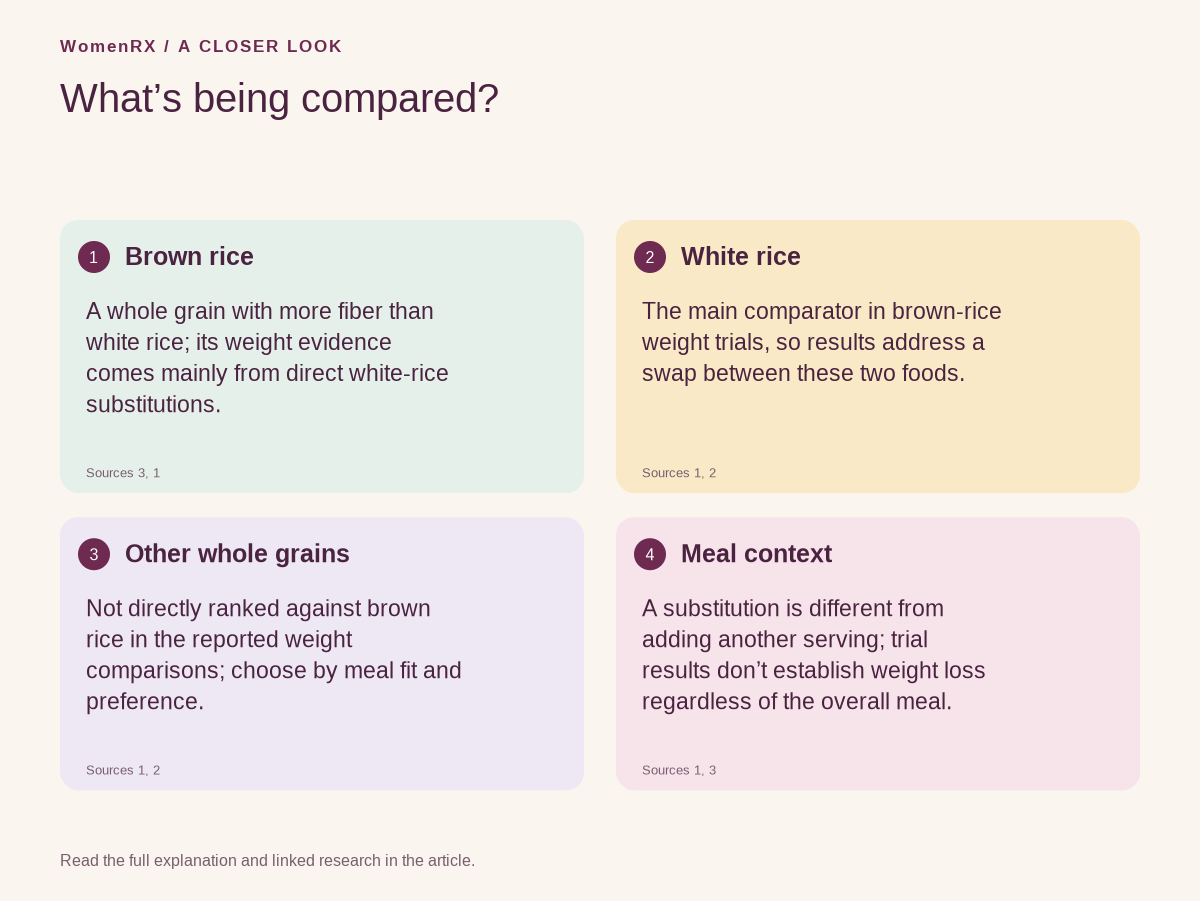
What’s being compared?
Brown rice: A whole grain with more fiber than white rice; its weight evidence comes mainly from direct white-rice substitutions.31
White rice: The main comparator in brown-rice weight trials, so results address a swap between these two foods.12
Other whole grains: Not directly ranked against brown rice in the reported weight comparisons; choose by meal fit and preference.12
Meal context: A substitution is different from adding another serving; trial results don’t establish weight loss regardless of the overall meal.13
Read the figure as text
The weight evidence is about replacing white rice with brown rice. It does not rank brown rice against other whole grains.- Brown rice: A whole grain with more fiber than white rice; its weight evidence comes mainly from direct white-rice substitutions.31
- White rice: The main comparator in brown-rice weight trials, so results address a swap between these two foods.12
- Other whole grains: Not directly ranked against brown rice in the reported weight comparisons; choose by meal fit and preference.12
- Meal context: A substitution is different from adding another serving; trial results don’t establish weight loss regardless of the overall meal.13
Sources you can check
- The effect of brown rice compared to white rice on adiposity indices, lipid profile, and glycemic markers: a systematic review and meta-analysis of randomized controlled trials.Golzarand M, Toolabi K, Eskandari Delfan S, Mirmiran P. · Critical reviews in food science and nutrition · 2022Return to first citation
- The effect of a brown-rice diets on glycemic control and metabolic parameters in prediabetes and type 2 diabetes mellitus: a meta-analysis of randomized controlled trials and controlled clinical trials.Abdul Rahim AF, Norhayati MN, Zainudin AM. · PeerJ · 2021Return to first citation
- Effect of Brown Rice Consumption on Inflammatory Marker and Cardiovascular Risk Factors among Overweight and Obese Non-menopausal Female Adults.Kazemzadeh M, Safavi SM, Nematollahi S, Nourieh Z. · International journal of preventive medicine · 2014Return to first citation