How to Spot Whole Grains and Use Them in Meals
The ingredient list tells you more about a grain product than its color or the words on the front of the package.
For packaged bread, cereal or pasta, look for a recognizable whole-grain ingredient, such as whole-wheat flour or oats, among the first ingredients. A product called “multigrain” isn’t necessarily whole grain. Then compare the fiber and protein on the Nutrition Facts labels using similar serving sizes. Whole grains can add fiber to a meal, but the amount varies by product. 6751
Start with the grain, not the color
A grain kernel has three parts: bran, germ and endosperm. Whole grains retain all three; refining removes the bran and germ, which also removes some fiber, vitamins and minerals. That’s why what the grain ingredient is matters more than whether a loaf looks brown. 7
On a packaged food, turn to the ingredient list. Whole-wheat flour, whole cornmeal, brown rice and oats are examples of ingredients you can recognize as whole grains. You may also see terms such as cracked wheat or buckwheat groats. By contrast, wheat flour or white flour without “whole” doesn’t tell you it’s whole grain. Bran and germ are useful grain parts, but either one on its own isn’t a whole grain. 6
A product name is a clue, not the final answer. “Multigrain” tells you it contains more than one grain, not that those grains are whole. If you’re choosing between two breads, look at their grain ingredients rather than relying on the names or front-of-package wording. 76
Check what a serving adds
Once you’ve found a whole-grain ingredient, use the Nutrition Facts panel to answer a different question: What does this particular food add to my meal? Check the listed serving size first, especially when comparing products with different slice sizes or cereal portions. Fiber and protein amounts on the panel apply to that serving, not necessarily the amount you’ll eat. 5
Whole grains are one source of dietary fiber, alongside nuts, seeds, fruit and vegetables. Fiber helps digestion and can help prevent constipation. Still, a whole-grain ingredient doesn’t tell you how many grams of fiber are in a serving, so check the number if fiber is your reason for choosing the product. 15
For a concrete example, an illustrative 40-gram portion of dry, unfortified regular or quick oats provides about 4 grams of fiber, 5.3 grams of protein and 152 calories, based on historical USDA food-composition data. That’s an example for that exact dry amount, not a recommended serving or a substitute for the label on the oats you buy. 8
Treat protein the same way: read the amount rather than assuming a grain product will supply most of the meal’s protein. For example, whole-grain toast with beans or a grain bowl with fish gives the grain a place alongside another protein-containing food. A healthy eating pattern can include whole-grain products as well as foods such as beans, fish and dairy; it doesn’t ask one food to do every job. 52
Make a swap that fits your appetite and digestion
You don’t have to replace every grain at once. For example, you might try oats at breakfast, choose a bread with whole-wheat flour as its main grain ingredient, or serve brown rice at a meal where you enjoy its texture. Those are options, not requirements. Preferences and budget belong in a healthy eating plan too. 62
If a higher-fiber choice leaves you bloated or crampy, make the change more gradually. Adding dietary fiber too quickly can cause gas, bloating and cramps. You can also get fiber from foods besides grains, so there’s room to find a mix you enjoy. 1
What the health research can, and can’t, tell you
Whole grains are a worthwhile part of an overall eating pattern, but they aren’t a stand-alone treatment. In a systematic review of randomized studies in adults, whole-grain foods produced modest reductions in LDL and total cholesterol compared with non-whole-grain control foods; the review did not find a reduction in HDL cholesterol or triglycerides. That finding concerns the foods studied over the study periods, not a guaranteed effect from buying any one loaf. 4
A separate review of prospective cohort studies found that higher fiber intake was associated with lower mortality, including cardiovascular mortality. Because those studies observed what people ate rather than assigning a single grain swap, the finding can’t establish what a particular product will do for you. 3
The shopping method is the same whether you’re in your cycling years, pregnant or past menopause: identify the grain ingredient, then consider the food’s contribution to your whole diet. These studies don’t establish a special whole-grain effect for any of those life stages. If you prefer some refined grains, you can still build a varied eating pattern that includes whole grains and other fiber-containing foods. 214
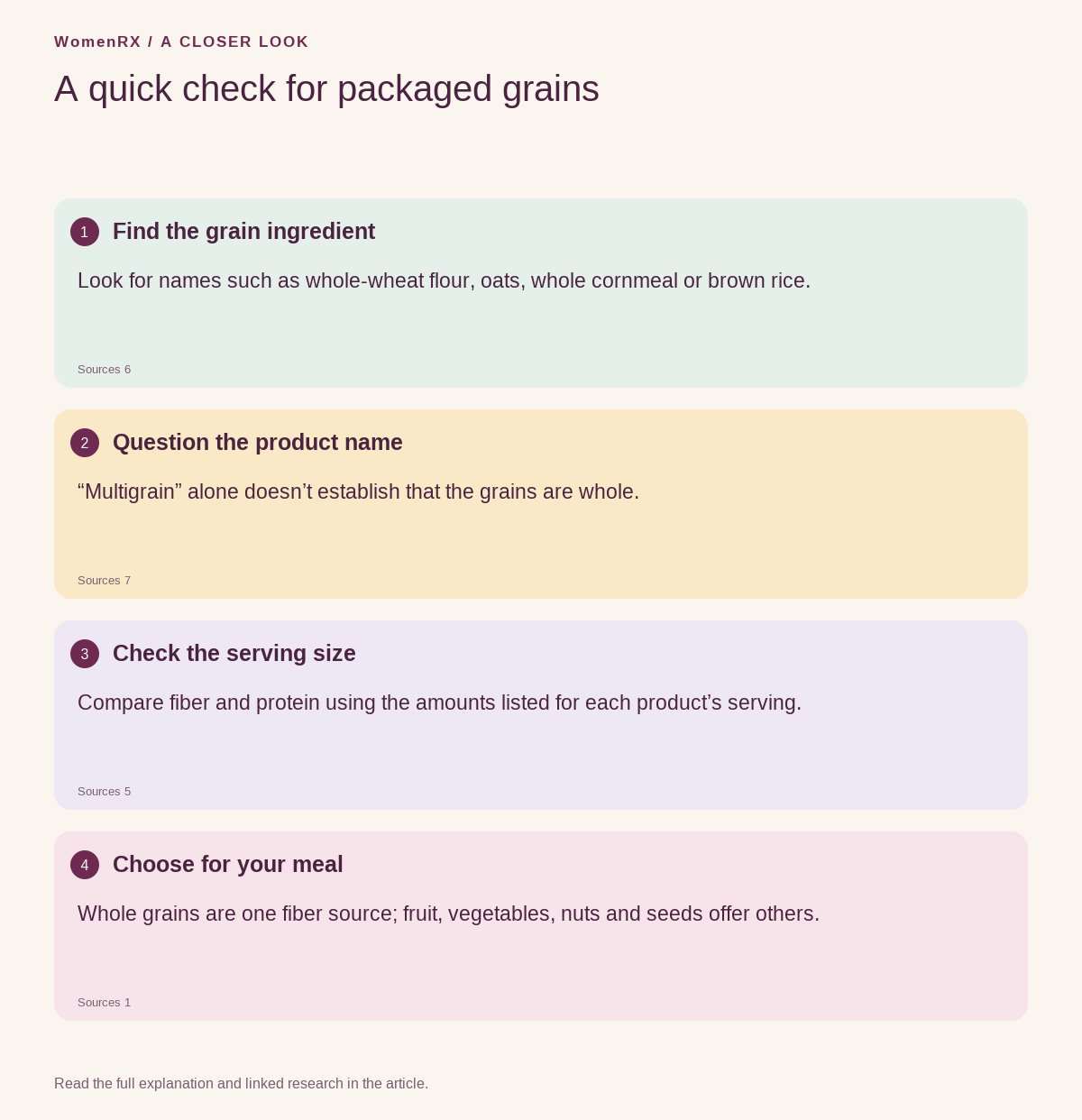
A quick check for packaged grains
Find the grain ingredient: Look for names such as whole-wheat flour, oats, whole cornmeal or brown rice.6
Question the product name: “Multigrain” alone doesn’t establish that the grains are whole.7
Check the serving size: Compare fiber and protein using the amounts listed for each product’s serving.5
Choose for your meal: Whole grains are one fiber source; fruit, vegetables, nuts and seeds offer others.1
Read the figure as text
Use the ingredient list to identify the grain, then the Nutrition Facts panel to compare what a serving provides.- Find the grain ingredient: Look for names such as whole-wheat flour, oats, whole cornmeal or brown rice.6
- Question the product name: “Multigrain” alone doesn’t establish that the grains are whole.7
- Check the serving size: Compare fiber and protein using the amounts listed for each product’s serving.5
- Choose for your meal: Whole grains are one fiber source; fruit, vegetables, nuts and seeds offer others.1
More questions, answered
Does “wheat bread” mean whole-wheat bread?
Not necessarily. Look for whole-wheat flour in the ingredient list. “Wheat flour” without “whole” doesn’t identify a whole-grain ingredient. 6
Is a product with added bran a whole-grain product?
Bran is one part of a grain, not the complete grain. Check whether the ingredient list also names a whole-grain ingredient; use the Nutrition Facts panel to see how much fiber the serving provides. 65
Sources you can check
- Dietary Fiber: MedlinePlusAccessed 2026-09-25Return to first citation
- Nutrition: MedlinePlusAccessed 2026-09-25Return to first citation
- Dietary fiber intake and all-cause and cause-specific mortality: An updated systematic review and meta-analysis of prospective cohort studies.Ramezani F, Pourghazi F, Eslami M, Gholami M, Mohammadian Khonsari N, Ejtahed HS, Larijani B, Qorbani M. · Clinical nutrition (Edinburgh, Scotland) · 2024Return to first citation
- Whole-grain and blood lipid changes in apparently healthy adults: a systematic review and meta-analysis of randomized controlled studies.Hollænder PL, Ross AB, Kristensen M. · The American journal of clinical nutrition · 2015Return to first citation
- Food Labeling: MedlinePlusAccessed 2026-09-25Return to first citation
- Appendix EAccessed 2026-09-25Return to first citation
- Whole Grains - Get The Facts - Canada.caAccessed 2026-09-25Return to first citation
- USDA SRLegacy: calculated illustrative oats portionAccessed 2026-09-26Return to first citation