Whole Grains and Weight Management: Which Foods Count?
A whole-grain swap can add variety and sometimes fiber to a meal, but a multigrain label doesn’t tell you what’s inside.
Look for a named whole-grain ingredient, such as whole-wheat flour, rolled oats or brown rice, rather than relying on “multigrain” on the front of a package. Whole grains can fit into weight management, but randomized trials haven’t shown that eating more of them reliably causes weight loss on its own. 675
Start with the grain, not the front of the box
A whole grain contains the bran, germ and endosperm of the grain kernel. Refining removes the bran and germ; white flour and white rice are familiar examples. Whole grains can be served as grains themselves, such as brown rice, or used as ingredients in foods such as bread and cereal. 7
That gives you a useful shopping distinction: A “multigrain” label alone doesn’t confirm that a product contains whole grains. Check the ingredient list for a named whole grain. Examples include whole-wheat flour, whole cornmeal, cracked wheat, buckwheat groats, rolled oats and brown rice. Quinoa and millet are also whole-grain options, even though their names don’t contain the word “whole.” 67
Pay particular attention to the main grain ingredient. A bread that lists whole-wheat flour as its primary grain ingredient gives you a clearer clue than one whose main grain ingredient is simply “wheat flour,” with a whole grain listed later. “Wheat flour” alone does not establish that the flour is whole grain. Neither does “enriched wheat flour”: enrichment adds certain nutrients, but it doesn’t make a refined flour whole. 67
Read Nutrition Facts for a different question
The ingredient list helps you identify the grain. The Nutrition Facts panel helps you decide how the product fits your meal. Its calories and nutrients are listed for the stated serving size, which may differ from the amount you actually eat. That’s especially useful when comparing two breads or cereals that both contain whole grains. 1
Check fiber there too, but don’t treat “high fiber” and “whole grain” as interchangeable. Whole grains are one source of fiber; fruits, vegetables, nuts and seeds provide it as well. Conversely, a food containing bran may provide a nutritious part of a grain without being a whole-grain food. Different whole grains can also vary in fiber content. 263
For example, if you’re choosing a breakfast cereal, first look for a whole-grain ingredient. Then compare the serving sizes and Nutrition Facts panels of the cereals you’d actually consider eating. This answers two separate questions: Is a whole grain in it? and What does a serving of this cereal provide? 61
What the weight research can, and can’t, tell you
Fiber can help you feel full sooner, which is one reason a fiber-containing food may be useful when managing weight. But that does not mean every whole-grain product is equally filling or that adding whole grains to your usual meals will, by itself, lead to weight loss. 235
In a systematic review of randomized trials, researchers found no significant overall effect of whole-grain consumption on body weight across 19 studies involving 1,698 adults. A separate trial offers a more specific result: among 242 men and women with overweight or obesity following an energy-restricted diet, the group assigned high-fiber rye products lost 1.08 kilograms (about 2.4 pounds) more over 12 weeks than the group assigned refined-wheat products. The trial compared particular foods within a weight-loss diet; it didn’t test whether all whole grains produce the same result. 54
Those findings are more useful together than either is alone. The rye trial gives a reason to consider a satisfying whole-grain replacement for a refined-grain food you already eat. The broader review is a reason not to expect a dependable weight-loss effect from the whole-grain label itself. These results do not establish a distinct effect for women or for women in midlife; the rye trial included men and women, and the reported result was not a women-specific estimate. 45
A practical way to use this at meals is to make a swap that suits what you like: rolled oats instead of a refined hot cereal, brown rice instead of white rice, or a bread with whole-wheat flour as its main grain ingredient instead of one made mainly with refined flour. These are examples of including whole grains, not a formula for weight loss. If you’re also increasing fiber, doing so gradually may help avoid gas, bloating and cramps. 672
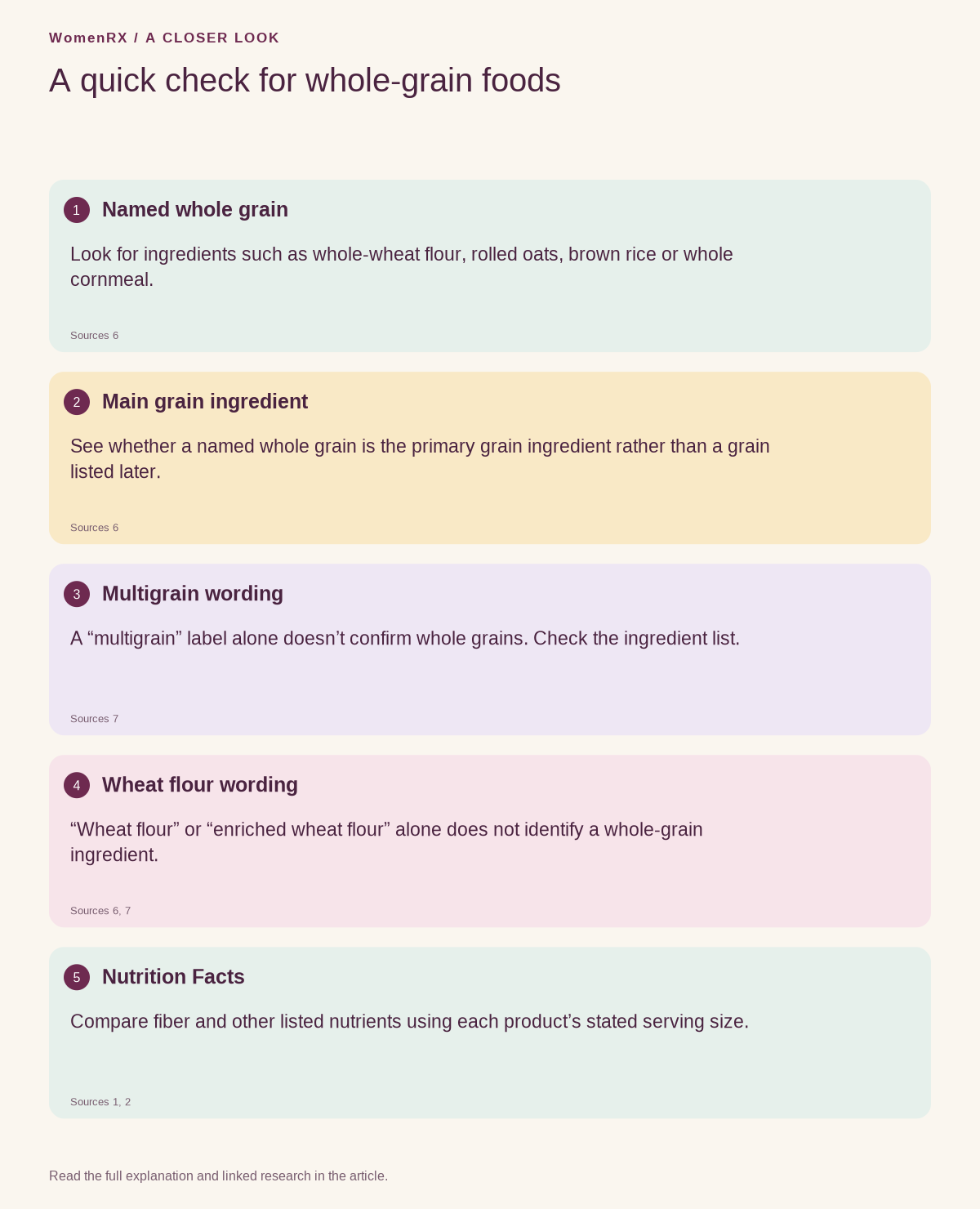
A quick check for whole-grain foods
Named whole grain: Look for ingredients such as whole-wheat flour, rolled oats, brown rice or whole cornmeal.6
Main grain ingredient: See whether a named whole grain is the primary grain ingredient rather than a grain listed later.6
Multigrain wording: A “multigrain” label alone doesn’t confirm whole grains. Check the ingredient list.7
Wheat flour wording: “Wheat flour” or “enriched wheat flour” alone does not identify a whole-grain ingredient.67
Nutrition Facts: Compare fiber and other listed nutrients using each product’s stated serving size.12
Read the figure as text
Use the ingredient list to identify the grain, then Nutrition Facts to compare the foods you’re considering. This is a shopping aid, not a weight-loss score.- Named whole grain: Look for ingredients such as whole-wheat flour, rolled oats, brown rice or whole cornmeal.6
- Main grain ingredient: See whether a named whole grain is the primary grain ingredient rather than a grain listed later.6
- Multigrain wording: A “multigrain” label alone doesn’t confirm whole grains. Check the ingredient list.7
- Wheat flour wording: “Wheat flour” or “enriched wheat flour” alone does not identify a whole-grain ingredient.67
- Nutrition Facts: Compare fiber and other listed nutrients using each product’s stated serving size.12
More questions, answered
Does “enriched” mean a grain is whole?
No. Enriched refined grains have certain nutrients added, but enrichment does not restore all the components of the whole grain. Look for a named whole-grain ingredient if that’s what you want to buy. 67
Sources you can check
- Food Labeling: MedlinePlusAccessed 2026-09-25Return to first citation
- Dietary Fiber: MedlinePlusAccessed 2026-09-25Return to first citation
- Next Generation Health Claims Based on Resilience: The Example of Whole-Grain Wheat.Hoevenaars F, van der Kamp JW, van den Brink W, Wopereis S. · Nutrients · 2020Return to first citation
- A hypocaloric diet rich in high fiber rye foods causes greater reduction in body weight and body fat than a diet rich in refined wheat: A parallel randomized controlled trial in adults with overweight and obesity (the RyeWeight study).Iversen KN, Carlsson F, Andersson A, Michaëlsson K, Langton M, Risérus U, Hellström PM, Landberg R. · Clinical nutrition ESPEN · 2021Return to first citation
- Whole-Grain Consumption Does Not Affect Obesity Measures: An Updated Systematic Review and Meta-analysis of Randomized Clinical Trials.Sadeghi O, Sadeghian M, Rahmani S, Maleki V, Larijani B, Esmaillzadeh A. · Advances in nutrition (Bethesda, Md.) · 2020Return to first citation
- Appendix EAccessed 2026-09-25Return to first citation
- Whole Grains - Get The Facts - Canada.caAccessed 2026-09-25Return to first citation