Can More Fiber Help With Weight Management?
Fiber-rich foods may help you feel full, but feeling full and losing weight are different outcomes.
Fiber can add bulk to meals and may help you feel full, which can support weight management. But trials of specific supplemental fibers don’t consistently show extra weight loss, even when appetite or food intake changes. In one trial of women with overweight, adding beta-glucan to a low-calorie diet didn’t produce more weight loss than the diet alone. 1 2
Fiber can make a meal more filling. That may help you feel satisfied after eating, but it doesn’t guarantee that your weight will change. The research makes more sense when you separate fiber-rich foods and overall eating patterns from trials of a single fiber supplement, and separate appetite from weight on the scale.
Fullness is not the same as weight loss
Fiber is found in plant foods, including whole grains, fruits, and vegetables. It adds bulk and can help you feel full sooner. That makes fiber a reasonable part of an eating pattern that feels satisfying, but fullness is an intermediate outcome, not proof of weight loss. 1
A food trial illustrates the distinction. In a six-week randomized trial, 69 adults with obesity were assigned to eat almonds or an isocaloric cookie snack. The almond group increased its fiber intake and improved measures of diet quality, but there was no significant difference between groups in body weight or appetite ratings. This was a test of swapping one snack for another, not a trial of fiber by itself or a weight-loss program. 3
What isolated-fiber trials show
A supplement trial can test a particular fiber more directly, but its result applies to that fiber and study setup, not to every high-fiber food or diet. For example, beta-glucans from barley have reduced appetite and energy intake in human studies, while trials measuring body weight have not shown a significant weight effect. 2
One of those trials included 66 women with overweight who followed a low-calorie diet for three months. Women were assigned to the diet with one of two beta-glucan amounts, or to the diet without beta-glucan. All three groups lost weight, but the beta-glucan groups did not lose significantly more than the control group. So this study tested whether beta-glucan added to a weight-loss diet made a difference; it did not show that fiber had no role in anyone’s overall diet. 2
That women-specific result is useful, but it’s a narrow slice of the evidence. It doesn’t tell us whether fiber affects weight differently during pregnancy, postpartum, the menstrual years, perimenopause, or after menopause. These studies don’t report results by those life stages.
A practical way to use the evidence
If you’re choosing between adding a fiber supplement and including more fiber-rich foods, think about what you want to change. Foods such as whole grains, fruits, and vegetables provide fiber as part of a meal or snack. A supplement delivers a more specific fiber, but results from one type shouldn’t be assumed to apply to another. Neither approach guarantees a change in body weight. 1 2
Try making a food change that feels satisfying and can fit your usual meals, rather than treating a supplement as a weight-loss shortcut. If you increase fiber, do it gradually: a quick jump can cause gas, bloating, or cramps. 1
The useful takeaway is modest: fiber may help with fullness, and fiber-rich choices can improve what you’re eating, but changes in appetite, food intake, and measured weight aren’t interchangeable. Judge a fiber choice by whether it works for your eating pattern, not by a promise that it will make the scale move.
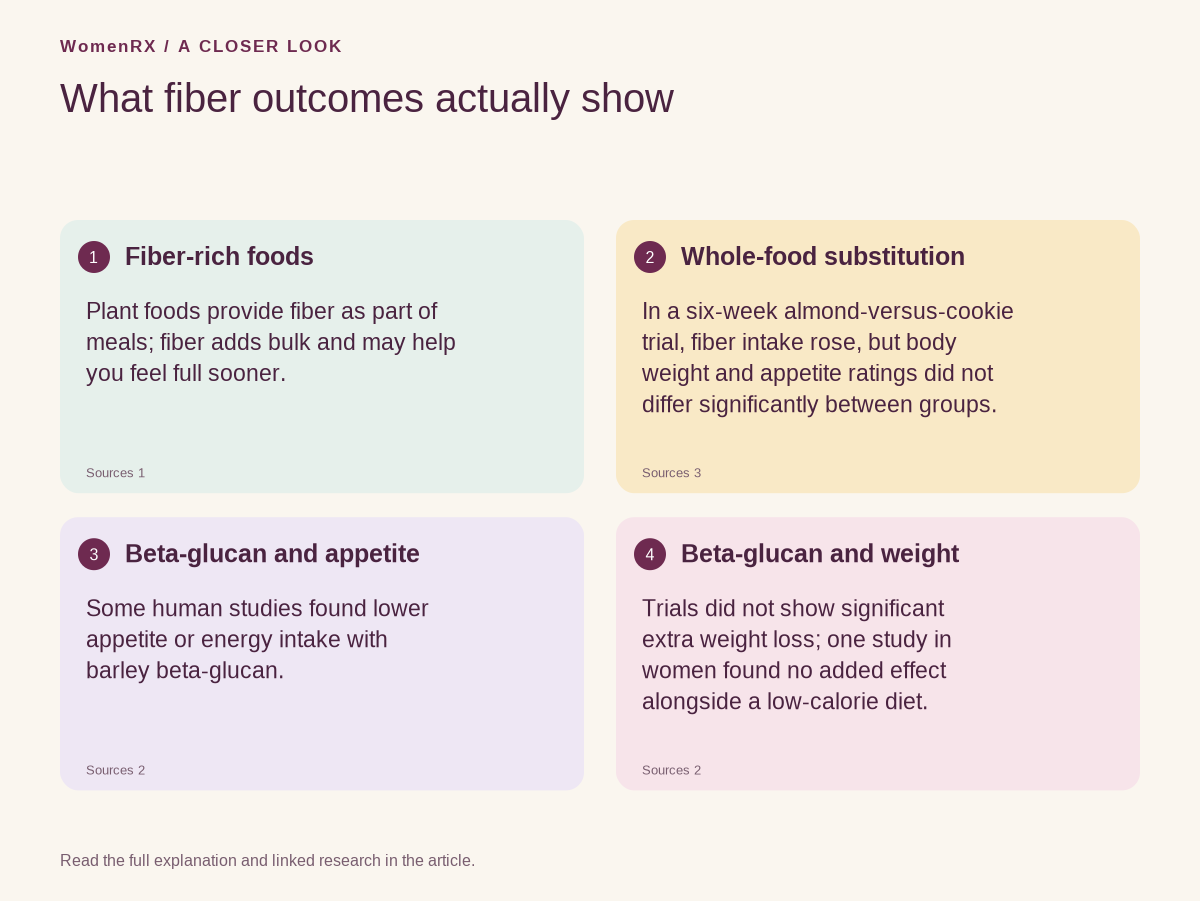
What fiber outcomes actually show
Fiber-rich foods: Plant foods provide fiber as part of meals; fiber adds bulk and may help you feel full sooner.1
Whole-food substitution: In a six-week almond-versus-cookie trial, fiber intake rose, but body weight and appetite ratings did not differ significantly between groups.3
Beta-glucan and appetite: Some human studies found lower appetite or energy intake with barley beta-glucan.2
Beta-glucan and weight: Trials did not show significant extra weight loss; one study in women found no added effect alongside a low-calorie diet.2
Read the figure as text
These findings separate possible fullness effects from measured weight outcomes and distinguish whole foods from a specific supplemental fiber.- Fiber-rich foods: Plant foods provide fiber as part of meals; fiber adds bulk and may help you feel full sooner.1
- Whole-food substitution: In a six-week almond-versus-cookie trial, fiber intake rose, but body weight and appetite ratings did not differ significantly between groups.3
- Beta-glucan and appetite: Some human studies found lower appetite or energy intake with barley beta-glucan.2
- Beta-glucan and weight: Trials did not show significant extra weight loss; one study in women found no added effect alongside a low-calorie diet.2
More questions, answered
Does feeling fuller mean I’ll lose weight?
Not necessarily. Feeling full or eating less at a particular meal is different from a measured change in body weight over time. In beta-glucan trials, appetite or energy intake could improve without a significant weight effect. 2
Can increasing fiber cause discomfort?
Yes. Increasing fiber too quickly can cause gas, bloating, and cramps. A gradual increase may be easier to tolerate. 1
Sources you can check
- Dietary Fiber: MedlinePlusAccessed 2026-09-25Return to first citation
- Dietary Supplements for Weight Loss - Health Professional Fact SheetAccessed 2026-09-25Return to first citation
- Almond Consumption Improves Inflammatory Profiles Independent of Weight Change: A 6-Week Randomized Controlled Trial in Adults with Obesity.Adepoju A, Rabbani E, Brickey P, Vieira-Potter V, Dhillon J. · Nutrients · 2026Return to first citation