Fiber and Women’s Health: What the Evidence Shows
Fiber’s clearest everyday benefit is digestive; broader findings in women are promising, but many are associations or early trials, not proof of prevention or treatment.
Fiber supports digestion and can help prevent constipation, but evidence for other outcomes needs more careful reading. 1 Studies in women have linked higher fiber intake with lower reported pelvic inflammatory disease prevalence and better metabolic markers, yet those associations don’t show that fiber caused the difference. 3 6 A pregnancy trial and a review of PCOS diet trials offer clues, not proof that fiber treats either condition. 2 5
Fiber is a part of plant foods, including fruits, vegetables, and whole grains. Its clearest established everyday role is digestive: it adds bulk and helps prevent constipation. Adding a lot more too quickly can cause gas, bloating, or cramps, so a gradual increase may be easier to tolerate. 1
For other outcomes, the key question is not just whether a study found a link. It’s whether it tested fiber itself, whether it studied women, and whether it can show cause and effect.
Digestion: the clearest practical benefit
Fiber is commonly described as soluble or insoluble; both types have health benefits. Fiber adds bulk, supports digestion, and helps prevent constipation. It can also help you feel full sooner; fullness alone doesn’t establish that fiber causes weight loss. 1
Pelvic inflammatory disease: a link, not prevention evidence
A U.S. survey analysis examined 2,345 women ages 20 to 59. Women reporting a history of pelvic inflammatory disease (PID) tended to report lower fiber intake. The study found an association between greater intake and lower PID prevalence, but it was observational: it compared reported diets and disease history rather than assigning fiber or tracking whether it prevented new infections. It can’t establish that eating more fiber prevents or treats PID. 3
That distinction matters because PID is an infection-related condition. This study raises a question about diet and reported disease prevalence; it doesn’t show that fiber can replace testing or treatment for an infection.
Pregnancy: early results from one small trial
A randomized trial studied 98 pregnant women at elevated risk of gestational diabetes. During a five-week intervention, participants were assigned to soluble fiber supplements or usual care. Gestational diabetes incidence did not differ statistically between groups. The fiber group had some better glucose measurements, less weight gain during the intervention, and no preterm births compared with 12% in the control group. 2
Those findings are worth following, but the trial was single-center and small, and the reported results don’t establish that fiber prevents gestational diabetes or preterm birth. A separate paper describes a planned trial of fiber supplements in women who already have gestational diabetes; a protocol describes what researchers intend to test, not results showing that the treatment works. 2 4
So pregnancy is a life stage with some direct research in women, but these findings are not strong enough to treat a fiber supplement as a proven way to prevent or manage gestational diabetes.
PCOS: promising findings, with a limit on attribution
A systematic review of randomized trials in women with polycystic ovary syndrome (PCOS) reported that high-fiber interventions reduced fasting glucose and insulin resistance, triglycerides, LDL cholesterol, and free androgen index, while increasing HDL cholesterol and sex hormone-binding globulin. The review also reported favorable findings for low-glycemic-index diets on several overlapping measures. Its abstract doesn’t establish whether fiber alone, rather than other changes within the high-fiber interventions, produced the effects. It also doesn’t show that fiber treats PCOS symptoms or improves fertility. 5
The distinction matters: a finding reported for a high-fiber dietary intervention doesn’t prove that fiber was the only relevant change.
Metabolic health and menopause: association isn’t an individual promise
An analysis of U.S. women’s survey data found that higher fiber intake was associated with lower odds of metabolic syndrome and insulin-related markers. The study also considered menopausal stage, but it doesn’t show that fiber has a distinct effect at a particular stage or that it caused the differences. 6
Across these outcomes, the practical takeaway is modest: fiber-rich foods are part of a healthy diet, and digestive benefits are the clearest established outcome. Research in women is starting to examine reproductive and metabolic outcomes, but associations and early trials shouldn’t be read as proof that fiber prevents PID, treats PCOS, or prevents pregnancy complications.
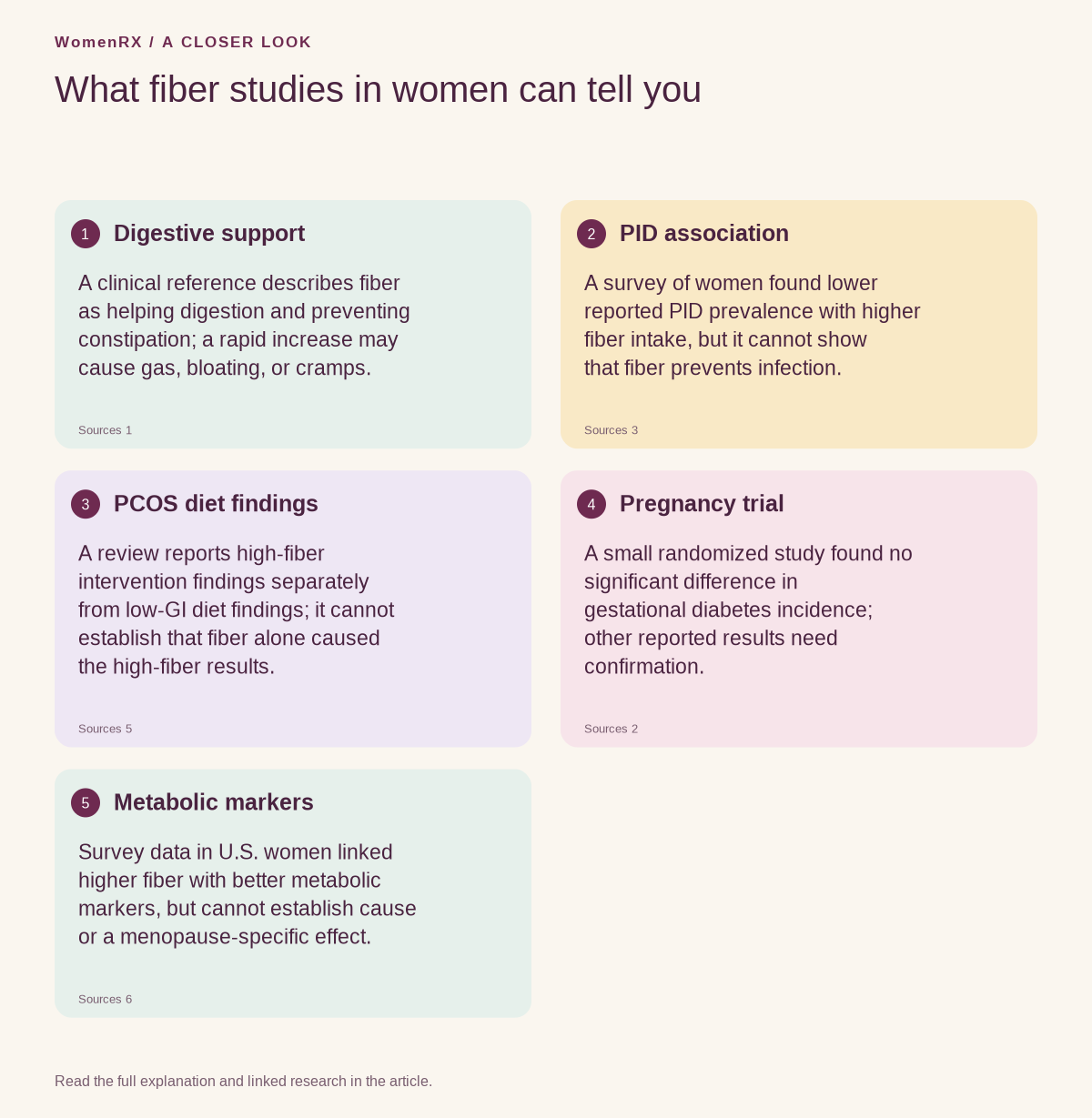
What fiber studies in women can tell you
Digestive support: A clinical reference describes fiber as helping digestion and preventing constipation; a rapid increase may cause gas, bloating, or cramps.1
PID association: A survey of women found lower reported PID prevalence with higher fiber intake, but it cannot show that fiber prevents infection.3
PCOS diet findings: A review reports high-fiber intervention findings separately from low-GI diet findings; it cannot establish that fiber alone caused the high-fiber results.5
Pregnancy trial: A small randomized study found no significant difference in gestational diabetes incidence; other reported results need confirmation.2
Metabolic markers: Survey data in U.S. women linked higher fiber with better metabolic markers, but cannot establish cause or a menopause-specific effect.6
Read the figure as text
The type of study changes how confidently a finding can be applied: digestive guidance, an association, a review of diet trials, and a small pregnancy trial answer different questions.- Digestive support: A clinical reference describes fiber as helping digestion and preventing constipation; a rapid increase may cause gas, bloating, or cramps.1
- PID association: A survey of women found lower reported PID prevalence with higher fiber intake, but it cannot show that fiber prevents infection.3
- PCOS diet findings: A review reports high-fiber intervention findings separately from low-GI diet findings; it cannot establish that fiber alone caused the high-fiber results.5
- Pregnancy trial: A small randomized study found no significant difference in gestational diabetes incidence; other reported results need confirmation.2
- Metabolic markers: Survey data in U.S. women linked higher fiber with better metabolic markers, but cannot establish cause or a menopause-specific effect.6
More questions, answered
Does the evidence show that fiber prevents PID?
No. A study of U.S. women found that higher fiber intake was associated with lower reported PID prevalence, but its observational design cannot show that fiber prevented the infection. 3
Is fiber proven to treat gestational diabetes?
Not from this evidence. A small trial in pregnant women at elevated risk did not find a statistically significant difference in gestational diabetes incidence, and a protocol for another trial is not a report of treatment results. 2 4
Sources you can check
- Dietary Fiber: MedlinePlusAccessed 2026-09-25Return to first citation
- Dietary fiber supplementation mitigates gestational diabetes risk and preterm birth via gut microbiota modulation: a randomized controlled trial.Zhang D, Sheng J, He P, Wang J, Zhou M, Sun Y, Cao Y, Jiang Y, Jia H, Wang L, Xu X, Teng Y. · Frontiers in endocrinology · 2026Return to first citation
- The association between dietary fiber intake and pelvic inflammatory disease in women: findings from the NHANES 2015-2018.Jin H, Niu Z, Zhao X. · BMC women's health · 2025Return to first citation
- Effects of soluble dietary fiber on glycolipid metabolism in gestational diabetes mellitus: study protocol for a randomized controlled clinical trial.Wang Y, Yuan H, Jiang R, Jia K, Ding X, Gu P, Sun J. · Trials · 2025Return to first citation
- Optimizing carbohydrate quality: a path to better health for women with PCOS.Zhang L, Jin Y, Yang A, Yu X, Li Y, Wang X, Heng C, Qi B, Gao B, Zhao G. · Frontiers in nutrition · 2025Return to first citation
- Prevalence and Temporal Trends of Metabolic Syndrome and Dietary Associations Among U.S. Women: NHANES 2013-2023.Feng S, Colwell B. · Journal of women's health (2002) · 2026Return to first citation