Fiber After 40: What Changes and What Doesn’t
Your bowel habits and usual diet matter more to a fiber decision than your 40th birthday.
Turning 40 isn’t, by itself, a reason to start a fiber supplement. First, look at the fiber-rich foods you eat and whether your bowel habits have changed. Adding fiber can modestly soften stools and improve regularity, but a new or persistent change deserves assessment rather than an automatic supplement fix.246 The cited US reference gives a fiber benchmark per calorie; it does not establish a women-specific change at 40.4
Start with your usual meals, not your age
Fiber comes from plants. Whole grains, fruits, and vegetables are familiar sources, and most Americans don’t eat enough of it.2 Before shopping for a supplement, consider where those foods show up in an ordinary day. For example, if breakfast is usually low in fiber, adding fruit or a whole-grain choice may be a more straightforward first change than buying a powder.
An added benefit of looking at foods is that you’re considering the rest of your diet, too. In a cross-sectional study of Japanese women, greater dietary variety was associated with higher fiber intake and better overall nutrient adequacy. That study can’t show that changing your meals will improve your bowel habits, and its findings don’t set a US fiber target.3
Make changes gradually. Increasing fiber too quickly can cause gas, bloating, and cramps.2 That’s useful feedback, not a reason to assume fiber is wrong for you.
What does the age guidance actually say?
A systematic review describes the US and Canadian dietary fiber reference as 14 grams per 1,000 calories. That is a general reference, not an instruction to add a set amount when you turn 40.4 The review did not establish an age-40 threshold for bowel benefits. It found insufficient evidence for specific subpopulations and does not provide a menopause-specific recommendation.4 If you want a daily gram target for your specific age, this per-calorie reference alone doesn’t supply one.
The more immediate question is what you’re trying to change. In a review of randomized trials involving people with normal bowel function, higher fiber intake had small to modest effects on stool softness, stool amount, and frequency. Those results help explain why fiber can support regularity; they don’t prove that more fiber will resolve established constipation or an unexplained change in bowel habits.4
When might a supplement fit?
To check your usual intake, look back over a few ordinary days: how often did whole grains, fruit, or vegetables appear at breakfast, lunch, dinner, and snacks? If they rarely appear, try adding one fiber-rich food gradually before buying a product.2 This check shows where you could make a change; it does not measure your fiber grams. If food changes aren’t practical or haven’t been enough for a defined goal, it’s unclear whether a retail supplement would help in that situation.45 “Fiber” on a package doesn’t identify one interchangeable ingredient: in the review of people with normal bowel function, effects differed by fiber type, and evidence for specific subgroups was insufficient.4 A four-week trial found improved bowel-related quality of life with higher-fiber foods compared with lower-fiber foods in healthy adults. It did not compare a store-bought supplement with improving your usual diet.5
Your symptoms can help frame the choice. If you already have a diagnosis of irritable bowel syndrome (IBS) and constipation is the issue, NHS guidance suggests increasing soluble fiber through foods such as oats and pulses; it also says to ask a pharmacist about laxatives such as Fybogel.7 That’s advice for diagnosed IBS, not a reason to use a laxative for every kind of bowel change. It also differs from trying to maximize the stool effects seen across trials in people whose bowel function was normal.47 Neither those trials nor the food comparison identifies a best retail supplement or shows that one will treat constipation.45 If constipation persists despite changes, assess the symptom rather than keep adding fiber indefinitely.6
Don’t let a new bowel change become a fiber experiment
You don’t need a bowel movement every day to be healthy. But if your bowel habits have changed, MedlinePlus advises checking with a healthcare provider.6 The evidence described above does not establish a menopause-specific fiber recommendation; it doesn’t change that advice about a new bowel change.46
For diarrhea, the timing and accompanying symptoms make the next step clearer: contact a provider if it lasts more than two days as an adult, or if you have signs of dehydration, severe abdominal or rectal pain, or black, tarry stools.1 Those are reasons to seek assessment, not to try to correct the problem by adding fiber.
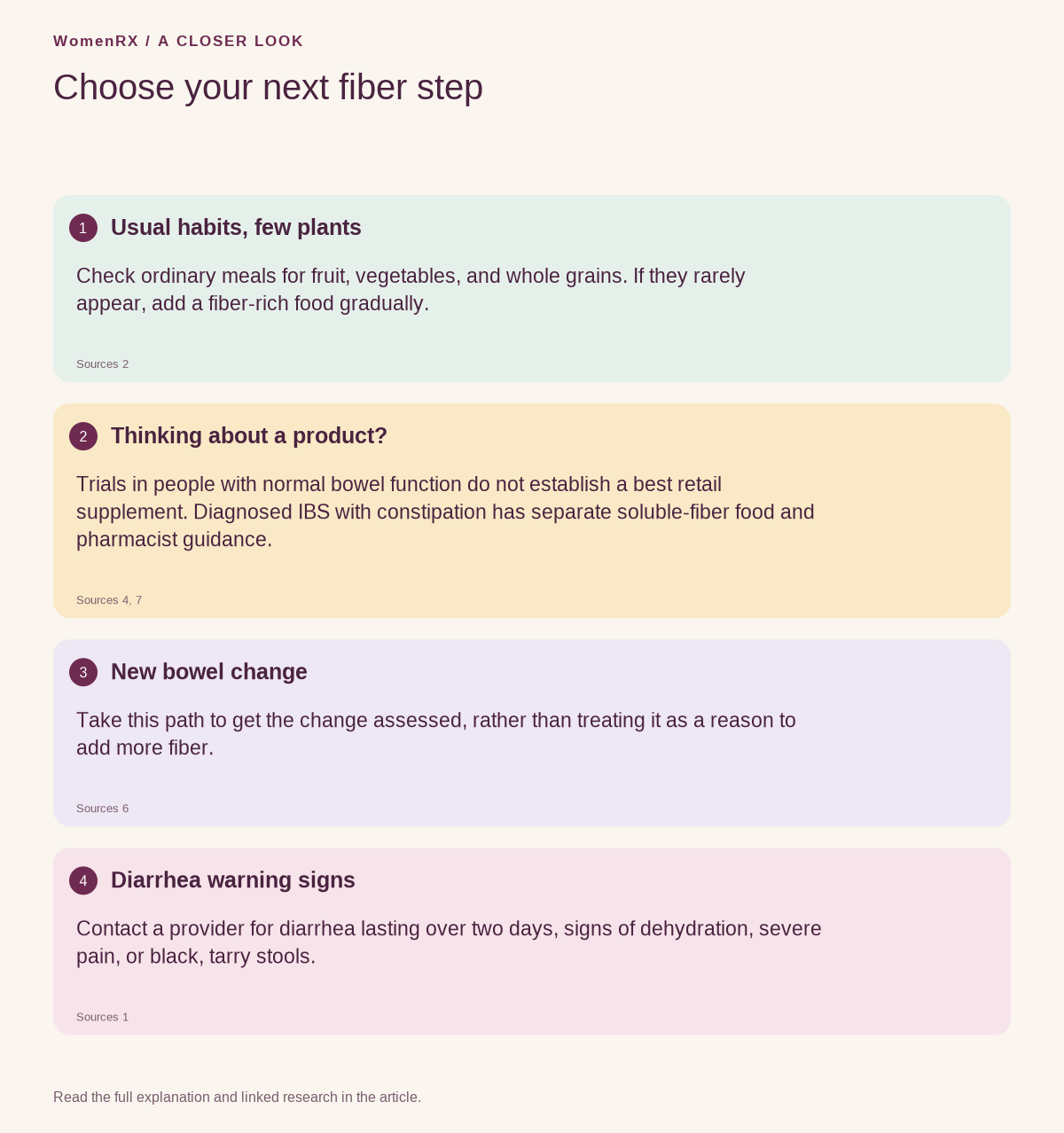
Choose your next fiber step
Usual habits, few plants: Check ordinary meals for fruit, vegetables, and whole grains. If they rarely appear, add a fiber-rich food gradually.2
Thinking about a product?: Trials in people with normal bowel function do not establish a best retail supplement. Diagnosed IBS with constipation has separate soluble-fiber food and pharmacist guidance.47
New bowel change: Take this path to get the change assessed, rather than treating it as a reason to add more fiber.6
Diarrhea warning signs: Contact a provider for diarrhea lasting over two days, signs of dehydration, severe pain, or black, tarry stools.1
Read the figure as text
First ask whether your bowel habits have changed. If they haven’t, look at your usual meals. A new bowel change follows the assessment branch rather than the food or product branch.- Usual habits, few plants: Check ordinary meals for fruit, vegetables, and whole grains. If they rarely appear, add a fiber-rich food gradually.2
- Thinking about a product?: Trials in people with normal bowel function do not establish a best retail supplement. Diagnosed IBS with constipation has separate soluble-fiber food and pharmacist guidance.47
- New bowel change: Take this path to get the change assessed, rather than treating it as a reason to add more fiber.6
- Diarrhea warning signs: Contact a provider for diarrhea lasting over two days, signs of dehydration, severe pain, or black, tarry stools.1
More questions, answered
Is a daily bowel movement the goal?
No. You don’t have to go every day. What matters more is whether your usual pattern has changed or passing stool has become difficult or painful.6
Should I add more fiber if I have diarrhea?
Don’t treat new or ongoing diarrhea as a simple fiber shortage. If it lasts more than two days, or comes with dehydration, severe pain, or black, tarry stools, contact a healthcare provider.1
Sources you can check
- Diarrhea | MedlinePlusAccessed 2026-09-25Return to first citation
- Dietary Fiber: MedlinePlusAccessed 2026-09-25Return to first citation
- An alternative dietary variety score reflects nutrient adequacy across different life stages in Japanese women.Tateishi Y, Nakamura H, Tajima R, Hayashi N, Murakami K, Okubo H. · Frontiers in nutrition · 2026Return to first citation
- Fiber intake and laxation in people with normal bowel function: a systematic review.Balk EM, Couch E, Mai HJ, Chen Y, Adam GP, Kanaan G, Caputo EL, Trikalinos TA, Williams G, Duncanson K, Talley NJ, Lichtenstein AH. · The American journal of clinical nutrition · 2026Return to first citation
- Effects of Dietary Fiber Supplementation on Gut Microbiota and Bowel Function in Healthy Adults: A Randomized Controlled Trial.Inoue R, Suzuki K, Takaoka M, Narumi M, Naito Y. · Microorganisms · 2025Return to first citation
- Constipation | MedlinePlusAccessed 2026-09-25Return to first citation
- Diet, lifestyle and medicines for IBS (irritable bowel syndrome) - NHSAccessed 2026-09-25Return to first citation