Psyllium After 40: Match the Supplement to the Goal
Psyllium may help with constipation, but your age or menopause stage alone doesn’t tell you whether you need it.
Psyllium is a reasonable option to consider when constipation is the problem, especially if you’re not getting much fiber from food. Trials in adults with chronic constipation suggest fiber supplements, including psyllium, can improve bowel symptoms, though gas may increase. Start by identifying your goal and looking at your usual meals; age 40 or menopause alone isn’t a reason to add it. 1 3
Start with the problem you want to solve
Psyllium makes most sense when you have a specific reason to consider it, such as constipation alongside a low-fiber eating pattern. It isn’t something you need simply because you’re over 40 or entering perimenopause or menopause. The useful question is what you want it to do.
Constipation can mean having fewer than three bowel movements a week, passing hard or dry stools, or finding them painful to pass. You don’t have to have a bowel movement every day to be regular. 2
If your goal is a clinician-identified cholesterol or other lipid target, constipation research doesn’t answer whether psyllium is right for that goal. Ask about the specific target and plan rather than assuming that evidence for one use applies to another.
If constipation is the issue, look at fiber first
Fiber from foods such as whole grains, fruits, and vegetables can help prevent constipation. If your usual meals include few of these, adding more fiber-rich foods gradually is a practical first step. Increasing fiber too quickly can cause gas, bloating, or cramps. 1
Psyllium forms a gel and holds water. That can help change stool bulk and consistency. 4 In a 2022 meta-analysis of 16 randomized trials involving 1,251 adults with chronic constipation, fiber supplements improved outcomes overall, and psyllium was among the fiber types with significant effects on stool frequency. The review also found that fiber supplementation improved stool consistency overall. 3 A 2025 review also links psyllium’s water-retaining gel to changes in stool hydration and consistency. 4 The studies varied, so the results don’t guarantee the same benefit for every person. 3
Psyllium isn’t free of tradeoffs. In the meta-analysis, flatulence was more common in the fiber groups than in control groups. If you already have bothersome bloating or gas, that may affect whether a fiber supplement feels worthwhile. 3
Don’t assume a bowel change is menopause
If you notice bowel changes during perimenopause or menopause, the timing alone doesn’t show what’s causing them or mean you need psyllium. Consider the specific change, your food and fluid habits, and whether a medicine could be contributing. MedlinePlus advises asking whether medicines you take may cause constipation and checking with a provider when bowel habits change. 2
The psyllium constipation research described here studied adults with chronic constipation, not a menopause-specific need for fiber. It supports considering psyllium for the bowel problem, not taking it based on life stage. 3
Decide from fiber intake and bowel habits, not age alone
- Your aim is regularity, and your diet is low in fiber: Try building fiber-rich foods into meals gradually. If constipation remains a problem, psyllium is an option to discuss or consider based on its evidence for adult constipation. 1 3
- You’re already eating a range of fiber-rich foods and aren’t constipated: Age alone doesn’t create a clear reason to add a supplement.
- Your bowel habits have changed, or a medicine may be involved: Look into the change rather than treating it as a menopause symptom by default. Ask about medicines that may contribute. 2
- Your goal is a lipid target: Get advice specific to that target; constipation findings aren’t evidence for a lipid benefit.
If your usual bowel habits change, check with a healthcare provider rather than assuming more fiber is the whole answer. 2
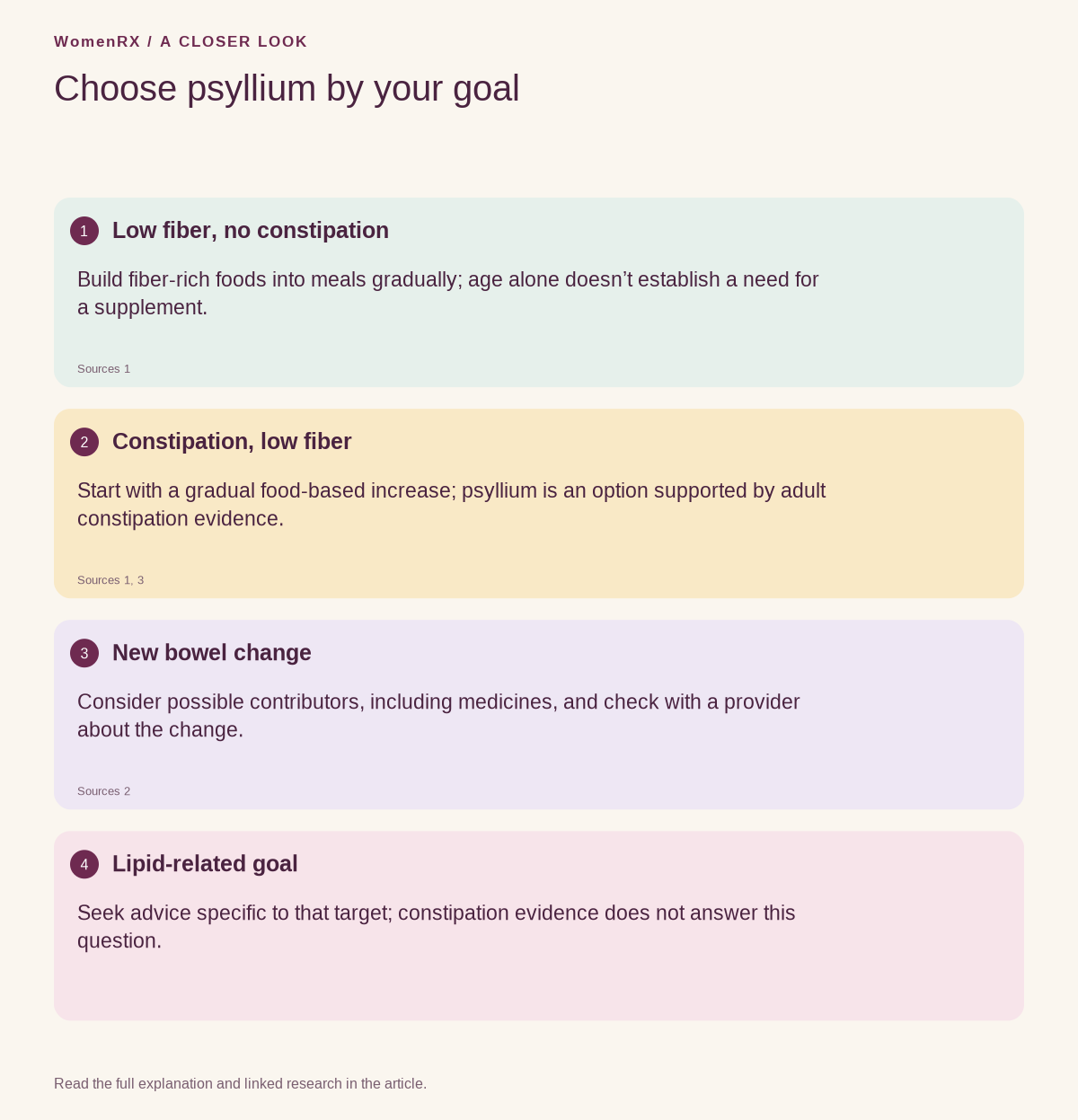
Choose psyllium by your goal
Low fiber, no constipation: Build fiber-rich foods into meals gradually; age alone doesn’t establish a need for a supplement.1
Constipation, low fiber: Start with a gradual food-based increase; psyllium is an option supported by adult constipation evidence.13
New bowel change: Consider possible contributors, including medicines, and check with a provider about the change.2
Lipid-related goal: Seek advice specific to that target; constipation evidence does not answer this question.
Read the figure as text
Follow the reason you’re considering psyllium, not your age alone.- Low fiber, no constipation: Build fiber-rich foods into meals gradually; age alone doesn’t establish a need for a supplement.1
- Constipation, low fiber: Start with a gradual food-based increase; psyllium is an option supported by adult constipation evidence.13
- New bowel change: Consider possible contributors, including medicines, and check with a provider about the change.2
- Lipid-related goal: Seek advice specific to that target; constipation evidence does not answer this question.
More questions, answered
Do I need to have a bowel movement every day?
No. MedlinePlus says it isn’t important to have a bowel movement every day. A change in your usual bowel habits is a reason to check with a provider. 2
Can psyllium cause gas or bloating?
It can. Fiber supplements were associated with more flatulence than control treatments in a meta-analysis of adults with chronic constipation. Increasing dietary fiber too quickly can also cause gas, bloating, or cramps. 1 3
Sources you can check
- Dietary Fiber: MedlinePlusAccessed 2026-09-25Return to first citation
- Constipation | MedlinePlusAccessed 2026-09-25Return to first citation
- The Effect of Fiber Supplementation on Chronic Constipation in Adults: An Updated Systematic Review and Meta-Analysis of Randomized Controlled Trials.van der Schoot A, Drysdale C, Whelan K, Dimidi E. · The American journal of clinical nutrition · 2022Return to first citation
- The role and therapeutic effectiveness of Plantago ovata husk (psyllium husk) in the prevention and non-pharmacological treatment of gastrointestinal diseases. Part 2. Clinical use of psyllium husk in the treatment of constipation and diarrhea.Przybyszewska J, Kuźmiński A, Przybyszewski M, Popławski C. · Przeglad gastroenterologiczny · 2025Return to first citation