Myo-Inositol After 40: Match It to Your Goal
Myo-inositol has been studied mainly for PCOS and fertility, not as a treatment for perimenopause or menopause symptoms.
Being over 40, by itself, isn’t a reason to take myo-inositol. Clinical findings concern PCOS, including metabolic and reproductive outcomes, and don’t establish a benefit for hot flashes, sleep changes, or other menopause symptoms. Whether it’s worth discussing depends on your goal and whether you have a condition, such as PCOS, that matches the research population. 1 2 3
Start with what you want it to do
If you’re considering myo-inositol because of hot flashes, changing sleep, mood shifts, or irregular periods in perimenopause, the key question is whether it has been tested for that problem. Clinical findings on PCOS don’t establish myo-inositol as a treatment for menopause symptoms. Being in your 40s or later isn’t, on its own, an evidence-based reason to take it.
That doesn’t mean age is irrelevant to your health. It means the reason for taking a supplement should fit the condition and outcome studied. PCOS is a specific diagnosis, not another name for the hormonal changes of perimenopause.
Where the evidence points: PCOS, not menopause
Several studies focus on women with PCOS. In a 12-week trial of 60 women with PCOS, a combination of myo-inositol and D-chiro-inositol was compared with metformin. Both groups showed improvements in reported metabolic and reproductive measures, including insulin-resistance measures and menstrual regularity. Because the supplement combined two forms of inositol and the comparison was metformin, this trial doesn’t show that myo-inositol alone treats symptoms associated with aging or menopause. 1
Another randomized trial compared metformin plus myo-inositol with metformin alone in people with PCOS over 24 weeks. It reported better results for some insulin-resistance and menstrual outcomes with the combination. That offers a reason to discuss inositol as a PCOS-related option, but it can’t tell us whether myo-inositol alone would have the same effect, or whether the findings apply to perimenopause. 3
For people with PCOS undergoing fertility treatment, a review of 17 intervention studies assessed inositol supplementation and assisted-reproduction outcomes. The authors reported a higher clinical pregnancy rate with inositol supplementation, but the studies were specifically about PCOS and assisted reproduction. That is not evidence that inositol improves fertility for everyone over 40 or eases menopause symptoms. The review’s age meta-regression did not find a statistically significant difference in the clinical-pregnancy effect by age. That analysis still doesn’t establish an effect specifically for women over 40. 2
Is the goal PCOS care, fertility or a menopause symptom?
First, name the outcome you’re hoping for. “Help with menopause” is broad. Are you hoping to improve hot flashes, sleep, blood sugar, cycle changes, or fertility? A result for one condition or outcome shouldn’t be assumed to carry over to another.
Next, ask whether PCOS is actually part of the picture. If you’ve had a PCOS diagnosis, or have questions about whether your symptoms have another cause, ask how that diagnosis was made and whether it fits your current concerns.
Finally, compare myo-inositol with options that have evidence for your particular goal. If you’re considering it for PCOS, useful questions include: Which symptom or measurable outcome are we targeting? Is the evidence for myo-inositol alone or a combination product? How would we tell whether it’s helping? If your goal is a menopause symptom, ask what options are supported for that symptom rather than relying on PCOS findings.
Bottom line: Myo-inositol may be worth a conversation when the goal is related to diagnosed PCOS. PCOS and fertility findings don’t give a reason to take it simply because you’re over 40, or establish it as a menopause treatment.
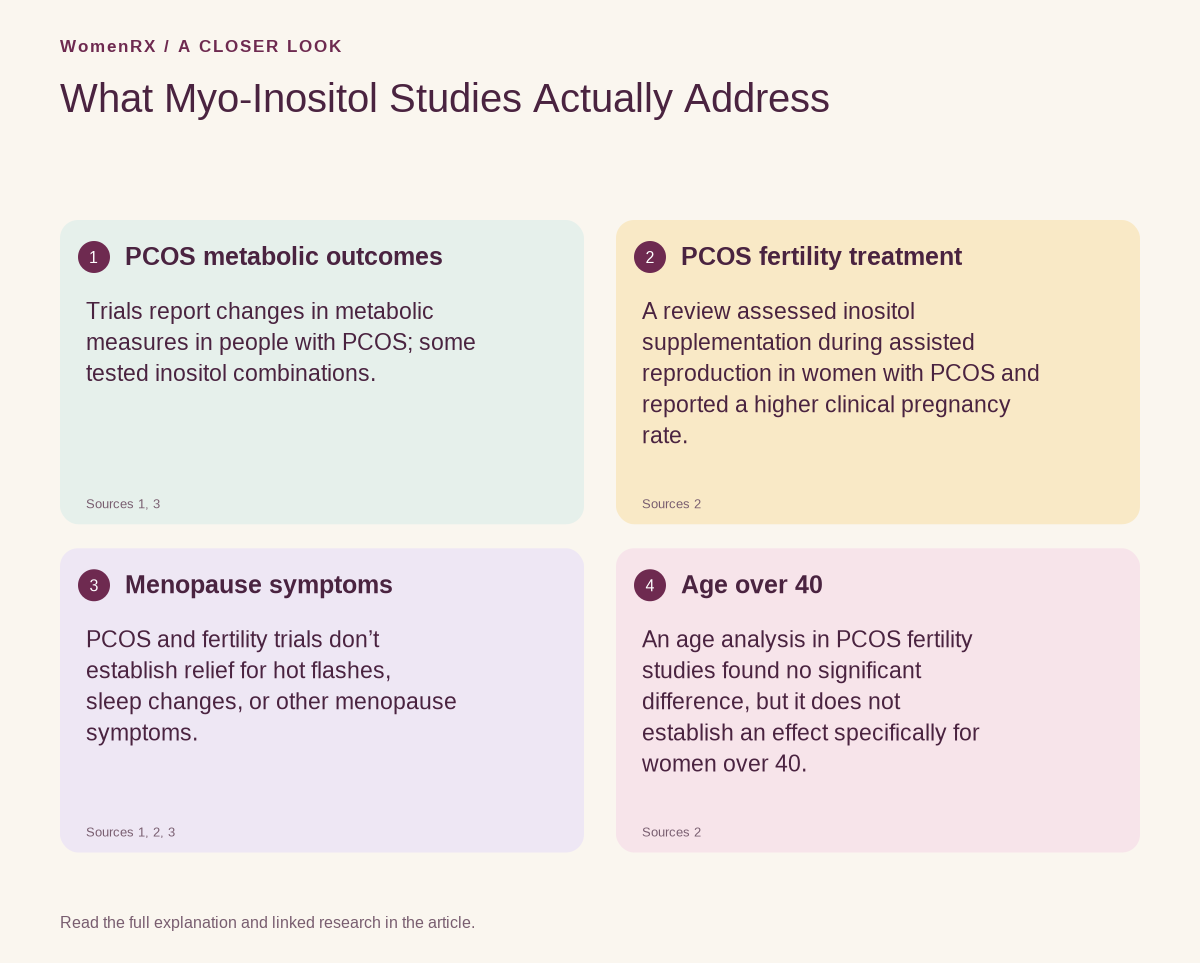
What Myo-Inositol Studies Actually Address
PCOS metabolic outcomes: Trials report changes in metabolic measures in people with PCOS; some tested inositol combinations.13
PCOS fertility treatment: A review assessed inositol supplementation during assisted reproduction in women with PCOS and reported a higher clinical pregnancy rate.2
Menopause symptoms: PCOS and fertility trials don’t establish relief for hot flashes, sleep changes, or other menopause symptoms.123
Age over 40: An age analysis in PCOS fertility studies found no significant difference, but it does not establish an effect specifically for women over 40.2
Read the figure as text
Findings are condition- and goal-specific: PCOS research shouldn’t be mistaken for menopause evidence.- PCOS metabolic outcomes: Trials report changes in metabolic measures in people with PCOS; some tested inositol combinations.13
- PCOS fertility treatment: A review assessed inositol supplementation during assisted reproduction in women with PCOS and reported a higher clinical pregnancy rate.2
- Menopause symptoms: PCOS and fertility trials don’t establish relief for hot flashes, sleep changes, or other menopause symptoms.123
- Age over 40: An age analysis in PCOS fertility studies found no significant difference, but it does not establish an effect specifically for women over 40.2
More questions, answered
Does a study of PCOS apply to perimenopause?
Not automatically. PCOS trials measure outcomes in people with that condition, such as metabolic markers or menstrual regularity. They don’t establish that myo-inositol helps with perimenopause symptoms. 1 3
Does the research show that myo-inositol alone helps with PCOS?
Some studies examine combinations, including myo-inositol with D-chiro-inositol or with metformin. Those results can’t be treated as proof that myo-inositol alone has the same effects. 1 3
Sources you can check
- Comparative efficacy of combined myo-inositol and D-chiro inositol versus metformin across PCOS Phenotypes: enhancing ovarian function, ovulation, and stress response in a prospective clinical trial.Gul M, Khan H, Rauf B, Bukhari SMS, Ehtesham E, Malik MO, Shah FA, Alanazi FE, Shah M. · Naunyn-Schmiedeberg's archives of pharmacology · 2025Return to first citation
- The effect of myo-inositol on assisted reproductive technology outcomes in women with polycystic ovarian syndrome: A systematic review and meta-analysis of randomized clinical trial studies.Sene AA, Saeedzarandi M, Yazdizadeh M, Ghaffari SR, Amjadi F, Zandieh Z, Moradi Y. · International journal of reproductive biomedicine · 2025Return to first citation
- A Phase III, Double-Blind, Randomized, Multicenter, Clinical Trial to Evaluate the Efficacy and Safety of a Fixed-Dose Combination of Metformin Hydrochloride and Myo-Inositol Compared to Metformin in Patients With Polycystic Ovary Syndrome.Kriplani A, Tank P, Singh P, Maini N, Kaitala S, Kantha G L, Paul J, Shah S, Bhatara U, Sinha A, Singh T, Srivastava S, Malvi A. · Cureus · 2024Return to first citation