PCOS Supplements: Match Inositol Claims to Your Goal
Inositol has some evidence for changing hormone markers, but that doesn’t establish it as a treatment for insulin resistance, irregular cycles, or infertility.
Inositol research on androgen blood markers can’t identify a best supplement across PCOS goals. In a meta-analysis of nine trials involving 440 women, inositol was associated with changes in androgen-related blood tests, but results varied by metabolic profile. Those findings don’t establish that it improves blood sugar or insulin resistance, reliably regularizes cycles, or increases pregnancy rates. Those are separate outcomes with different care options. 3 1
Start with the outcome you want to change
PCOS can involve irregular or absent ovulation, higher androgen levels, and metabolic concerns, but not everyone has the same combination. That’s why a supplement claim should be judged by the outcome actually studied, not by a broad promise to “balance hormones.” 1
A meta-analysis of inositol trials examined androgen-related blood markers and found changes in several of them. 3 That is narrower than proving a noticeable change in unwanted hair or acne, more predictable periods, improved metabolic health, or a better chance of pregnancy.
If your priority is hormone markers
A systematic review and meta-analysis combined nine randomized trials, with 440 women with PCOS. Inositol supplementation was associated with lower levels of several androgen-related blood markers and higher sex hormone-binding globulin. The results varied considerably across some measures. 3
The subgroup findings also resist a one-size-fits-all recommendation. The most consistent reduction in total testosterone appeared among participants with a BMI below 25. The analysis did not find a significant improvement in that measure among participants who were overweight or had obesity, or among those with insulin resistance when considered independently of BMI. The authors describe these subgroup findings as exploratory, so they raise a question for further study rather than identify who should take inositol. 3
Blood markers are not the same as a demonstrated improvement in symptoms. This analysis focused on biochemical androgen measures and called for further trials using outcomes such as hirsutism, ovulation, and patient-reported changes. 3
If your priority is insulin resistance or metabolic health
Don’t treat an androgen-marker result as proof that a supplement improves insulin resistance or blood sugar. The inositol meta-analysis focused on androgen-related outcomes; it doesn’t answer those metabolic questions. 3
Metformin is sometimes discussed alongside inositol, but it’s a medication, not a supplement. A narrative review describes metformin as improving insulin sensitivity and potentially helping with androgen levels and ovulation, while noting that effects on pregnancy and live-birth rates remain controversial. That review is not a head-to-head comparison proving metformin is better for every person with PCOS. 2
PCOS care can include healthy eating and medicines chosen for the particular symptoms and goals involved. An insulin-sensitizing medicine may be part of care for some people. A supplement claim shouldn’t replace a plan for the metabolic concern you’re actually trying to address. 1
If your priority is periods or pregnancy
PCOS-related ovulation problems can lead to irregular or absent periods, but an inositol result on a blood test doesn’t show that cycles became regular or that ovulation improved. The meta-analysis did not establish those outcomes. 1 3
If you’re trying to get pregnant, focus on evidence about fertility outcomes, not just hormone levels or bleeding patterns. MedlinePlus notes that PCOS is a common cause of infertility, while many women with PCOS can still get pregnant; fertility treatment can include medicines or procedures such as IVF. The inositol meta-analysis doesn’t establish that inositol increases pregnancy rates. 1 3
If pregnancy is a possibility or a current goal, review the exact product and its ingredients with your care team or pharmacist before starting it. Research on androgen blood markers doesn’t settle the safety of every product, its interactions with medicines, or its use during pregnancy.
A practical way to assess a supplement claim
Before buying a product, ask what it is supposed to change: a blood marker, insulin resistance, cycle regularity, a symptom, or the chance of pregnancy. Then check whether the research measured that same outcome in people with PCOS like you. Inositol has a signal for some hormone markers, with uncertain subgroup differences; that is not evidence that it covers every PCOS goal. 3
Bring the label to a clinician or pharmacist if you take medication or are planning pregnancy. For treatment decisions, keep the conversation anchored to your priority, whether that’s metabolic health, cycle symptoms, or fertility, rather than treating “PCOS” as a single supplement target. 1
What the PCOS evidence measures
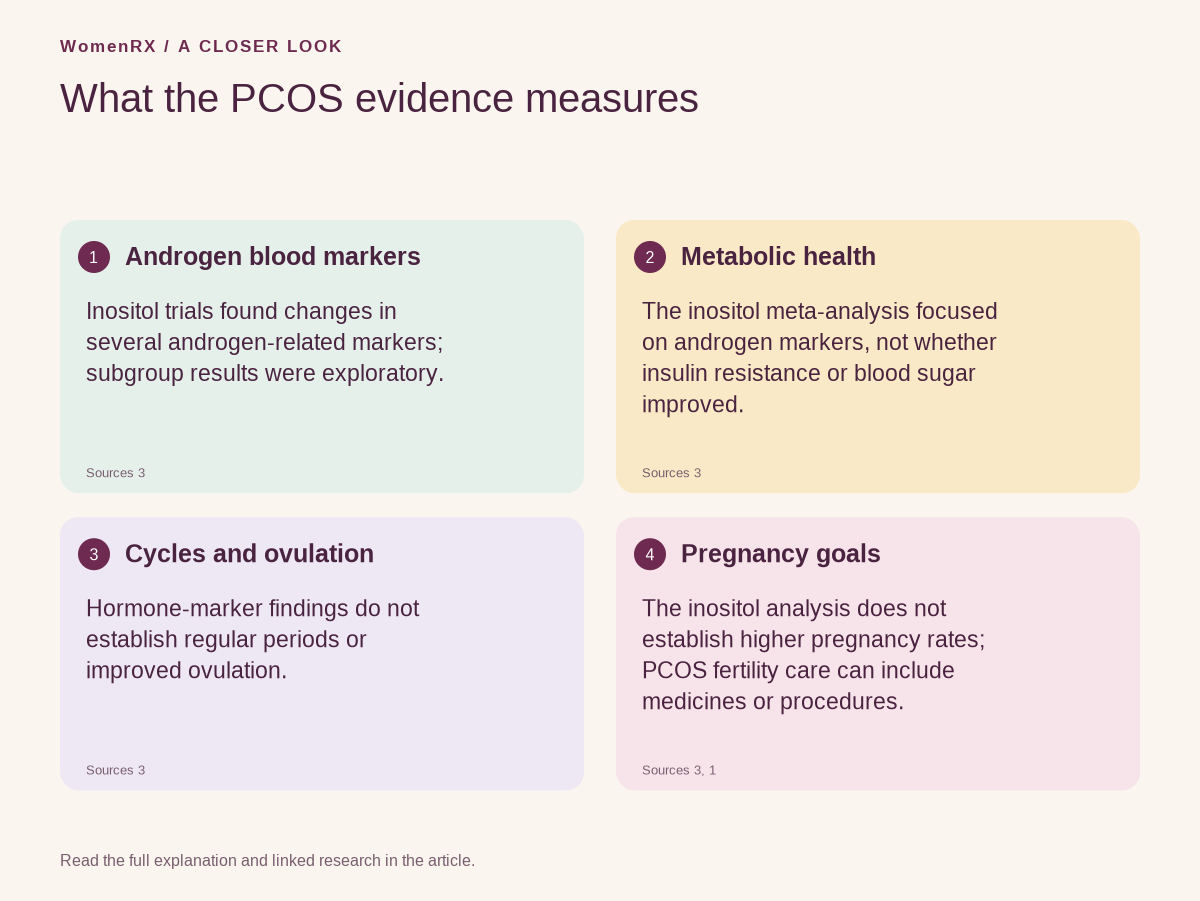
Androgen blood markers: Inositol trials found changes in several androgen-related markers; subgroup results were exploratory.3
Metabolic health: The inositol meta-analysis focused on androgen markers, not whether insulin resistance or blood sugar improved.3
Cycles and ovulation: Hormone-marker findings do not establish regular periods or improved ovulation.3
Pregnancy goals: The inositol analysis does not establish higher pregnancy rates; PCOS fertility care can include medicines or procedures.31
Read the figure as text
A supplement result for one outcome doesn’t automatically answer a different PCOS question.- Androgen blood markers: Inositol trials found changes in several androgen-related markers; subgroup results were exploratory.3
- Metabolic health: The inositol meta-analysis focused on androgen markers, not whether insulin resistance or blood sugar improved.3
- Cycles and ovulation: Hormone-marker findings do not establish regular periods or improved ovulation.3
- Pregnancy goals: The inositol analysis does not establish higher pregnancy rates; PCOS fertility care can include medicines or procedures.31
More questions, answered
Does inositol improve fertility in PCOS?
The meta-analysis described here assessed androgen-related blood markers, not whether inositol raises pregnancy or live-birth rates. It therefore can’t establish a fertility benefit. PCOS fertility care may involve medicines or procedures selected for the person’s situation. 3 1
Is metformin a PCOS supplement?
No. Metformin is a medication. A narrative review describes possible benefits for insulin sensitivity and ovulation, but says evidence about pregnancy and live-birth outcomes remains controversial. 2
Sources you can check
- PCOS | Polycystic Ovary Syndrome | MedlinePlusAccessed 2026-09-25Return to first citation
- Therapeutic Potential of Anti-Obesity Drugs in Obesity-Associated Female Reproductive Dysfunction: Translating Mechanistic Evidence into Personalized Clinical Strategies.Varra FN, Theodosis-Nobelos P, Varra VK, Varras M. · Medicina (Kaunas, Lithuania) · 2026Return to first citation
- Metabolic Phenotype Predicts Biochemical Response to Inositol Supplementation in Polycystic Ovary Syndrome: A Systematic Review and Meta-Analysis.Tienforti D, Puocci G, Venditti C, Gizzi V, Pisanò C, Cocci E, Perfetto E, D'Alessandro F, Spagnolo L, Baroni MG, Barbonetti A. · Clinical endocrinology · 2026Return to first citation