PCOS Supplements: What Inositol May Help, and What’s Unclear
Inositol has been studied for metabolic measures, menstrual patterns, and ovulation, but evidence for one outcome doesn’t prove a benefit for another.
Inositol may improve some metabolic measures in people with PCOS, and there are possible benefits for ovulation, but the evidence is limited and varies by outcome and formulation. A systematic review that informed the 2023 international PCOS guideline update found the overall evidence inconclusive. Metformin is a medication, not a supplement, and comparisons with inositol don’t establish one best option for everyone. 3
Start with the outcome you want to change
“Does inositol work for PCOS?” can mean several different things. You might want more regular periods, evidence that you’re ovulating, a change in an insulin-related blood test, or help getting pregnant. Those outcomes aren’t interchangeable. A better question is whether a study measured the result you care about, in people with a similar goal.
A systematic review that informed the 2023 international PCOS guideline update assessed 30 trials involving 2,230 participants; 19 trials were pooled in meta-analyses. It found possible benefits for some metabolic measures and potential ovulation benefits from D-chiro-inositol, but inositol may have no effect on other outcomes. The review concluded that the overall evidence was limited and inconclusive. 3
What the studies say about inositol
Metabolic measures: The review found evidence suggesting that myo-inositol or D-chiro-inositol may help some metabolic measures. That describes changes measured in studies. It doesn’t establish that taking inositol prevents diabetes, treats every metabolic concern, or will make a noticeable difference in how you feel. PCOS can involve metabolic as well as reproductive concerns, so it helps to identify which measure or health goal is relevant to you. 1 3
Periods and ovulation: A randomized trial compared a combination of myo-inositol and D-chiro-inositol in a 40:1 ratio with metformin in 60 women with PCOS over 12 weeks. Both groups had improvements in menstrual regularity and insulin-sensitivity measures. The trial was small, and its results don’t show that the combination was better than metformin or establish that the same result applies to every person or product. 2
The systematic review found potential ovulation benefits for D-chiro-inositol, but that finding doesn’t establish a reliable effect across all inositol formulations or all PCOS outcomes. A change in menstrual pattern and confirmed ovulation are distinct results, so don’t treat one as proof of the other. 3
Pregnancy: Ovulation, becoming pregnant, and having a live birth are separate outcomes. A 2026 umbrella review of 13 meta-analyses reported pooled improvements in ovulation and live birth with inositol compared with placebo or folic acid. But none of the 85 evidence items it assessed was rated high quality; 40% were rated low quality and 41.1% very low quality. These findings are worth understanding, but they don’t promise that inositol will improve your individual chance of pregnancy. 4
If you’re considering pregnancy, ask how a supplement fits with care focused on conception. An improvement in a blood test or cycle pattern doesn’t by itself establish that a treatment is adequate for your fertility goal.
Inositol and metformin are different kinds of options
Metformin is a medication, not a supplement. The systematic review describes it as a guideline-recommended option for metabolic and body-measure outcomes in PCOS. In comparisons with inositol, metformin may improve waist-to-hip ratio and hirsutism; the review found likely no difference in reproductive outcomes, while evidence about body mass index was very uncertain. Myo-inositol likely caused fewer gastrointestinal side effects than metformin in the reviewed comparisons. Those findings can inform a discussion, but they don’t settle which approach fits your goals or circumstances. 3
One small trial comparing metformin with a combination of myo-inositol and D-chiro-inositol found improvements in both groups, but it cannot establish that the treatments are equivalent. A broader comparison review offers a more cautious picture: likely no difference for reproductive outcomes, but uncertainty for some other measures. 2 3
What about other supplements?
An umbrella review of nutrition studies in women with PCOS reported that vitamin D, fish oil or omega-3, and curcumin were associated with improvements in selected metabolic measures. It also reported an ovulation benefit from inositol among subfertile women with PCOS. These are findings for particular outcomes, not evidence that every supplement helps every person with PCOS or can replace care aimed at a specific concern. 5
Make a supplement claim more specific
When a product says it “balances hormones” or “fixes insulin resistance,” ask what the research actually measured: a blood test, menstrual pattern, ovulation, pregnancy, or live birth? Then ask what the study compared the product with, and whether participants shared your goal. A result for one inositol type or combination doesn’t establish that every formulation or ratio works the same way. 2 3 4
You could make the conversation concrete: “My main goal is more regular periods, metabolic health, or getting pregnant. What outcome should we use to judge whether this is helping, and how does it fit with my current care?” That keeps the focus on the result you want, rather than a broad promise about PCOS.
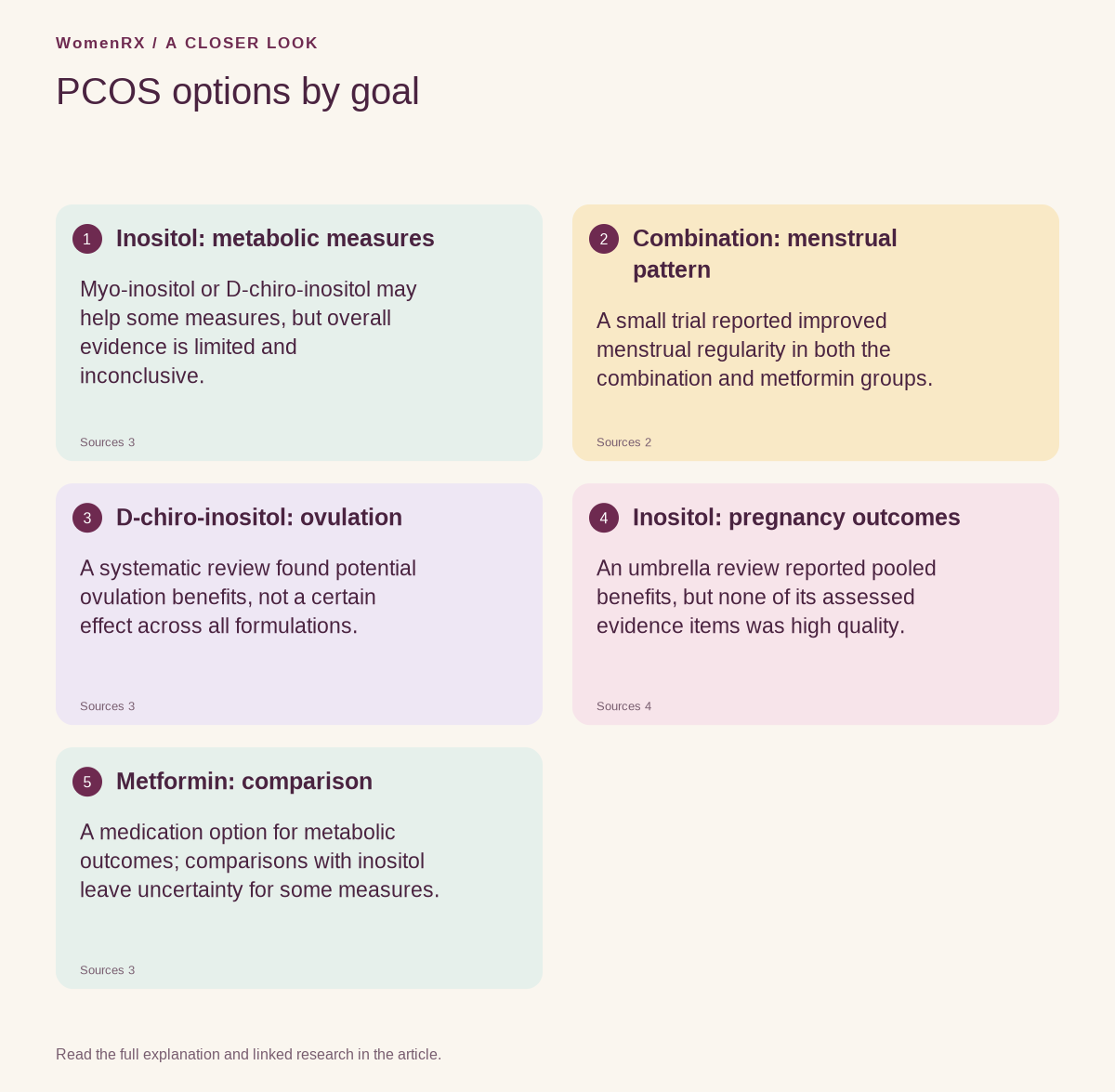
PCOS options by goal
Inositol: metabolic measures: Myo-inositol or D-chiro-inositol may help some measures, but overall evidence is limited and inconclusive.3
Combination: menstrual pattern: A small trial reported improved menstrual regularity in both the combination and metformin groups.2
D-chiro-inositol: ovulation: A systematic review found potential ovulation benefits, not a certain effect across all formulations.3
Inositol: pregnancy outcomes: An umbrella review reported pooled benefits, but none of its assessed evidence items was high quality.4
Metformin: comparison: A medication option for metabolic outcomes; comparisons with inositol leave uncertainty for some measures.3
Read the figure as text
The evidence differs depending on whether your goal is a metabolic measure, cycle pattern, ovulation, or pregnancy.- Inositol: metabolic measures: Myo-inositol or D-chiro-inositol may help some measures, but overall evidence is limited and inconclusive.3
- Combination: menstrual pattern: A small trial reported improved menstrual regularity in both the combination and metformin groups.2
- D-chiro-inositol: ovulation: A systematic review found potential ovulation benefits, not a certain effect across all formulations.3
- Inositol: pregnancy outcomes: An umbrella review reported pooled benefits, but none of its assessed evidence items was high quality.4
- Metformin: comparison: A medication option for metabolic outcomes; comparisons with inositol leave uncertainty for some measures.3
More questions, answered
Does a more regular period prove that I’m ovulating?
No. Menstrual regularity and ovulation are distinct outcomes in PCOS research. A change in cycle pattern by itself doesn’t establish that ovulation occurred. 2 3
Is inositol proven to work as well as metformin?
No broad conclusion is established. A systematic review found likely no difference in reproductive outcomes, but some other comparisons were uncertain. One small 12-week trial reported improvements in both groups, which doesn’t prove equivalence. 2 3
Sources you can check
- Metabolic Syndrome | MedlinePlusAccessed 2026-09-25Return to first citation
- Comparative efficacy of combined myo-inositol and D-chiro inositol versus metformin across PCOS Phenotypes: enhancing ovarian function, ovulation, and stress response in a prospective clinical trial.Gul M, Khan H, Rauf B, Bukhari SMS, Ehtesham E, Malik MO, Shah FA, Alanazi FE, Shah M. · Naunyn-Schmiedeberg's archives of pharmacology · 2025Return to first citation
- Inositol for Polycystic Ovary Syndrome: A Systematic Review and Meta-analysis to Inform the 2023 Update of the International Evidence-based PCOS Guidelines.Fitz V, Graca S, Mahalingaiah S, Liu J, Lai L, Butt A, Armour M, Rao V, Naidoo D, Maunder A, Yang G, Vaddiparthi V, Witchel SF, Pena A, Spritzer PM, Li R, Tay C, Mousa A, Teede H, ... · The Journal of clinical endocrinology and metabolism · 2024Return to first citation
- Effects of inositol in women with polycystic ovary syndrome: an umbrella review of meta-analyses from randomized controlled trials.Duan M, Yang M, Li C, Wu X, Yin X, Zhu H. · Frontiers in endocrinology · 2026Return to first citation
- Effects of nutrition on metabolic and endocrine outcomes in women with polycystic ovary syndrome: an umbrella review of meta-analyses of randomized controlled trials.Moslehi N, Zeraattalab-Motlagh S, Rahimi Sakak F, Shab-Bidar S, Tehrani FR, Mirmiran P. · Nutrition reviews · 2023Return to first citation