D-Chiro-Inositol for PCOS: What the Evidence Shows
Studies have examined D-chiro-inositol for some metabolic and ovulation outcomes, but findings from mixed formulas don’t tell you what D-chiro-inositol alone can do.
For PCOS, research has studied D-chiro-inositol (DCI) in relation to metabolic measures and ovulation, but the overall evidence for inositol is limited and inconclusive. Many studies use myo-inositol (MI), a blend of MI and DCI, or additional treatments, so their results can’t establish the effect of a DCI-only supplement. The label and your treatment goal both matter. 4
If you’re considering D-chiro-inositol for PCOS, start by checking whether the evidence matches the supplement you’re looking at. A study of DCI alone is not the same as a study of myo-inositol, a blend of the two, or a blend taken alongside other treatments. That distinction matters when interpreting claims about insulin resistance, periods, or fertility.
What has been studied
A systematic review prepared to inform the international PCOS guideline assessed inositol trials across metabolic, hormonal, reproductive, and other outcomes. It found possible benefits for some metabolic measures with myo-inositol or DCI, and a potential benefit from DCI for ovulation. But the review judged the overall evidence for inositol in PCOS to be limited and inconclusive, with possible benefits for some outcomes and no effect for others. These findings don’t establish that a particular DCI product will improve insulin resistance or another symptom for you. 4
A newer umbrella review of meta-analyses also found that the underlying evidence varied in quality: none of the evidence items it assessed were rated high quality. Its comparison across inositol types advises caution with DCI alone. This is a reason to avoid treating broad claims about “inositol” as proof for a DCI-only formula. 6
The formula changes what a result can tell you
DCI alone: This is the formulation to look for when asking what DCI by itself has been shown to do. The review evidence suggests possible metabolic effects and potential effects on ovulation, but it does not provide a clear, dependable promise for an individual outcome. 4
Myo-inositol alone: Findings from MI studies are not DCI findings. The review reports possible metabolic benefits for MI or DCI, but evidence for one form should not automatically be attributed to the other. 4
MI plus DCI: A combination study tests the blend, not either ingredient on its own. For example, one small randomized pilot compared a 40:1 MI-to-DCI combination with metformin in 30 people with PCOS. It measured the hormone asprosin over 12-16 weeks; the greater reduction reported with the blend did not reach statistical significance. That result does not establish a DCI-only benefit or show that the blend improves a symptom that wasn’t measured. 2
Some studies combine inositols with other interventions too. A 12-week trial assigned 192 women with PCOS to metformin, an MI/DCI combination, calorie restriction, or all three. The combination group had the greatest reported improvement in several measures, including HOMA-IR, but because the combined group received multiple interventions, the result cannot isolate the effect of DCI. 1
Insulin resistance is one outcome, not the whole decision
If your main goal is to address insulin resistance, ask what measure a study actually used and what the comparison was. HOMA-IR is a measure used in PCOS trials; a change in a trial measure does not, on its own, show how you will feel or whether a supplement will meet your treatment goal. Results from a combined formula or a multi-part treatment also shouldn’t be presented as evidence for DCI alone. 134
If your goal is ovulation or pregnancy, keep those outcomes separate from metabolic ones. The systematic review found potential benefit for ovulation with DCI, but its overall conclusion remained that inositol evidence is limited and inconclusive. A retrospective pilot study before IVF looked at an MI/DCI formula with antioxidants, not DCI alone. Because it was observational and tested a combined supplement, it can’t establish that DCI improves fertility or pregnancy outcomes. 45
A practical way to assess a product
Before deciding whether a supplement fits your care, bring the label and ask:
- Does it contain DCI alone, MI alone, or both? If both, what amounts and ratio are listed?
- Is the evidence being discussed for that exact formulation, or for a different blend?
- Which outcome are we considering: an insulin-resistance measure, ovulation, cycle regularity, or something else?
- What other treatments or changes were part of the study, and could they explain the result?
- How will this fit with the care you already have for PCOS, and how will we know whether it is helping?
These questions won’t turn uncertain evidence into a guarantee. They can help keep the discussion specific: what the product contains, which result matters to you, and what the research actually tested.
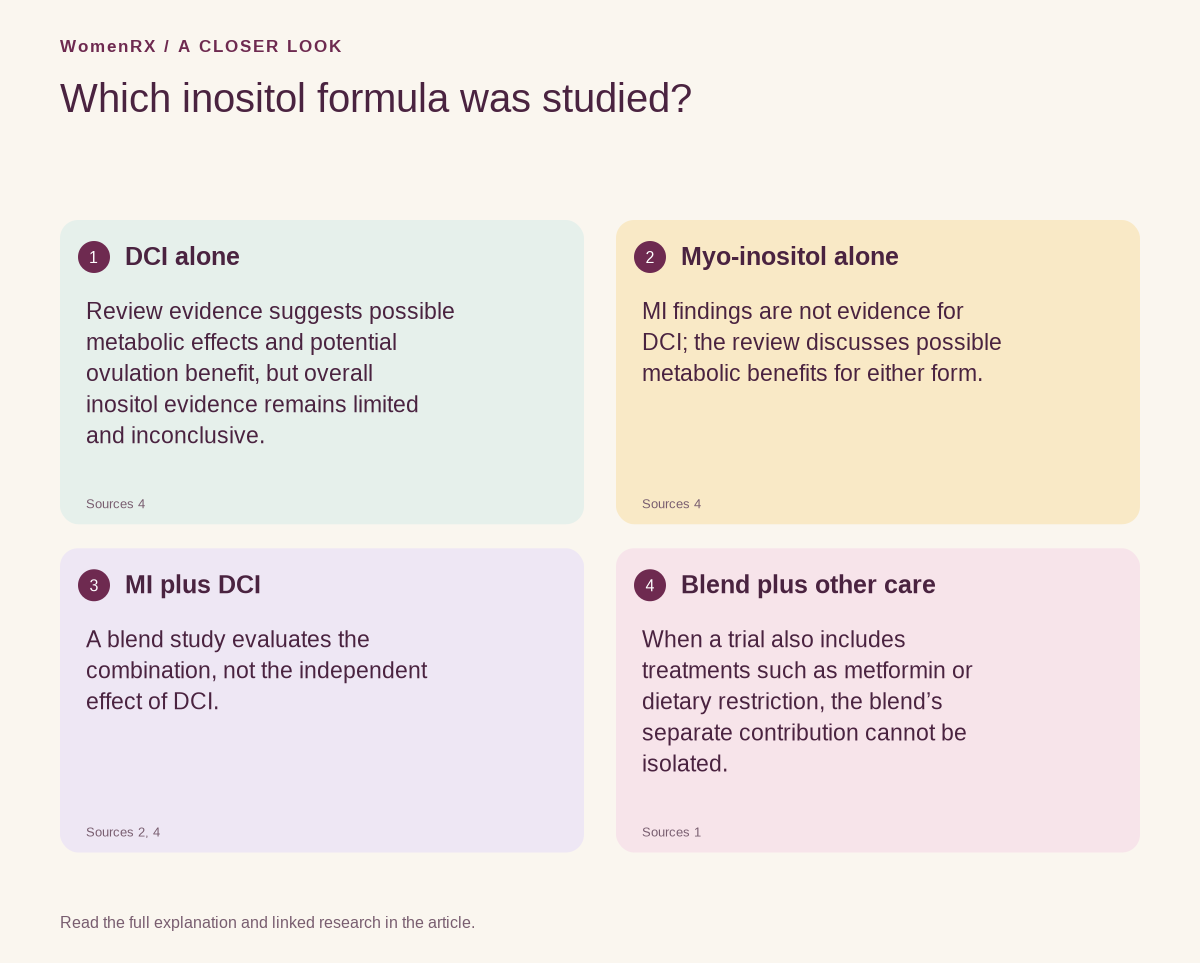
Which inositol formula was studied?
DCI alone: Review evidence suggests possible metabolic effects and potential ovulation benefit, but overall inositol evidence remains limited and inconclusive.4
Myo-inositol alone: MI findings are not evidence for DCI; the review discusses possible metabolic benefits for either form.4
MI plus DCI: A blend study evaluates the combination, not the independent effect of DCI.24
Blend plus other care: When a trial also includes treatments such as metformin or dietary restriction, the blend’s separate contribution cannot be isolated.1
Read the figure as text
The ingredient combination determines which conclusions a PCOS study can support.- DCI alone: Review evidence suggests possible metabolic effects and potential ovulation benefit, but overall inositol evidence remains limited and inconclusive.4
- Myo-inositol alone: MI findings are not evidence for DCI; the review discusses possible metabolic benefits for either form.4
- MI plus DCI: A blend study evaluates the combination, not the independent effect of DCI.24
- Blend plus other care: When a trial also includes treatments such as metformin or dietary restriction, the blend’s separate contribution cannot be isolated.1
More questions, answered
Does evidence for an MI/DCI blend apply to DCI alone?
No. A study of a blend can’t separate the effect of DCI from myo-inositol or other ingredients. Look for studies of the same formulation as the product you’re considering. 24
Does D-chiro-inositol improve fertility in PCOS?
The systematic review found potential benefit for ovulation with DCI, but concluded that the overall inositol evidence is limited and inconclusive. A study of a combination supplement before IVF does not show that DCI alone improves fertility. 45
Sources you can check
- Multimodal Therapy With Metformin, Inositol and Dietary Restriction Improves Insulin Resistance and Endocrine Outcomes in Women With Polyendocrine Metabolic Ovarian Syndrome: A Randomized Controlled Trial.Irfan NU, Saleem S, Irfan A. · Clinical endocrinology · 2026Return to first citation
- Effect of 40:1 myo-inositol/D-chiro-inositol treatment on serum asprosin levels in polycystic ovary syndrome: a prospective randomized pilot study.Ozay OE, Ozay Y, Edebal O, Calcagno M, Ozay AC. · Ginekologia polska · 2025Return to first citation
- Comparative efficacy of combined myo-inositol and D-chiro inositol versus metformin across PCOS Phenotypes: enhancing ovarian function, ovulation, and stress response in a prospective clinical trial.Gul M, Khan H, Rauf B, Bukhari SMS, Ehtesham E, Malik MO, Shah FA, Alanazi FE, Shah M. · Naunyn-Schmiedeberg's archives of pharmacology · 2025Return to first citation
- Inositol for Polycystic Ovary Syndrome: A Systematic Review and Meta-analysis to Inform the 2023 Update of the International Evidence-based PCOS Guidelines.Fitz V, Graca S, Mahalingaiah S, Liu J, Lai L, Butt A, Armour M, Rao V, Naidoo D, Maunder A, Yang G, Vaddiparthi V, Witchel SF, Pena A, Spritzer PM, Li R, Tay C, Mousa A, Teede H, ... · The Journal of clinical endocrinology and metabolism · 2024Return to first citation
- A 3.6:1 myo-inositol to D-chiro-inositol ratio and antioxidant-based food supplement before IVF improves fertility in women with PCOS: a pilot observational retrospective cohort study.Belchín Fernández P, Calvente V, Gómez Roso MJ, González Expósito E, Silván Bueno A, Aparicio Fluge M, Ordoñez Pérez D. · Journal of obstetrics and gynaecology : the journal of the Institute of Obstetrics and Gynaecology · 2026Return to first citation
- Effects of inositol in women with polycystic ovary syndrome: an umbrella review of meta-analyses from randomized controlled trials.Duan M, Yang M, Li C, Wu X, Yin X, Zhu H. · Frontiers in endocrinology · 2026Return to first citation