D-Chiro-Inositol Safety in PCOS: What We Know
D-chiro-inositol’s safety is less clear than supplement labels may suggest, especially when it’s used with fertility treatment or during pregnancy.
In the PCOS fertility research discussed here, evidence does not define DCI-specific side effects or establish safety during pregnancy or breastfeeding. The review mainly studied myo-inositol, often did not report adverse effects, and included only a single-trial comparison involving DCI. That does not settle the safety of DCI alone, blends, or use in other populations. 2
The short version: safety is not well mapped
D-chiro-inositol (DCI) is one form of inositol. For women with PCOS, the practical safety question is not simply whether “inositol” has been studied. It’s whether the specific product, formulation, and situation you’re considering have been studied well enough to identify harms.
The clearest limitation is in fertility research. A 2018 Cochrane review included 13 randomized trials with 1,472 subfertile women with PCOS. Those trials studied myo-inositol, mostly before IVF. The review said adverse effects were often not reported, and evidence quality was low or very low. Comparisons involving DCI were among the single-trial comparisons, so there wasn’t enough evidence to combine results or establish a dependable DCI-specific safety profile. 2
That means the evidence does not support a confident list of DCI side effects, nor does it show that DCI is free of side effects. A lack of reported harms is not the same as a thorough safety assessment.
DCI alone is not the same as a blend
Check what a product actually contains before comparing it with research. A bottle may contain DCI alone, myo-inositol and DCI together, or several added ingredients. These are different exposures, not interchangeable versions of one treatment.
For example, one observational study described a combination containing myo-inositol, DCI, chromium, antioxidants, and vitamins. Any reported experience with that product would not establish the safety of DCI by itself, or show which ingredient caused a benefit or problem. 4 Another study examined a myo-inositol/DCI combination in women with PCOS, but its abstract does not provide a controlled comparison that can establish DCI-alone safety. 3
So, when you ask about a product, bring the full label: ingredient names, amounts, and any other supplements or medicines you take. The formulation matters more than the front-label phrase “inositol.” The PCOS fertility evidence discussed here does not answer how DCI interacts with specific medicines, so it would be misleading to give a generic interaction list.
Fertility findings don’t answer the safety question
A supplement may be promoted for ovulation, metabolic measures, or fertility, but those are questions about possible effects, not proof of safety. In the Cochrane review, the evidence for inositol and fertility outcomes was uncertain, and adverse effects were frequently missing from reports. Most trials involved myo-inositol rather than DCI alone. Those findings cannot be used to promise a fertility benefit or to assume DCI has the same risk profile. 2
This distinction matters if you’re already using ovulation-induction or IVF treatment. A supplement should not quietly replace or alter a treatment plan. Tell your fertility team the exact product you’re considering, particularly if it is a blend; the evidence does not establish how DCI combines with specific fertility medicines.
Pregnancy and breastfeeding are separate questions
Trying to conceive is not the same evidence context as taking a supplement while pregnant or breastfeeding. The PCOS fertility review concerned subfertile women trying to conceive; it does not establish DCI safety during pregnancy or lactation. 2 General pregnancy guidance advises checking supplements with your care team before taking them, and advises against starting or stopping medicines without discussing the decision. 1
If you become pregnant while taking DCI, share the bottle or a photo of its full label with your prenatal care team and ask whether to continue. That’s a product-specific conversation, not a reason to assume all inositol products are either safe or unsafe. The PCOS fertility trials discussed here do not establish DCI’s safety during breastfeeding either.
A useful way to decide what to ask
Before adding DCI to PCOS care, get clear on three things: what exact formulation is it, what outcome are you hoping for, and what safety evidence applies to that formulation and situation? If the answer relies on studies of myo-inositol or multi-ingredient blends, say so. That helps keep a possible benefit separate from what is actually known about DCI’s risks.
If you use prescription treatment, ask how the supplement fits alongside that plan rather than stopping or changing treatment on your own. For pregnancy, the question should be revisited with the actual product label because general supplement information cannot establish safety for a specific DCI product. 1
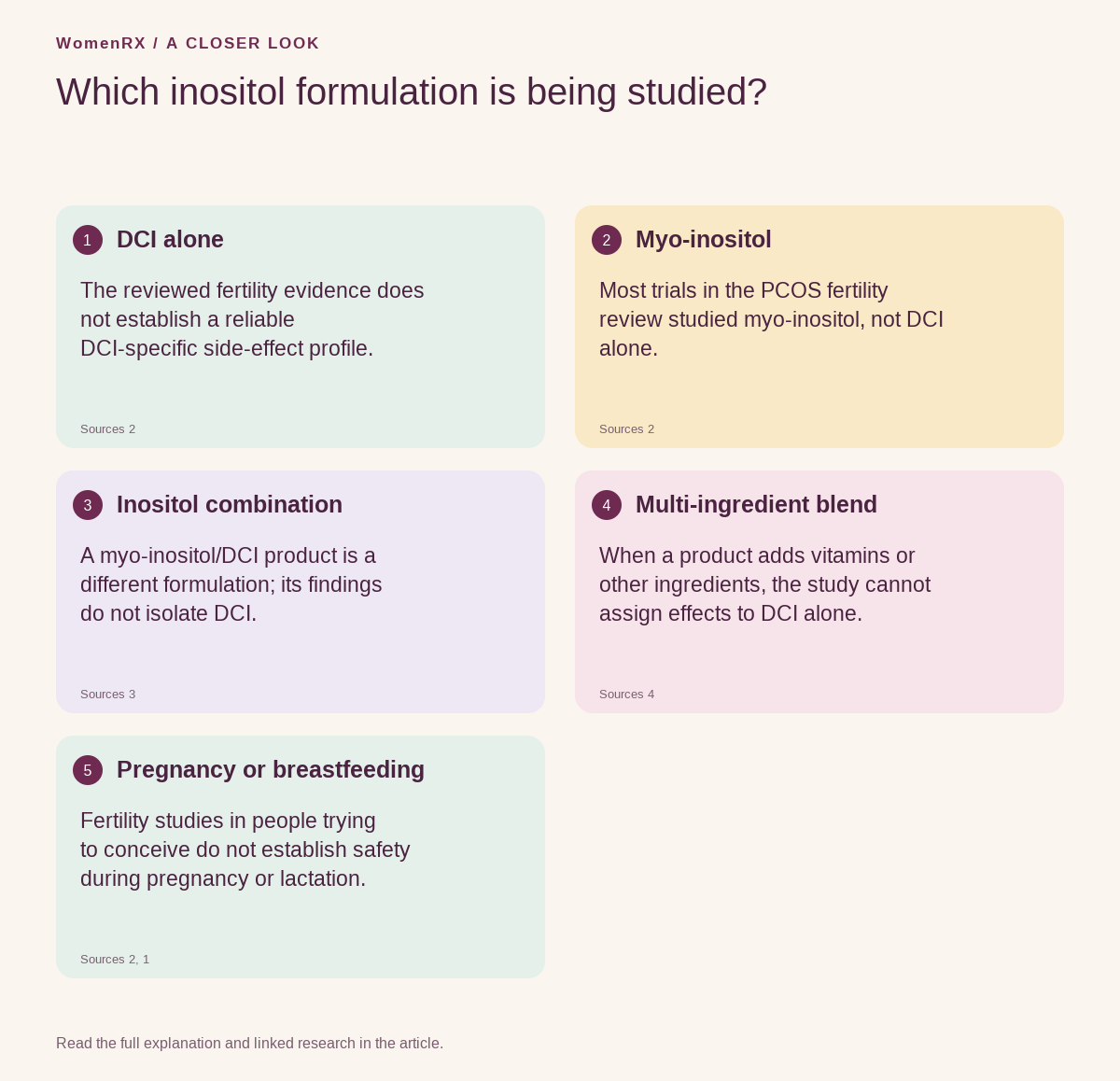
Which inositol formulation is being studied?
DCI alone: The reviewed fertility evidence does not establish a reliable DCI-specific side-effect profile.2
Myo-inositol: Most trials in the PCOS fertility review studied myo-inositol, not DCI alone.2
Inositol combination: A myo-inositol/DCI product is a different formulation; its findings do not isolate DCI.3
Multi-ingredient blend: When a product adds vitamins or other ingredients, the study cannot assign effects to DCI alone.4
Pregnancy or breastfeeding: Fertility studies in people trying to conceive do not establish safety during pregnancy or lactation.21
Read the figure as text
The label and study formulation matter: evidence about a blend cannot automatically answer questions about DCI alone or use during pregnancy.- DCI alone: The reviewed fertility evidence does not establish a reliable DCI-specific side-effect profile.2
- Myo-inositol: Most trials in the PCOS fertility review studied myo-inositol, not DCI alone.2
- Inositol combination: A myo-inositol/DCI product is a different formulation; its findings do not isolate DCI.3
- Multi-ingredient blend: When a product adds vitamins or other ingredients, the study cannot assign effects to DCI alone.4
- Pregnancy or breastfeeding: Fertility studies in people trying to conceive do not establish safety during pregnancy or lactation.21
More questions, answered
Can I assume a myo-inositol and D-chiro-inositol blend has the same safety evidence as D-chiro-inositol alone?
No. A combination product is a different formulation, and evidence from a blend cannot identify the effects of DCI by itself. Some PCOS studies have examined products with several ingredients, which makes it harder to attribute any effect or harm to one component. 3 4
Does research in women trying to conceive establish safety during pregnancy?
No. Trials in subfertile women trying to conceive do not establish safety after pregnancy begins or during breastfeeding. Pregnancy guidance recommends discussing supplements with your care team before taking them. 2 1
Sources you can check
- Pregnancy and Medicines | MedlinePlusAccessed 2026-09-25Return to first citation
- Inositol for subfertile women with polycystic ovary syndrome.Showell MG, Mackenzie-Proctor R, Jordan V, Hodgson R, Farquhar C. · The Cochrane database of systematic reviews · 2018Return to first citation
- Management of polycystic ovary syndrome among Indian women using myo-inositol and D-chiro-inositol.Vyas L, Raiturker AP, Sud S, Goyyal P, Abhyankar M, Revankar S, Walia S. · Bioinformation · 2022Return to first citation
- Efficacy of combination therapy of inositols, antioxidants and vitamins in obese and non-obese women with polycystic ovary syndrome: an observational study.Advani K, Batra M, Tajpuriya S, Gupta R, Saraswat A, Nagar HD, Makwana L, Kshirsagar S, Kaul P, Ghosh AK, Pradhan S, Mehta A, Jaiswal A, Nakhate KT, Kamdi S. · Journal of obstetrics and gynaecology : the journal of the Institute of Obstetrics and Gynaecology · 2020Return to first citation