How to Check a D-Chiro-Inositol Product’s Claims
Check the exact formula, the evidence behind its intended use, and whether product-specific quality claims can be verified.
Look for D-chiro-inositol (DCI) by name, with its amount per serving shown separately from any myo-inositol. Then compare the product’s formula, intended use, and target population with the research behind its claims. PCOS fertility studies examine specific formulations and treatment settings; they don’t establish benefits for women generally or verify what’s in a particular product batch. 1 2 3
Start with what the label actually tells you
Look for D-chiro-inositol (DCI) by name, not just “inositol.” Check the amount per serving and how many servings make up the stated daily amount. If the product also contains myo-inositol, look for a separate amount for each. A combined blend amount doesn’t tell you how much of either isomer it contains.
That difference matters when you compare a product with research. One randomized, double-blind study compared two myo-inositol/DCI combinations in women with PCOS undergoing ICSI. Because the combinations had different DCI amounts, the results relate to those specific formulations and that fertility-treatment setting, not automatically to a DCI-only product or another blend. 1
Ask what the product’s promise means
Broad phrases such as “hormone balance” or “fertility support” don’t tell you which outcome a product is claiming to affect. Try to make the claim specific: Is it about menstrual cycles, insulin-related measures, ovulation, or an outcome during fertility treatment? Then check whether the cited study measured that outcome in a relevant population.
PCOS fertility research is not the same as evidence for women generally. For example, a randomized trial in women with PCOS undergoing IVF compared a myo-inositol/DCI combination with DCI alone. The abstract reported better oocyte and embryo quality and pregnancy rates with the combination. That does not show that DCI alone has the same effect, or that either approach improves fertility for women without PCOS or outside that treatment setting. 2
Another trial studied 84 women with PCOS and a normal insulin response who were undergoing ICSI. It compared myo-inositol with DCI and reported better oocyte and embryo outcomes in the myo-inositol group. That result is specific to the study’s participants and treatment context; it isn’t a general verdict on every product containing either isomer. 3
Taken together, these trials are a reason to check the exact ingredient combination and study setting, not to assume all inositol products are interchangeable. For PCOS or fertility-treatment decisions, consider product claims alongside your clinician-guided care. The cited trials do not test a supplement as a replacement for PCOS care. 1 2 4
Treat clinical evidence and quality evidence separately
A study reporting a health outcome doesn’t tell you what’s in a specific bottle or batch. If a company says its product is tested, certified, or especially pure, ask what documentation it can provide for the specific product and lot. Useful questions include who performed the testing, what was tested, and whether the documentation addresses the ingredients and amounts on the label.
A logo or general statement about testing is not the same as documentation you can examine. Even product- or lot-specific records address a different question from clinical research: they may help you check a quality claim, but they don’t show that the formula works for PCOS or fertility. The clinical trials discussed here report treatment outcomes, not testing of retail brands or batches. 1 2 3
A five-part label and claims audit
- Isomer: Does the label name DCI specifically?
- Amount: Can you identify DCI per serving and per stated daily serving?
- Combination: If myo-inositol is included, are its amount and the DCI amount listed separately?
- Evidence: Does the cited research test this formula, for the claimed outcome, in a relevant population and setting?
- Quality claim: Can you examine documentation for the specific product or lot, rather than relying only on a broad statement or logo?
If the amount is hidden in a blend, you can’t determine the individual ingredient amounts from the label. If product- or lot-specific documentation isn’t available, the quality claim isn’t independently checkable from what you have. Those are separate gaps: neither one, by itself, determines whether a clinical claim is supported.
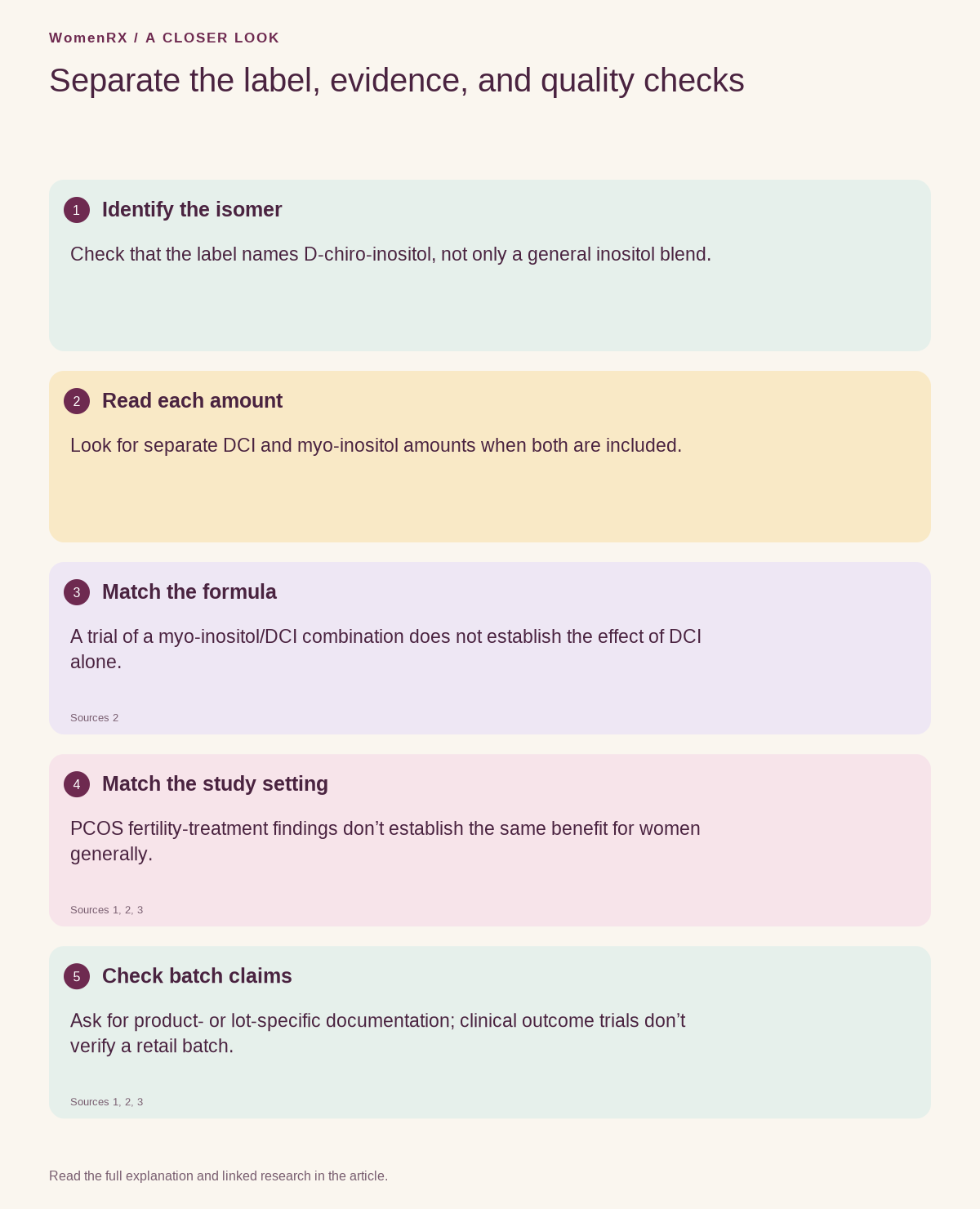
Separate the label, evidence, and quality checks
Identify the isomer: Check that the label names D-chiro-inositol, not only a general inositol blend.
Read each amount: Look for separate DCI and myo-inositol amounts when both are included.
Match the formula: A trial of a myo-inositol/DCI combination does not establish the effect of DCI alone.2
Match the study setting: PCOS fertility-treatment findings don’t establish the same benefit for women generally.123
Check batch claims: Ask for product- or lot-specific documentation; clinical outcome trials don’t verify a retail batch.123
Read the figure as text
Use these questions to distinguish product composition from study relevance and product-specific documentation.- Identify the isomer: Check that the label names D-chiro-inositol, not only a general inositol blend.
- Read each amount: Look for separate DCI and myo-inositol amounts when both are included.
- Match the formula: A trial of a myo-inositol/DCI combination does not establish the effect of DCI alone.2
- Match the study setting: PCOS fertility-treatment findings don’t establish the same benefit for women generally.123
- Check batch claims: Ask for product- or lot-specific documentation; clinical outcome trials don’t verify a retail batch.123
More questions, answered
Does research on a myo-inositol/DCI combination support a DCI-only product?
Not by itself. A randomized trial in women with PCOS undergoing IVF compared a combination with DCI alone and reported better oocyte and embryo quality and pregnancy rates with the combination. The finding concerns those treatments and that setting, not proof that DCI alone has the same effect. 2
Do PCOS fertility studies show that DCI improves fertility for all women?
No. The cited trials involved women with PCOS, and some specifically studied people undergoing IVF or ICSI. They don’t establish the same benefit for women without PCOS or for those trying to conceive outside fertility treatment. 1 2 3
Sources you can check
- Comparison of the effect of two combinations of myo-inositol and D-chiro-inositol in women with polycystic ovary syndrome undergoing ICSI: a randomized controlled trial.Mendoza N, Diaz-Ropero MP, Aragon M, Maldonado V, Llaneza P, Lorente J, Mendoza-Tesarik R, Maldonado-Lobon J, Olivares M, Fonolla J. · Gynecological endocrinology : the official journal of the International Society of Gynecological Endocrinology · 2019Return to first citation
- The combined therapy myo-inositol plus D-chiro-inositol, rather than D-chiro-inositol, is able to improve IVF outcomes: results from a randomized controlled trial.Colazingari S, Treglia M, Najjar R, Bevilacqua A. · Archives of gynecology and obstetrics · 2013Return to first citation
- Myo-inositol rather than D-chiro-inositol is able to improve oocyte quality in intracytoplasmic sperm injection cycles. A prospective, controlled, randomized trial.Unfer V, Carlomagno G, Rizzo P, Raffone E, Roseff S. · European review for medical and pharmacological sciences · 2011Return to first citation
- Comparison of Clinical, Metabolic and Hormonal Effects of Metformin Versus Combined Therapy of Metformin With Myoinositol Plus D-Chiro-Inositol in Women With Polycystic Ovary Syndrome (PCOS): A Randomized Controlled Trial.Bahadur A, Arora H, Ravi AK, Naithani M, Bahurupi Y, Chaturvedi J, Ajmani M, Mundhra R. · Cureus · 2021Return to first citation