How to Check a Peptide Product’s Safety Claims
A peptide’s name is only the starting point: the product, formulation, route, and claimed use all need to match the evidence behind a safety claim.
Start by getting the exact product name, active ingredient, formulation, route, and claimed use in writing. If it’s presented as an FDA-approved medicine, look for that product in Drugs@FDA and compare its approved labeling with what you’re being offered. Evidence for an approved medicine doesn’t automatically establish the quality or safety of a clinic-prepared or “research use only” product bearing the same ingredient name.234
First, identify what’s actually being offered
“Peptide” describes a broad class of substances, not one standard of evidence or one kind of product. An approved medicine, a compounded preparation, an investigational drug, and a vial sold as “research use only” can all appear in the same online conversation. Treating them as interchangeable is where a safety claim can become misleading.3
Ask for the name on the container and the active ingredient, then pin down the form and route. Is the offer for a manufactured pen, a vial prepared for injection, or something else? Who makes or prepares the item you would receive? These aren’t technicalities. Even within a named prescription medicine, presentations can differ: Mounjaro’s prescribing information calls for training appropriate to the specific presentation a patient receives.1 If a clinic says its vial contains tirzepatide, that statement alone does not establish that the vial is Mounjaro or that evidence for a manufactured Mounjaro presentation applies to the clinic’s preparation.14
Match the approval claim to the product and purpose
If a seller or clinic says a peptide product is “FDA approved,” ask which named product is approved and for what use. Drugs@FDA connects drug applications with approval status and FDA-approved labeling. Compare the product name, ingredient, formulation, route, and labeled use with the item and purpose being advertised.2
For example, “tirzepatide is an ingredient in an established medicine” and “this particular vial has FDA-approved labeling” are different claims. Likewise, a claim about a medicine’s approved use does not, by itself, establish evidence for a different wellness goal. A review of unregulated peptide promotion describes how the credibility of established medicines can spill over to unrelated or weakly evidenced products.3 If the names or descriptions don’t line up, ask the seller to explain the difference rather than filling in the gap yourself.
Separate a clinical result from a product-quality promise
Next, ask what evidence supports the specific benefit being promised and whether it studied the same substance, route, and kind of product. A study of a prescription medicine is not a test of a different clinic preparation. A discussion of compounded GLP-1 medicines identifies potential concerns about quality, dosing accuracy, and stability; a review of gray-market peptide use also describes uncertainty about identity, purity, contamination, and sterility.43
That distinction matters most when a claim moves quickly from “this ingredient has been studied” to “our product is safe.” The first may be a claim about research. The second is a claim about the item you’ll actually receive. Ask what supports each one. A “research use only” label is not evidence that a product has been shown safe for personal use; such products are a separate category in reviews of peptide access and may have unclear identity and quality.3
Check whether the safety information fits your life
If you’re pregnant or trying to conceive, don’t let a general “safe for women” claim stand in for information about the exact medicine. For a concrete example, Mounjaro’s prescribing information says human pregnancy data are insufficient to evaluate several pregnancy outcomes and describes potential fetal risks based on animal studies. Those statements concern Mounjaro, not every peptide, but they show why the product’s pregnancy section matters.1
If you’re breastfeeding, ask for product-specific information rather than assuming the pregnancy section answers that question. Bring up contraception and hormone-related treatments, too, so a proposed product can be assessed alongside what you already use. A clinical discussion of GLP-1-based medications, for example, flags a potential issue with absorption of oral contraceptives related to delayed gastric emptying. That is a reason to check the particular medication’s interaction information, not a claim that all peptides interfere with contraception.4
The useful end point is a clear match: this item, used this way, for this purpose, supported by information that actually applies to it. If the person offering it can provide only evidence for a different product or a broad claim about peptides, you still don’t have an answer about the product in front of you.23
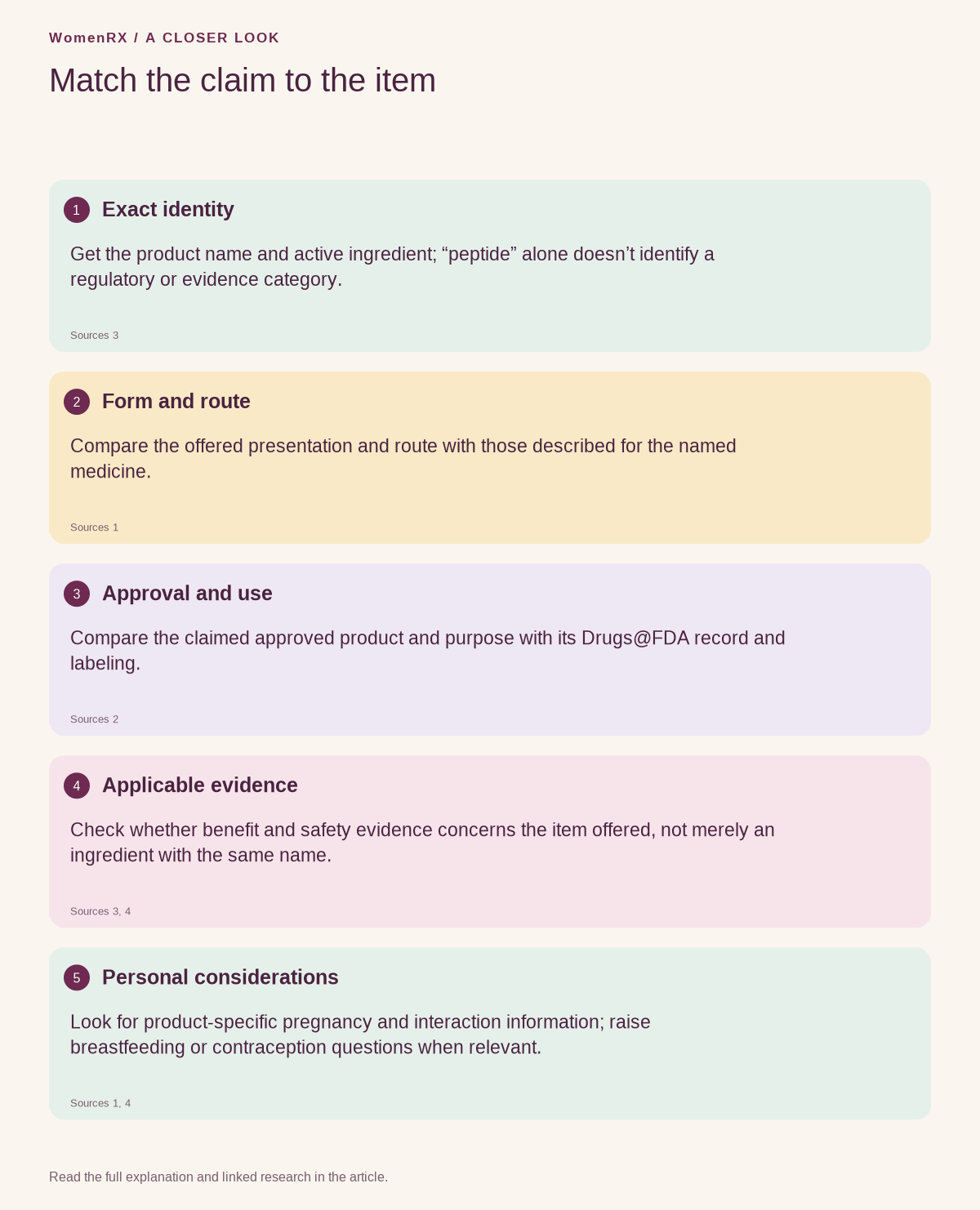
Match the claim to the item
Exact identity: Get the product name and active ingredient; “peptide” alone doesn’t identify a regulatory or evidence category.3
Form and route: Compare the offered presentation and route with those described for the named medicine.1
Approval and use: Compare the claimed approved product and purpose with its Drugs@FDA record and labeling.2
Applicable evidence: Check whether benefit and safety evidence concerns the item offered, not merely an ingredient with the same name.34
Personal considerations: Look for product-specific pregnancy and interaction information; raise breastfeeding or contraception questions when relevant.14
Read the figure as text
Use these checks to find where a safety or approval claim does, and does not, apply.- Exact identity: Get the product name and active ingredient; “peptide” alone doesn’t identify a regulatory or evidence category.3
- Form and route: Compare the offered presentation and route with those described for the named medicine.1
- Approval and use: Compare the claimed approved product and purpose with its Drugs@FDA record and labeling.2
- Applicable evidence: Check whether benefit and safety evidence concerns the item offered, not merely an ingredient with the same name.34
- Personal considerations: Look for product-specific pregnancy and interaction information; raise breastfeeding or contraception questions when relevant.14
More questions, answered
Does “research use only” tell me a peptide is safe?
No. It identifies a different context from an approved medicine; it does not establish that a product has been evaluated for your use. Reviews of gray-market peptide products describe possible uncertainty about identity, purity, and sterility.3
Sources you can check
- MOUNJARO (TIRZEPATIDE) INJECTION, SOLUTION MOUNJARO KWIKPEN (TIRZEPATIDE) INJECTION, SOLUTION [ELI LILLY AND COMPANY] | US prescribing information and patient instructionsAccessed 2026-09-25Return to first citation
- DGIdb 5.0: rebuilding the drug-gene interaction database for precision medicine and drug discovery platforms.Cannon M, Stevenson J, Stahl K, Basu R, Coffman A, Kiwala S, McMichael JF, Kuzma K, Morrissey D, Cotto K, Mardis ER, Griffith OL, Griffith M, Wagner AH. · Nucleic acids research · 2024Return to first citation
- Unregulated Peptide Use in the Age of Biohacking: Digital Promotion, Gray-Market Access, and Emerging Public Health Risks.Hailu KT, Abriha FN, Duguma YM, Haddad RR, Liyew T, Kasagga A. · Cureus · 2026Return to first citation
- Glucagon-like peptide-1 receptor agonists for obesity: Growing popularity met with growing questions over safety.Chao AM, Gilden A, Wadden TA. · PLoS medicine · 2026Return to first citation