Grey-Market Peptides: What Product Claims Can’t Tell You
A polished label or certificate of analysis can’t by itself establish what’s in a peptide product or whether it’s safe for you.
Peptides aren’t one uniform kind of product: established medicines and experimental products sold outside accountable medical and manufacturing systems have different evidence and safeguards. With a grey-market product, identity, strength, purity, sterility, storage, and clinical follow-up may be uncertain. A certificate or “research use only” label doesn’t resolve those questions. There’s no basis here to say women are categorically at greater risk. 1

Start with the product, not the word “peptide”
“Peptide” describes a broad class of molecules, not a single treatment with one safety profile. Some peptide medicines have defined uses and clinical oversight. Others are investigational or promoted for wellness without the same evidence or accountability. So a product’s risk depends on what it is, how it was made and handled, how it’s used, and whether anyone is monitoring its effects. 1
That distinction matters when someone offers a product online, through a wellness channel, or as a “research” compound. Medical-sounding language doesn’t show that the product has been reviewed as a medicine or that its claims are established. A 2026 narrative review describes online peptide use involving uncertain product identity, purity, potency, sterility, storage, and dosing, alongside self-injection and limited adverse-event monitoring. 1
What a label or certificate can’t settle
A seller may provide a certificate of analysis, purity claim, or “for research use only” disclaimer. Those details may look reassuring, but they don’t by themselves establish that the product in your hand is the one tested, that the stated strength is accurate, or that it was made and stored to standards suitable for human use. The review describes these documents appearing in markets where manufacturing oversight and traceability may be limited. 1
The concerns are practical, not abstract. If the identity or strength is uncertain, a person may not know what they’re taking. If sterility or handling is uncertain, an injectable product raises additional questions. If storage conditions are unclear, the product’s condition may be hard to assess. And if dosing, mixing, or combining products is guided by online advice rather than a clinician, there may be no reliable way to interpret an unexpected effect or report it through usual medical channels. These risks can overlap. 1
That doesn’t mean every product outside a standard medical channel is identical, or that every peptide medicine is unsafe. The useful comparison is whether a specific product has a traceable source, reliable quality controls, evidence for the intended use, and clinical oversight. The existence of legitimate peptide medicines doesn’t establish that a similarly named or marketed product has the same identity, quality, or evidence. 1
Ask questions that test the chain of responsibility
Before deciding what to do, bring the exact product information to a pharmacist or clinician, if possible: the name, seller, label, lot or batch information, and any certificate or promotional claims. Ask:
- What is this product’s exact active ingredient, and is it an approved medicine or an investigational product?
- Who made it, and can its source and batch be traced?
- What does the certificate actually test, and does it verify identity, strength, and sterility for this specific batch?
- Is there good human evidence for this exact product and the reason it’s being offered?
- Could it interact with my medicines or duplicate another treatment I use?
- Who will monitor effects, help if something goes wrong, and document or report an adverse event?
These questions don’t guarantee a product is safe. They help reveal when the answers rely on a seller’s assurances rather than verifiable quality information or a plan for clinical follow-up. If the product’s identity, source, or intended use can’t be made clear, that uncertainty is itself relevant to the decision. 1
Keep women’s risks specific, not assumed
The available discussion doesn’t establish that women as a group face greater risk from grey-market peptides. Nor does a general claim about “peptides” answer whether a particular product has been studied in a particular population. If you’re pregnant, breastfeeding, trying to conceive, or could become pregnant, ask about evidence for the specific compound and product in that life stage. Broad wellness claims or findings in other adults don’t answer that question. 1
There are product-specific distinctions, too. For example, a 2026 discussion of GLP-1 medicines describes concerns about quality, dosing accuracy, and stability with compounded alternatives, and warns that marketed patches and “microdosing” approaches lack supporting pharmacologic evidence. Those points concern GLP-1 products and should not be treated as findings about every peptide or every nonstandard product. 2
The central question isn’t whether a product is called a peptide. It’s whether you can verify what it is, how it was made and handled, what evidence supports its use, and who is accountable for monitoring it.
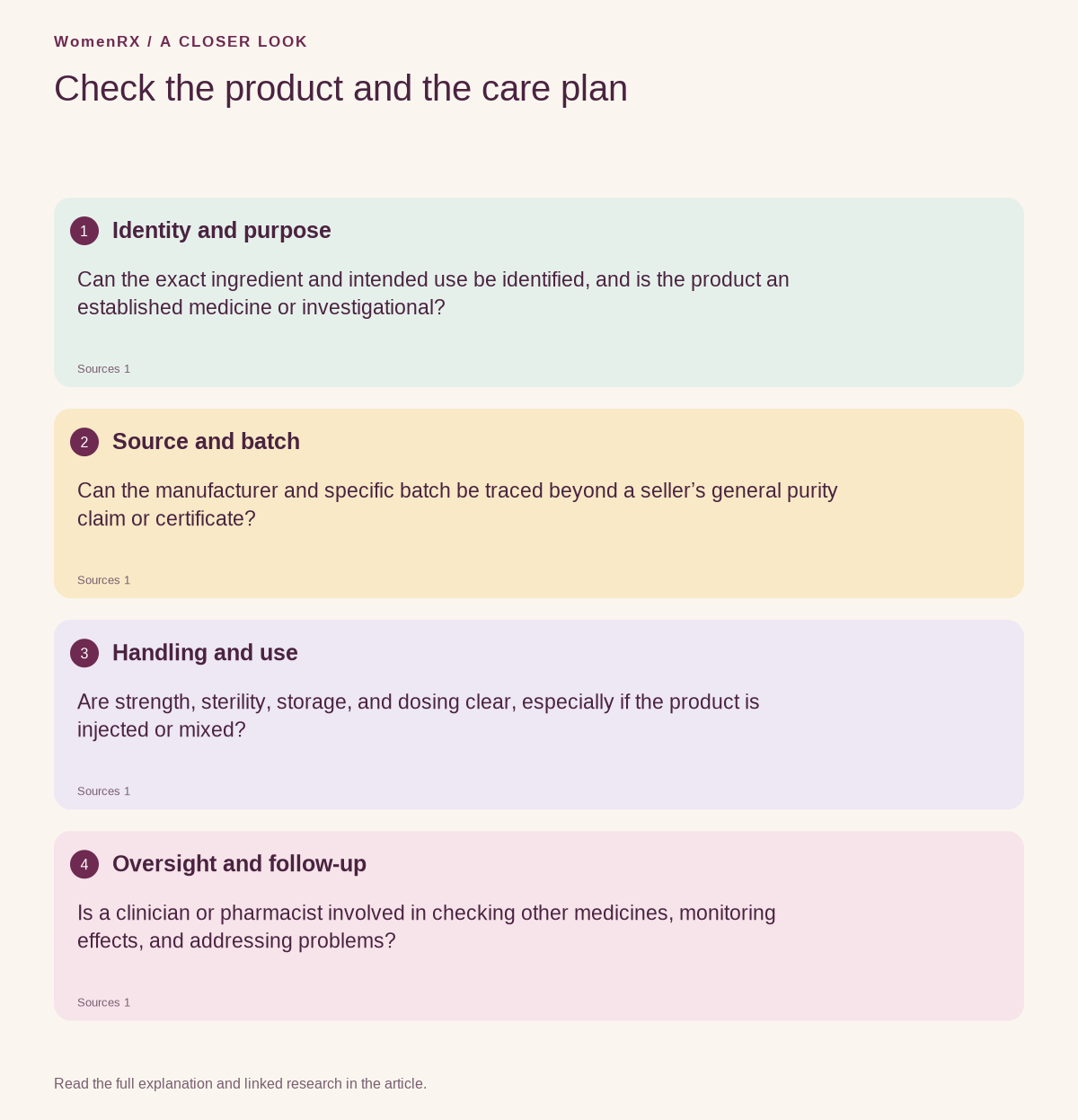
Check the product and the care plan
Identity and purpose: Can the exact ingredient and intended use be identified, and is the product an established medicine or investigational?1
Source and batch: Can the manufacturer and specific batch be traced beyond a seller’s general purity claim or certificate?1
Handling and use: Are strength, sterility, storage, and dosing clear, especially if the product is injected or mixed?1
Oversight and follow-up: Is a clinician or pharmacist involved in checking other medicines, monitoring effects, and addressing problems?1
Read the figure as text
A quick way to separate verifiable information from assurances when assessing a nonstandard peptide product.- Identity and purpose: Can the exact ingredient and intended use be identified, and is the product an established medicine or investigational?1
- Source and batch: Can the manufacturer and specific batch be traced beyond a seller’s general purity claim or certificate?1
- Handling and use: Are strength, sterility, storage, and dosing clear, especially if the product is injected or mixed?1
- Oversight and follow-up: Is a clinician or pharmacist involved in checking other medicines, monitoring effects, and addressing problems?1
More questions, answered
Does “research use only” mean a product is safer?
No. That phrase doesn’t establish the product’s identity, quality, or suitability for human use. The review describes research-use disclaimers appearing alongside consumer promotion, sometimes without the safeguards and traceability expected for approved medicines. 1
Does a certificate of analysis prove a product is safe?
Not on its own. A certificate or purity claim doesn’t necessarily confirm that the product you have matches the tested batch or establish appropriate strength, sterility, handling, or safety for your intended use. Ask what was tested and whether the result is traceable to that specific product. 1
Sources you can check
- Unregulated Peptide Use in the Age of Biohacking: Digital Promotion, Gray-Market Access, and Emerging Public Health Risks.Hailu KT, Abriha FN, Duguma YM, Haddad RR, Liyew T, Kasagga A. · Cureus · 2026Return to first citation
- Glucagon-like peptide-1 receptor agonists for obesity: Growing popularity met with growing questions over safety.Chao AM, Gilden A, Wadden TA. · PLoS medicine · 2026Return to first citation