Are Peptides Supported for Menopause Symptoms?
A peptide’s role in hot-flash biology doesn’t show that taking it will ease a menopause symptom.
Peptides aren’t established treatments for menopause symptoms. A signaling molecule linked to hot flashes, or one measured during a study, isn’t evidence that taking it helps. These studies don’t test peptide therapy; menopause guidance identifies other options with clinical support for symptoms such as hot flashes and vaginal discomfort. 1 2 4
A biological role is not a treatment result
“Peptide” alone doesn’t tell you whether a product has been tested for a particular menopause symptom. Researchers have linked signaling molecules such as kisspeptin, neurokinin B, and calcitonin gene-related peptide to hot-flash biology. That helps explain what may be happening in the body. It doesn’t show that taking one of these molecules will prevent hot flashes or night sweats. 4
To support a treatment claim, research needs to test the treatment in people and measure the symptom it’s meant to improve. A laboratory finding, a proposed mechanism, or a change in a blood marker can be a research clue, but it isn’t the same as demonstrating symptom relief.
What the evidence means for each symptom
Hot flashes and night sweats
Hot flashes involve the brain’s temperature-regulating system, and multiple chemical signals may play a role. But a role in that system doesn’t establish a peptide treatment. The North American Menopause Society identifies hormone therapy as the most effective treatment for vasomotor symptoms, which include hot flashes and night sweats. Its nonhormone guidance recommends options including cognitive behavioral therapy, clinical hypnosis, and certain prescription medicines. Which approach fits depends on your symptoms, health, and preferences. 1 2 4
Sleep problems
Orexin is a neuropeptide involved in sleep and wakefulness. In a study of women within three years of menopause, researchers measured orexin levels during and after a hormone-therapy trial. They did not give participants orexin as a treatment. Insomnia severity decreased similarly across the treatment groups, and changes in orexin did not track with changes in sleep. This study therefore doesn’t show that taking orexin helps menopause-related sleep problems. 3
Vaginal or urinary symptoms
Bothersome vaginal and urinary symptoms can be part of genitourinary syndrome of menopause. For certain women with these symptoms, the 2022 menopause position statement describes options such as low-dose vaginal estrogen, vaginal dehydroepiandrosterone, and oral ospemifene. These are specific treatments, not evidence that peptide products treat these symptoms. 1
Weight and metabolism
A study of recently menopausal women also measured body mass index alongside orexin. Women assigned to hormone therapy had smaller increases in BMI than those assigned to placebo, but changes in orexin did not correlate with changes in BMI. That result doesn’t support using orexin as a weight treatment. 3
A separate study tested an experimental estrogen-mimicking peptide in human-derived vascular smooth muscle cells. Cell research can examine how a substance acts under laboratory conditions, but this study did not test treatment outcomes in postmenopausal women. It cannot establish a benefit for menopause symptoms or weight. 5
How to assess a peptide claim
Start with the symptom, not the broad promise of “menopause support.” Ask what exact product or molecule is being discussed, whether it was tested in people at the menopausal stage relevant to you, and whether the study measured the symptom the product claims to help. Evidence about a biological pathway or a lab result answers a different question from evidence that a treatment improves hot flashes, sleep, vaginal symptoms, or weight.
For established care, options differ by symptom. Menopause guidance supports hormone therapy for vasomotor symptoms and identifies nonhormonal options as well. For bothersome genitourinary symptoms, it describes a different set of treatments. Those distinctions matter more than whether a product is marketed under the broad label “peptide.” 1 2
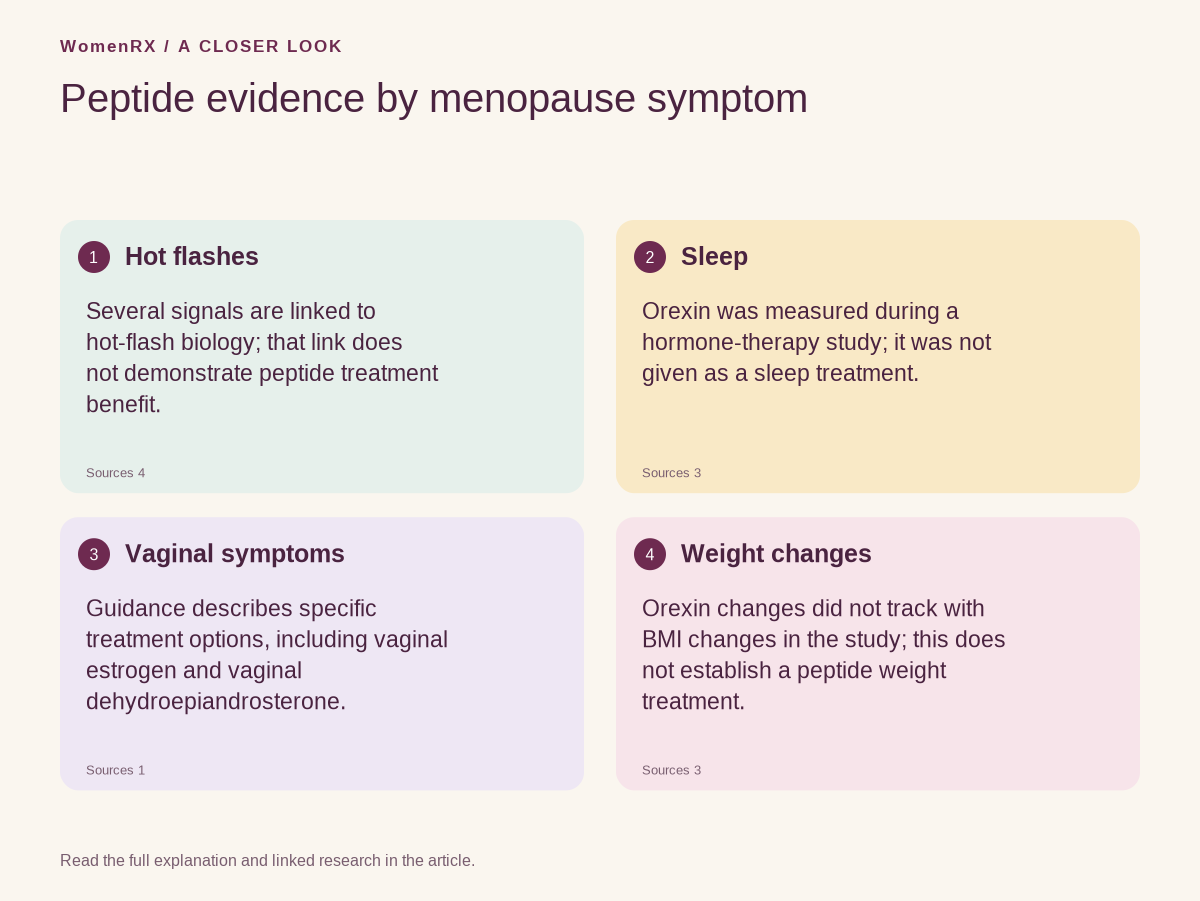
Peptide evidence by menopause symptom
Hot flashes: Several signals are linked to hot-flash biology; that link does not demonstrate peptide treatment benefit.4
Sleep: Orexin was measured during a hormone-therapy study; it was not given as a sleep treatment.3
Vaginal symptoms: Guidance describes specific treatment options, including vaginal estrogen and vaginal dehydroepiandrosterone.1
Weight changes: Orexin changes did not track with BMI changes in the study; this does not establish a peptide weight treatment.3
Read the figure as text
A mechanism or measurement is different from testing a treatment for the symptom.- Hot flashes: Several signals are linked to hot-flash biology; that link does not demonstrate peptide treatment benefit.4
- Sleep: Orexin was measured during a hormone-therapy study; it was not given as a sleep treatment.3
- Vaginal symptoms: Guidance describes specific treatment options, including vaginal estrogen and vaginal dehydroepiandrosterone.1
- Weight changes: Orexin changes did not track with BMI changes in the study; this does not establish a peptide weight treatment.3
More questions, answered
Does a peptide linked to hot flashes mean peptide therapy can stop them?
No. A link to hot-flash biology can help researchers study how symptoms arise, but it doesn’t show that taking the peptide reduces hot flashes. That benefit needs to be demonstrated by testing a treatment and measuring symptoms. 4
Sources you can check
- The 2022 hormone therapy position statement of The North American Menopause Society.“The 2022 Hormone Therapy Position Statement of The North American Menopause Society” Advisory Panel. · Menopause (New York, N.Y.) · 2022Return to first citation
- The 2023 nonhormone therapy position statement of The North American Menopause Society.Menopause (New York, N.Y.) · 2023Return to first citation
- Plasma orexin A levels in recently menopausal women during and 3 years following use of hormone therapy.Cintron D, Beckman JP, Bailey KR, Lahr BD, Jayachandran M, Miller VM. · Maturitas · 2017Return to first citation
- Menopausal Hot Flashes: A Concise Review.Bansal R, Aggarwal N. · Journal of mid-life health · 2019Return to first citation
- The effects of peptides with estrogen-like activity on cell proliferation and energy metabolism in human derived vascular smooth muscle cells.Somjen D, Knoll E, Gayer B, Kasher R, Kohen F, Stern N. · Journal of cellular biochemistry · 2010Return to first citation