Collagen Peptides and Injectable Peptides Aren’t the Same
An oral collagen supplement and an injected peptide differ in what they contain, how they enter the body, and what their evidence can tell you.
Oral collagen peptides are hydrolyzed collagen taken by mouth as a supplement; some small trials in women have tested particular products for skin measures such as hydration. “Injectable peptides” is a broad label for different substances, not one treatment. Results from an oral collagen study cannot establish that an injectable works, or that it’s safe, for the same purpose. 2 3 1

The word “peptide” doesn’t make two products equivalent
A peptide is a chain of amino acids, but that description alone doesn’t tell you what a product does. The source material, exact molecule, formulation, route into the body, and intended use all matter.
Collagen peptides sold as oral supplements are made by breaking collagen down into smaller peptides. In skin studies, researchers have tested specific hydrolyzed collagen products taken by mouth. One trial tested tuna-skin collagen peptides; another tested oral collagen peptides in Japanese women. Those findings apply to the products, participants, and skin outcomes studied, not to every product called a peptide. 2 3
“Injectable peptides,” by contrast, can refer to different therapeutic substances and approaches. A review of injectable peptides in orthopaedic and sports medicine discusses several distinct compounds, including BPC-157, TB-4, and tesamorelin. They aren’t one interchangeable ingredient or a single treatment category with one shared purpose. 1
Compare the product, not just the label
What’s in it: An oral collagen supplement supplies hydrolyzed collagen peptides from a particular source. A specific injectable contains a particular peptide or peptide combination. The word “peptide” doesn’t establish that its ingredients match collagen peptides, or that they act in the same way. 1 2
How it’s used: The collagen products in the cited skin trials were taken orally. The other review concerns injectable approaches. Because the route and product differ, a result from swallowing one formulation can’t be treated as evidence for injecting another. 1 2 3
What it’s meant to do: Some oral collagen trials measured skin characteristics. The injectable review covers proposed uses in orthopaedics and sports medicine, and describes evidence for each peptide separately. For example, it reports that tesamorelin is approved for treating HIV-associated lipodystrophy, while the review found no supporting orthopaedic evidence for it. That example shows why a medicine’s specific indication matters: evidence for one use does not establish a different one. 1
What the studies can show: A controlled human trial of an oral supplement can provide evidence about that product and the outcomes measured. It doesn’t automatically answer questions about another molecule, another route, or another intended use. Likewise, an injectable’s biological rationale or animal results aren’t proof that it improves an outcome in people. The injectable review says evidence for some widely discussed orthopaedic peptide approaches is largely preclinical or limited, and identifies gaps in human evidence. 1
What skin studies in women actually tested
There is human trial evidence for some oral collagen products and measured skin outcomes in women, but it is product-specific. In one double-blind, placebo-controlled trial, 72 healthy women aged 40-60 took tuna collagen peptides or placebo for eight weeks. At eight weeks, the groups differed significantly on the measured skin parameters except facial transepidermal water loss. The study measured hydration, elasticity, density, and water loss; it did not test an injectable peptide. 2
Another placebo-controlled trial enrolled 99 healthy Japanese women aged 35-50 and tested oral collagen peptides for 12 weeks. The researchers reported increased skin water content and natural moisturizing factor, and reduced transepidermal water loss; elasticity and skin thickness did not change. That mix of results is a useful reminder that “skin benefits” isn’t one single outcome. 3
These trials don’t show that every collagen supplement produces the same effects, or that the results apply to injectable peptides. They also don’t establish how meaningful the measured changes are for every person’s visible skin concerns. The findings are specific to the studied women, formulations, time periods, and measurements. 2 3
A practical way to assess a claim
When a product is described as a peptide, look for the exact substance and ask what route was studied. Then check whether the human research tested that same formulation for the same intended use. For example, an oral collagen trial measuring hydration is not direct evidence for an injectable promoted for tissue repair. The question isn’t simply whether both products contain peptides; it’s whether there is relevant human evidence for that specific product and claim. 1 2 3
Be especially cautious when a claim jumps from a lab or animal finding to a promised human benefit. The orthopaedic review describes potential findings for some injectable peptides in preclinical models, while noting limited or absent human evidence for several proposed uses. That gap matters: promising early research and demonstrated benefit in people are not the same thing. 1
So, if your question is whether oral collagen research supports an injectable peptide, the answer is no. It supports only a narrower conclusion: certain oral collagen formulations have been studied for particular skin measures, including in women. An injectable needs its own evidence for its exact substance, route, purpose, and population.
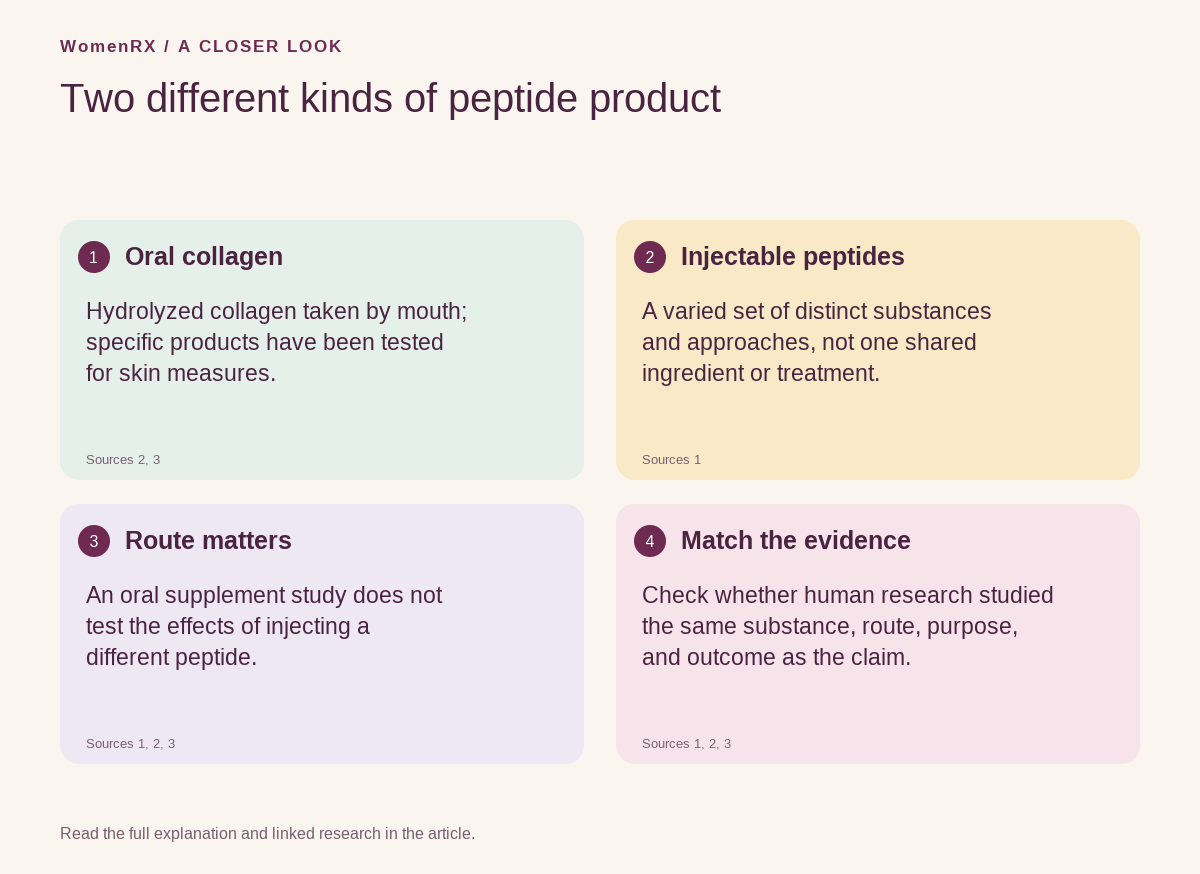
Two different kinds of peptide product
Oral collagen: Hydrolyzed collagen taken by mouth; specific products have been tested for skin measures.23
Injectable peptides: A varied set of distinct substances and approaches, not one shared ingredient or treatment.1
Route matters: An oral supplement study does not test the effects of injecting a different peptide.123
Match the evidence: Check whether human research studied the same substance, route, purpose, and outcome as the claim.123
Read the figure as text
Compare the product and the evidence behind its specific claim, rather than treating the shared word “peptide” as proof of equivalence.- Oral collagen: Hydrolyzed collagen taken by mouth; specific products have been tested for skin measures.23
- Injectable peptides: A varied set of distinct substances and approaches, not one shared ingredient or treatment.1
- Route matters: An oral supplement study does not test the effects of injecting a different peptide.123
- Match the evidence: Check whether human research studied the same substance, route, purpose, and outcome as the claim.123
More questions, answered
Does “peptide” mean an injectable contains collagen?
No. “Peptide” describes a broad class of amino-acid chains, not a shared ingredient or effect. Oral collagen products and injectable peptide approaches can involve different substances and purposes. 1 2
Do collagen skin studies in women prove the same result for all women?
No. The cited trials studied particular oral products in specific groups of women and measured particular skin outcomes. They don’t establish that every product or every woman will have the same result. 2 3
Sources you can check
- Injectable Peptide Therapy: A Primer for Orthopaedic and Sports Medicine Physicians.Mayfield CK, Bolia IK, Feingold CL, Lin EH, Liu JN, Rick Hatch GF, Gamradt SC, Weber AE. · The American journal of sports medicine · 2026Return to first citation
- The evidence from in vitro primary fibroblasts and a randomized, double-blind, placebo-controlled clinical trial of tuna collagen peptides intake on skin health.Morakul B, Teeranachaideekul V, Wongrakpanich A, Leanpolchareanchai J. · Journal of cosmetic dermatology · 2024Return to first citation
- Oral Supplementation of Collagen Peptides Improves Skin Hydration by Increasing the Natural Moisturizing Factor Content in the Stratum Corneum: A Randomized, Double-Blind, Placebo-Controlled Clinical Trial.Miyanaga M, Uchiyama T, Motoyama A, Ochiai N, Ueda O, Ogo M. · Skin pharmacology and physiology · 2021Return to first citation