What to Check on a Collagen Supplement Label
Start with the animal source and the full ingredient list, because collagen products and the formulas studied in research aren’t interchangeable.
Check what the collagen comes from, then read the entire ingredient list for added nutrients or other active ingredients. “Hydrolyzed” and “peptides” describe processed collagen, not its animal source. Research has tested specific formulas, sometimes with added ingredients, and small studies reporting few side effects can’t establish that every product is safe or effective. Pregnancy and breastfeeding weren’t covered by some trials.
Start with the source
“Collagen peptides” or “hydrolyzed collagen” tells you about the form of the collagen, not which animal it came from. Hydrolyzed collagen is made by processing collagen from animal tissue. In studies, products have included bovine collagen and collagen from shark cartilage, so don’t assume two products are equivalent just because both say “collagen peptides.” Look for a named source on the label. If it isn’t clear, ask the manufacturer or a pharmacist before buying. 1 4
The source matters if you avoid particular animal ingredients or have a known allergy. Check the product’s own label rather than relying on the word “collagen” alone. If the source or another ingredient is unclear, get it clarified before trying the product.
Read beyond the collagen
Some products combine collagen with other ingredients. One small skin study, for example, tested a formula containing collagen peptides along with acerola extract, vitamin C, zinc, vitamin E, and biotin. A knee-pain trial tested a different product containing bovine collagen and vitamin C. 2 4
That matters for both safety and interpretation: if you experience a side effect, the study may not tell you which ingredient caused it. Compare the full ingredient list with supplements you already take, including added vitamins and minerals. If you take medicines or have a health condition, a pharmacist or clinician can help check the complete formula rather than just the collagen ingredient.
What side-effect studies can and can’t tell you
A 12-week study of 20 adults, 18 of them women, reported a few gastrointestinal complications while testing one oral collagen product. Another pilot study followed nine women taking a collagen-containing, multi-ingredient formula for 12 weeks and recorded no adverse events. These small studies offer limited information about those particular products and participants; they don’t establish how often side effects occur with collagen supplements generally. 2 3
A larger randomized knee-osteoarthritis study tested a specific bovine collagen-and-vitamin-C product for six months in 120 adults, half of them women, and reported no adverse effects. But its findings apply to that product and study population, not automatically to other collagen sources or formulas. 4
Treat benefit claims as product-specific
A study of a formula that includes collagen doesn’t show that collagen alone produced the outcome. For instance, the skin pilot tested a combination of ingredients and had no comparison group; the knee study also tested collagen with vitamin C. Neither establishes that a different product will produce the same result. 2 4
Look for the exact product and outcome behind a claim. Skin measurements in a small study, for example, aren’t proof of a broad beauty benefit, and a joint study doesn’t establish a skin benefit. The label may tell you what’s in the container, but it can’t make research on a different formula apply to it.
Pregnancy and breastfeeding need a closer check
Some collagen research has excluded pregnant and nursing participants. A trial of a multi-ingredient knee supplement, for example, excluded pregnant women and nursing mothers. That means its safety findings don’t answer whether the product is safe during pregnancy or breastfeeding. 1
If you’re pregnant or breastfeeding, show your clinician or pharmacist the exact product label before adding it. Ask about the collagen source and every added ingredient, not just the headline ingredient. This is especially useful when the product combines collagen with several vitamins, minerals, or extracts.
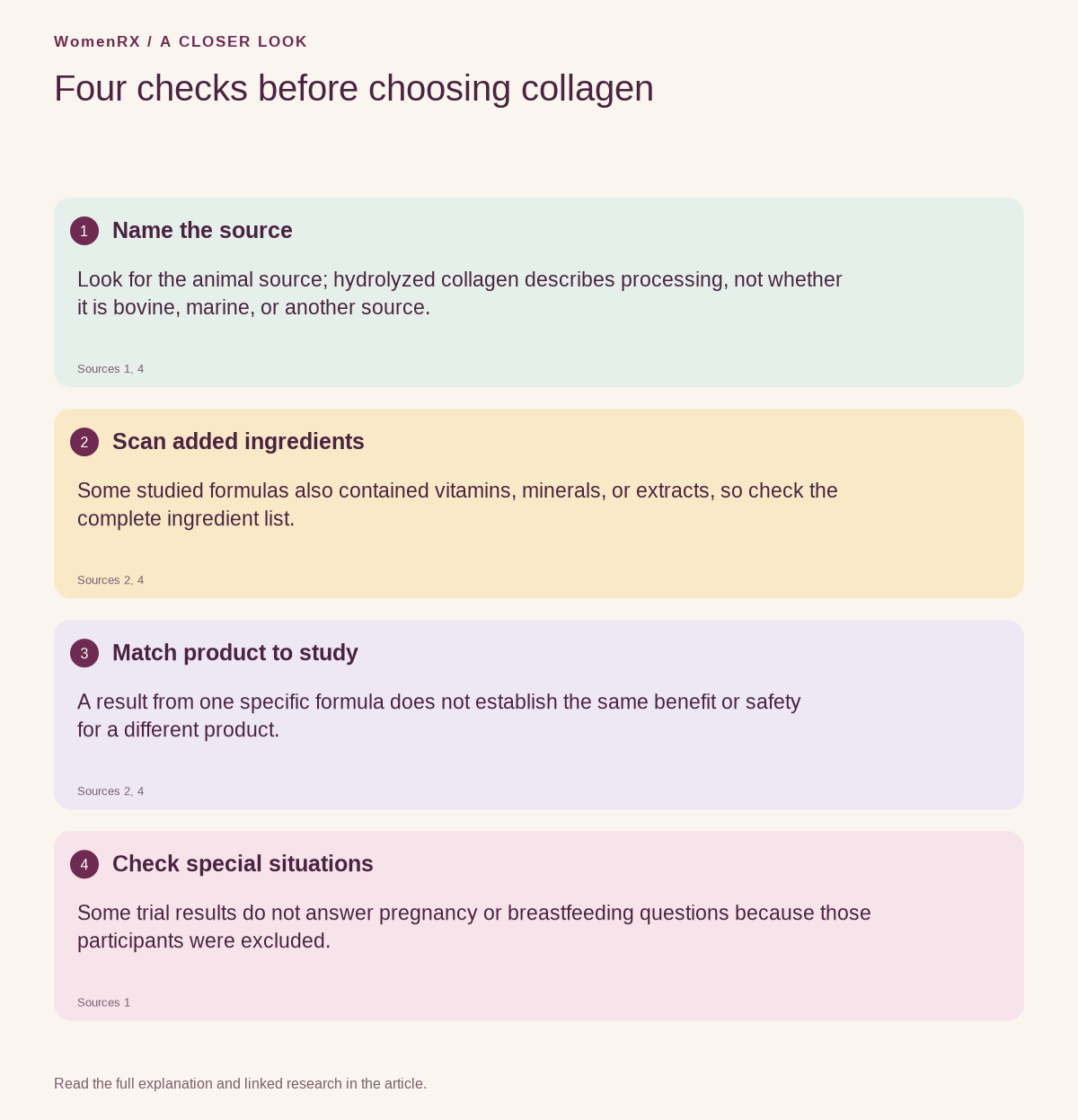
Four checks before choosing collagen
Name the source: Look for the animal source; hydrolyzed collagen describes processing, not whether it is bovine, marine, or another source.14
Scan added ingredients: Some studied formulas also contained vitamins, minerals, or extracts, so check the complete ingredient list.24
Match product to study: A result from one specific formula does not establish the same benefit or safety for a different product.24
Check special situations: Some trial results do not answer pregnancy or breastfeeding questions because those participants were excluded.1
Read the figure as text
Use the full label to distinguish the collagen source from the rest of the formula, then consider what the research does and doesn’t cover.- Name the source: Look for the animal source; hydrolyzed collagen describes processing, not whether it is bovine, marine, or another source.14
- Scan added ingredients: Some studied formulas also contained vitamins, minerals, or extracts, so check the complete ingredient list.24
- Match product to study: A result from one specific formula does not establish the same benefit or safety for a different product.24
- Check special situations: Some trial results do not answer pregnancy or breastfeeding questions because those participants were excluded.1
More questions, answered
Does “hydrolyzed” mean the collagen is from fish?
No. “Hydrolyzed” describes processed collagen, not its animal source. Check the label for the source; studies have tested products from different animal sources. 1 4
Can a small study showing no side effects prove a product is safe?
No. A small study can report what happened among its participants, but it can’t establish how often side effects occur more broadly or whether the result applies to other formulas. 2 3
Sources you can check
- Glucosamine-containing supplement improves locomotor functions in subjects with knee pain: a randomized, double-blind, placebo-controlled study.Kanzaki N, Ono Y, Shibata H, Moritani T. · Clinical interventions in aging · 2015Return to first citation
- Restoration of the Ultrastructural Integrity of the Dermal Collagen Network by 12-Week Ingestion of Special Collagen Peptides.Dähnhardt D, Dähnhardt-Pfeiffer S, Segger D, Poeggeler B, Lemmnitz G. · Dermatology and therapy · 2024Return to first citation
- Tolerability and efficacy assessment of an oral collagen supplement for the improvement of biophysical and ultrasonographic parameters of skin in middle eastern consumers.Samadi A, Movaffaghi M, Kazemi F, Yazdanparast T, Ahmad Nasrollahi S, Firooz A. · Journal of cosmetic dermatology · 2023Return to first citation
- Oral administration of hydrolyzed collagen alleviates pain and enhances functionality in knee osteoarthritis: Results from a randomized, double-blind, placebo-controlled study.Carrillo-Norte JA, Gervasini-Rodríguez G, Santiago-Triviño MÁ, García-López V, Guerrero-Bonmatty R. · Contemporary clinical trials communications · 2025Return to first citation