Taking Collagen for Months? What the Research Can Tell You
A collagen study can answer a narrow question about a particular preparation, but it may not answer whether your blend is useful or safe to take for years.
Collagen has been studied for specific outcomes, but those findings don’t establish the long-term safety of every collagen product. A knee osteoarthritis review found some benefits from collagen, while a broader osteoarthritis review found short-term pain effects for collagen hydrolysate. Neither finding is a years-long safety guarantee. Check your product’s collagen source, added ingredients, and whether research matches your reason for taking it. 1 2 4
First, match the research to your reason for taking it
If you’ve taken collagen for months, the useful question is more specific than “Does collagen work?” What preparation was studied, for which outcome, in whom, and for how long? Those details matter when a tub of collagen peptides and a skin, hair, and nail blend can have very different ingredient lists. 1 4
A 2025 review included five collagen studies in people with knee osteoarthritis and found benefits on some outcomes. Across all supplements in that review, interventions lasted from four weeks to 36 months. That range does not tell us that collagen itself was studied for 36 months. The authors called for better trials to assess long-term efficacy. 1
A separate 2018 review covered supplements for hand, hip, or knee osteoarthritis. It found collagen hydrolysate among those with large short-term effects on pain. Across the supplements reviewed, none showed a clinically important effect on pain at long-term follow-up. That finding concerns lasting symptom benefit, not whether continued collagen use causes harm. 2
Skin and hair claims involve different evidence. A review of hydrolyzed marine collagen discussed skin research but identified long-term safety as a need for future study. In a hair study, people with telogen effluvium took a product containing collagen, vitamins, and zinc for one month. Because the ingredients were combined, the study cannot isolate collagen’s effect; a month of use also cannot answer a years-long safety question. 5 6
What do the safety reports actually cover?
In the 2025 knee osteoarthritis review, seven studies across all the supplements reported adverse events, including one collagen study. The reported events were mild and resolved with management. That is useful to know, but sparse adverse-event reporting cannot establish the safety of years of use or of a different formula. 1
More women than men participated in the knee osteoarthritis studies overall. That does not, by itself, establish collagen’s effects specifically after menopause. Nor do studies in adults with osteoarthritis or telogen effluvium establish whether a collagen product is safe during pregnancy or breastfeeding, particularly when it contains other active ingredients. 1 4 6
Read the label as a list of separate questions
What is the collagen source and preparation? Look for the stated source, such as fish, and whether the product calls itself hydrolyzed collagen or collagen peptides. These details help you compare it with a studied preparation; a shared word on two labels does not make the products interchangeable. In one marine-collagen investigation, only four of 65 brands examined identified the source species on the label. 2 3
What else is in it? Read the entire Supplement Facts panel, not just the front of the package. A retail survey of skin, hair, and nail supplements found products containing vitamins, minerals, botanicals, and animal-derived ingredients, including collagen. Added ingredients can raise their own safety or interaction questions. For example, a collagen-and-vitamin blend should not be judged solely by findings from a study of a different collagen preparation. If you take medication, check the specific added ingredients rather than assuming the collagen name settles the interaction question; these studies do not establish a particular collagen-medicine interaction. 4 7
What does a quality claim cover? Researchers measured metals and metalloids in selected fish- and jellyfish-derived collagen products and found variation between brands. None of the tested samples exceeded the European Union limits assessed, and estimated daily intakes were below the tolerable intakes used in that analysis. That is a finding about those samples and that assessment, not a guarantee about every product or future batch. 3
The bottom line for continued use is a comparison, not a blanket yes or no: does research on the preparation and outcome you care about resemble the product in your hand, including everything added to it? If it doesn’t, a reassuring result for another collagen product can only take you so far. 1 2 4
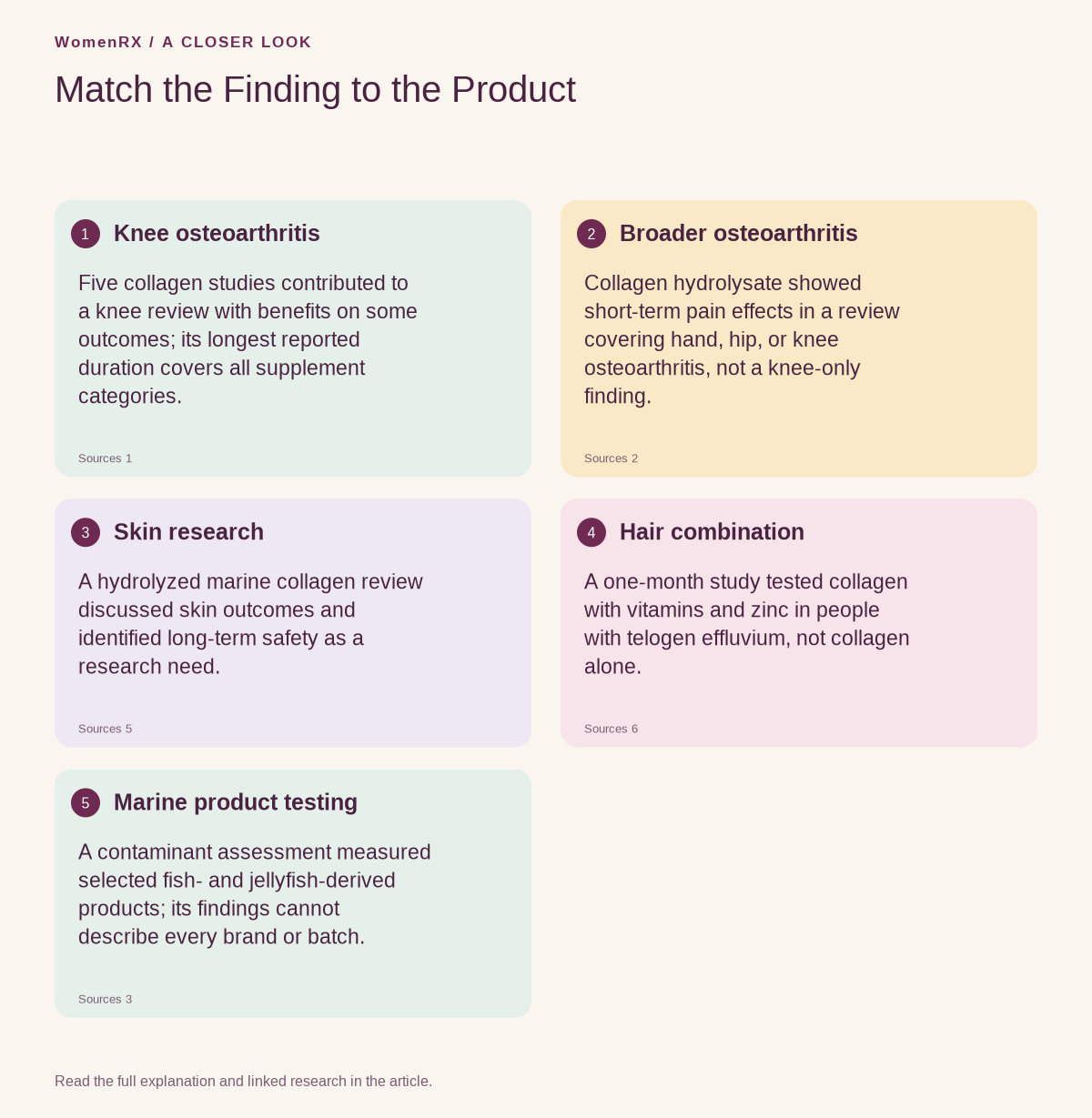
Match the Finding to the Product
Knee osteoarthritis: Five collagen studies contributed to a knee review with benefits on some outcomes; its longest reported duration covers all supplement categories.1
Broader osteoarthritis: Collagen hydrolysate showed short-term pain effects in a review covering hand, hip, or knee osteoarthritis, not a knee-only finding.2
Skin research: A hydrolyzed marine collagen review discussed skin outcomes and identified long-term safety as a research need.5
Hair combination: A one-month study tested collagen with vitamins and zinc in people with telogen effluvium, not collagen alone.6
Marine product testing: A contaminant assessment measured selected fish- and jellyfish-derived products; its findings cannot describe every brand or batch.3
Read the figure as text
These studies answer different questions, so their findings are not interchangeable.- Knee osteoarthritis: Five collagen studies contributed to a knee review with benefits on some outcomes; its longest reported duration covers all supplement categories.1
- Broader osteoarthritis: Collagen hydrolysate showed short-term pain effects in a review covering hand, hip, or knee osteoarthritis, not a knee-only finding.2
- Skin research: A hydrolyzed marine collagen review discussed skin outcomes and identified long-term safety as a research need.5
- Hair combination: A one-month study tested collagen with vitamins and zinc in people with telogen effluvium, not collagen alone.6
- Marine product testing: A contaminant assessment measured selected fish- and jellyfish-derived products; its findings cannot describe every brand or batch.3
Sources you can check
- Comparative Effectiveness of Nutritional Supplements in the Treatment of Knee Osteoarthritis: A Network Meta-Analysis.Zhang Y, Gui Y, Adams R, Farragher J, Itsiopoulos C, Bow K, Cai M, Han J. · Nutrients · 2025Return to first citation
- Dietary supplements for treating osteoarthritis: a systematic review and meta-analysis.Liu X, Machado GC, Eyles JP, Ravi V, Hunter DJ. · British journal of sports medicine · 2018Return to first citation
- Toxic metals and metalloids in collagen supplements of fish and jellyfish origin: Risk assessment for daily intake.Cammilleri G, Tortorici M, Pantano L, Galluzzo FG, Pulvirenti A, Buscemi MD, Lo Dico GM, Macaluso A, Calabrese V, Jacob UM, Ferrantelli V. · Open medicine (Warsaw, Poland) · 2025Return to first citation
- Safety Concerns of Skin, Hair and Nail Supplements in Retail Stores.Perez-Sanchez AC, Burns EK, Perez VM, Tantry EK, Prabhu S, Katta R. · Cureus · 2020Return to first citation
- Hydrolyzed Marine Collagen: Emerging Evidence of Benefits via the Oral Route - Review and Insights for Medical Aesthetics Practitioners.Bartoletti E, Cavallini M, Klinger MEA, Lim TS, Llorca Pérez VM, Raichi M. · Clinical, cosmetic and investigational dermatology · 2025Return to first citation
- Effect of a Hydrolyzed Collagen, Vitamin, and Zinc Containing Nutritional Supplement on Telogen Effluvium.Arias EM, Manzanares S, Floriach N, Sarró E, Bravo E, Querol I. · International journal of trichology · 2025Return to first citation
- Risks of Skin, Hair, and Nail Supplements.Burns EK, Perez-Sanchez A, Katta R. · Dermatology practical & conceptual · 2020Return to first citation