Collagen Before Breakfast: Does Timing Matter?
A fasting study measured collagen-related compounds in blood, but it didn’t test whether taking collagen before food improves absorption or results.
You don’t need to take collagen before breakfast based on this human study. It compared collagen dissolved in coffee with collagen in water, with both taken while participants were fasting. It didn’t compare fasting with taking collagen alongside a meal, so it can’t tell us whether breakfast changes absorption or long-term results. 1
What the fasting study measured
In a randomized crossover study, healthy volunteers took a single dose of bovine collagen hydrolysate dissolved in water or coffee while fasting. Researchers measured collagen-related amino acids and peptides in the blood over six hours. This design can compare the two drinks under fasting conditions; it can’t show whether fasting itself makes a difference. 1
Some free amino-acid measures changed over time depending on whether collagen was dissolved in coffee or water. For the measured bioactive peptides, the study reported similar absorption measures between the two drinks. Neither result answers the breakfast question: there was no meal condition to compare. 1
Blood levels after a dose are also not the same as a lasting change in skin, joints, or another outcome. A short-term absorption measure can’t establish that a particular time of day improves results.
Clinical results don’t settle meal timing
A separate randomized, placebo-controlled trial included 77 healthy women and reported improvements in some skin measures after 12 weeks of collagen peptides. The trial studied a supplement over time, not whether participants took it with food or on an empty stomach. It therefore can’t show that fasting is needed for those results. 2
The trial excluded people who were pregnant or breastfeeding, as well as those planning pregnancy. Its findings don’t answer questions about collagen timing or outcomes in those stages. The reported results also don’t break outcomes down by menopausal stage, so they don’t establish whether the findings apply differently before, during, or after menopause. 2
Choose a time that fits your routine
If you like taking collagen before breakfast, the fasting study shows that collagen-related compounds were measurable in blood after a fasting dose. If you prefer taking it with breakfast, that study doesn’t show that a meal would prevent absorption or reduce results. It simply didn’t test that comparison, so neither approach has been established as better.
For flavored powders or blends, check the directions for the full product rather than assuming a study of collagen alone applies to every added ingredient. The useful distinction is simple: this research measured absorption in one fasting drink comparison and skin outcomes in a separate trial. Neither tested whether taking collagen on an empty stomach improves results.
What collagen timing studies tested
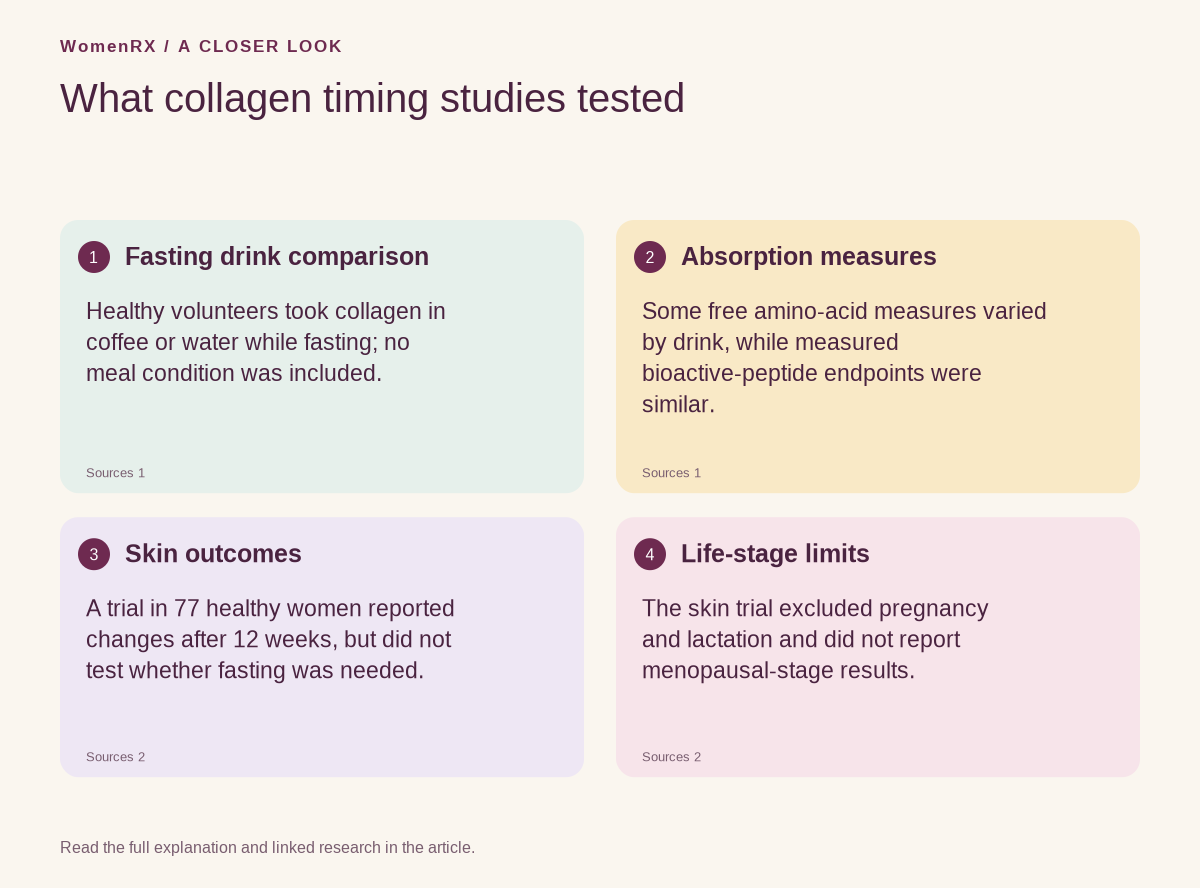
Fasting drink comparison: Healthy volunteers took collagen in coffee or water while fasting; no meal condition was included.1
Absorption measures: Some free amino-acid measures varied by drink, while measured bioactive-peptide endpoints were similar.1
Skin outcomes: A trial in 77 healthy women reported changes after 12 weeks, but did not test whether fasting was needed.2
Life-stage limits: The skin trial excluded pregnancy and lactation and did not report menopausal-stage results.2
Read the figure as text
These studies answer different questions: one measured short-term absorption, while another measured skin outcomes over time.- Fasting drink comparison: Healthy volunteers took collagen in coffee or water while fasting; no meal condition was included.1
- Absorption measures: Some free amino-acid measures varied by drink, while measured bioactive-peptide endpoints were similar.1
- Skin outcomes: A trial in 77 healthy women reported changes after 12 weeks, but did not test whether fasting was needed.2
- Life-stage limits: The skin trial excluded pregnancy and lactation and did not report menopausal-stage results.2
More questions, answered
Does coffee stop collagen from being absorbed?
In a fasting comparison, measured bioactive-peptide absorption endpoints were similar when collagen was mixed with coffee or water, though some free amino-acid measures varied. The study doesn’t establish what happens when either drink is taken with a meal. 1
Does collagen timing differ during pregnancy or menopause?
The skin trial excluded pregnancy and breastfeeding and didn’t report results by menopausal stage. It therefore can’t answer whether timing or outcomes differ in those life stages. 2
Sources you can check
- Unravelling the bioavailability of amino acids and bioactive peptides from collagen hydrolysate in coffee in healthy volunteers.Virgilio N, Schoen C, van der Steen B, Kleinnijenhuis AJ, van Holthoon FL, Vleminckx S, Silva CIF, Prawitt J. · Food research international (Ottawa, Ont.) · 2025Return to first citation
- The Sustained Effects of Bioactive Collagen Peptides on Skin Health: A Randomized, Double-Blind, Placebo-Controlled Clinical Study.Wang Y, Zhu W, Luo W, Ma Y, Zhou Y. · Journal of cosmetic dermatology · 2025Return to first citation