When to Take Collagen: Does Timing Matter?
Collagen studies have tested daily use around exercise, but they haven’t shown that morning, bedtime, or pre-workout timing is best.
The exercise studies described here don’t establish that collagen works better in the morning, at bedtime, with meals, or before exercise. Some used daily collagen on training and rest days, sometimes split around workouts, but didn’t compare that schedule with another timing strategy. Overall protein intake is a separate question: athletic guidance addresses daily protein, not a collagen-specific dose or timing rule. 123
What the exercise studies actually tested
Some collagen research is described as “pre-workout” or “post-workout,” but that doesn’t necessarily mean researchers tested whether timing changes the result. In two reports from a 12-week trial, 55 mostly sedentary men took a specific collagen-peptide product or placebo while doing concurrent training three times a week. On training days, participants split their daily supplement between one hour before and immediately after exercise. On rest days, they took the full amount at the same time as on exercise days. The studies compared collagen with placebo, not one collagen schedule with another. 23
One report found differences favoring collagen in certain recovery measures after a muscle-damaging exercise test, including how quickly some strength and jump measures recovered. Another reported lower increases in some blood markers related to muscle stress. Those findings concern the supplement taken over weeks alongside training. They don’t show that taking collagen immediately before or after a workout caused the differences, or that the same results apply to women. 23
A separate trial in recreationally active men gave collagen immediately after a single resistance-training session and examined muscle gene activity over the following day. That design can help researchers study biological responses, but it didn’t compare morning with evening, pre-workout with post-workout, or collagen with meals versus without meals. Gene activity is also not the same as proving a lasting improvement in strength or muscle. 5
A daily schedule isn’t a timing comparison
A study in 20 healthy middle-aged men had participants take collagen in the morning and evening during each 33-day study period. On the day of the exercise test, one serving was taken an hour before exercise. The study compared collagen with placebo, not morning-only with evening-only or pre-exercise with post-exercise. So it can’t tell you which time of day is best. 4
The practical distinction is simple: a study can use a schedule without proving that schedule is optimal. To answer the timing question directly, researchers would need to compare different schedules while keeping the collagen, exercise, and other conditions similar. These studies don’t do that.
What about bedtime, meals, and women?
The available exercise studies don’t establish a bedtime advantage or show that collagen must be taken with or away from food. A study that includes a meal as part of its test procedure isn’t, by itself, evidence that taking collagen with meals improves the outcome. 3
The exercise studies that used specified supplement schedules described here enrolled men, including the study of middle-aged adults. They don’t report results for women or comparisons by menstrual status or menopause. That leaves a real limit on applying their specific findings to women; it doesn’t establish that women would respond differently. 2345
Keep timing in perspective
If you’re considering collagen for exercise, the best-supported takeaway about timing is modest: for the exercise outcomes studied here, no “right” hour has been demonstrated. Choose a time you can stick with if you decide to use it, rather than treating a narrow pre- or post-workout window as proven. The 12-week studies tested daily collagen alongside training, while the single-session study measured muscle gene activity after a post-exercise serving. Neither design tested collagen as a substitute for a sound overall eating pattern. Daily protein guidance for athletes addresses total protein intake, a broader question than whether to take collagen at a particular hour. It doesn’t establish a collagen-specific dose or timing rule. 1235
For example, someone who already has a convenient morning routine could use that routine for consistency. Someone who prefers taking supplements with dinner could do that instead. Neither example is a proven superior strategy. The useful question is not “Which hour is optimal?” but “Does this schedule fit my day, and am I keeping the rest of my nutrition and training in view?”
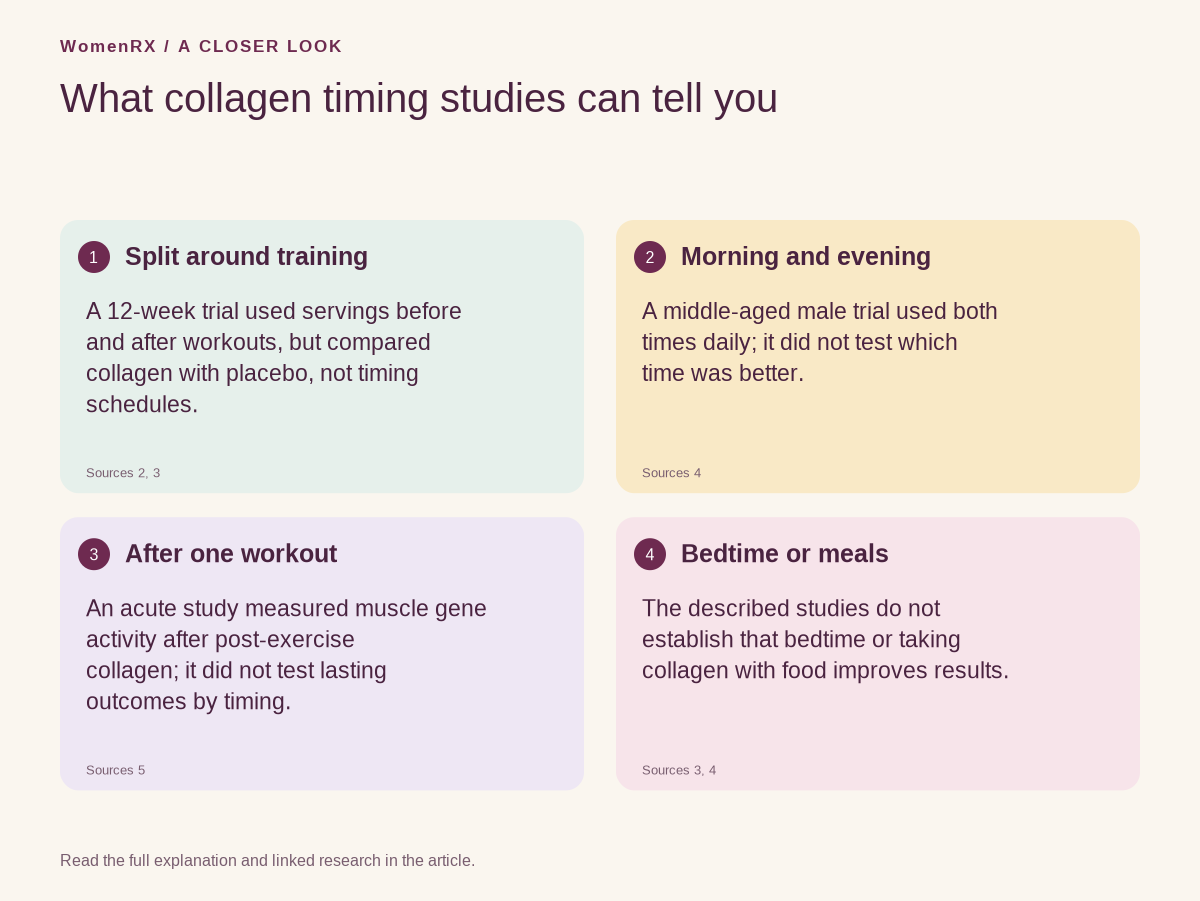
What collagen timing studies can tell you
Split around training: A 12-week trial used servings before and after workouts, but compared collagen with placebo, not timing schedules.23
Morning and evening: A middle-aged male trial used both times daily; it did not test which time was better.4
After one workout: An acute study measured muscle gene activity after post-exercise collagen; it did not test lasting outcomes by timing.5
Bedtime or meals: The described studies do not establish that bedtime or taking collagen with food improves results.34
Read the figure as text
A study schedule shows when participants took collagen; only a direct comparison can show whether that timing is better.- Split around training: A 12-week trial used servings before and after workouts, but compared collagen with placebo, not timing schedules.23
- Morning and evening: A middle-aged male trial used both times daily; it did not test which time was better.4
- After one workout: An acute study measured muscle gene activity after post-exercise collagen; it did not test lasting outcomes by timing.5
- Bedtime or meals: The described studies do not establish that bedtime or taking collagen with food improves results.34
More questions, answered
Should I take collagen before or after a workout?
Studies have used both pre- and post-exercise servings as part of a daily schedule, but they haven’t shown that one timing is better than the other. 235
Is bedtime the best time to take collagen?
The exercise studies described here don’t compare bedtime with morning or other schedules, so they can’t establish a bedtime benefit.
Sources you can check
- Dietary Supplements for Exercise and Athletic Performance - Health Professional Fact SheetAccessed 2026-09-25Return to first citation
- Reduction in systemic muscle stress markers after exercise-induced muscle damage following concurrent training and supplementation with specific collagen peptides - a randomized controlled trial.Bischof K, Stafilidis S, Bundschuh L, Oesser S, Baca A, König D. · Frontiers in nutrition · 2024Return to first citation
- Influence of specific collagen peptides and 12-week concurrent training on recovery-related biomechanical characteristics following exercise-induced muscle damage-A randomized controlled trial.Bischof K, Stafilidis S, Bundschuh L, Oesser S, Baca A, König D. · Frontiers in nutrition · 2023Return to first citation
- Dietary collagen peptides alleviate exercise-induced muscle soreness in healthy middle-aged males: a randomized double-blinded crossover clinical trial.Kuwaba K, Kusubata M, Taga Y, Igarashi H, Nakazato K, Mizuno K. · Journal of the International Society of Sports Nutrition · 2023Return to first citation
- Supplementation of Specific Collagen Peptides Following High-Load Resistance Exercise Upregulates Gene Expression in Pathways Involved in Skeletal Muscle Signal Transduction.Centner C, Jerger S, Mallard A, Herrmann A, Varfolomeeva E, Gollhofer S, Oesser S, Sticht C, Gretz N, Aagaard P, Nielsen JL, Frandsen U, Suetta C, Gollhofer A, König D. · Frontiers in physiology · 2022Return to first citation