When to Take Taurine: Does Timing Change the Results?
Human studies haven’t established a best time to take taurine, and results from combination supplements can’t show that taurine itself was responsible.
There’s no established best time of day to take taurine. Human trials have tested particular supplement plans for outcomes such as exercise performance and fatigue, but they haven’t compared morning, evening, or pre-workout timing. One football trial scheduled a combination supplement 60 minutes before training; that protocol doesn’t prove taurine alone works best then. 5 7 8
A study schedule isn’t a timing recommendation
If you’re choosing between taking taurine in the morning, before a workout, or at another time, the human trials described here don’t identify a winner. They tested specific schedules for specific outcomes, not different times of day against one another. A dose given before training tells you what researchers tested, not whether that timing is better.
Taurine also comes from more than one place. It’s present in foods such as seafood and dark meat, and the body makes some of it. Supplement trials study added taurine, often in plans that aren’t the same as ordinary food intake. Results from a supplement study don’t automatically tell you what to expect from taurine in food, or the other way around. 4
What the human studies have actually tested
Exercise performance: A randomized crossover study tested taurine alone, caffeine alone, their combination, and placebo in 32 trained male athletes. Taurine alone didn’t significantly affect the measured performance outcomes. The combination showed advantages on selected measures, but those results can’t establish that taurine alone caused them. The study examined acute supplementation, not a comparison of morning versus pre-workout timing. 8
A separate randomized trial enrolled 81 professional male football players for 10 days. Its taurine-containing groups also received caffeine, and one group received phosphatidylserine as well. The final dose was scheduled 60 minutes before a training session, but the trial wasn’t designed to test that timing against another schedule or to isolate taurine’s effect. 7 Another 14-day football study tested taurine with caffeine, with or without phosphatidylserine. It also evaluated combination protocols, not taurine by itself. 2
Fatigue associated with cirrhosis: In an open-label randomized trial, 202 adults with decompensated cirrhosis completed 12 weeks of taurine plus standard care or standard care alone. The study found no significant difference in fatigue improvement between the groups overall. A possible benefit among participants without anemia came from a post hoc subgroup analysis, so it remains a finding to investigate, not a general fatigue claim. This trial didn’t compare times of day. 5
Metabolic measures and body composition: A small randomized trial assigned 44 men with obesity to exercise, taurine, both, or a control condition for 12 weeks. It reported favorable changes in several measures in the exercise-plus-taurine group. With 11 participants per group, the results are preliminary and specific to that study’s population and combined plan. They don’t establish a taurine timing advantage. 1
A four-week randomized crossover study in 44 healthy adults tested taurine together with vitamins B6, B9, and B12. It reported changes in selected motivation-task measures, but the blend means the study can’t show whether taurine alone had an effect. 6
These studies aren’t evidence for one general-purpose benefit. They involve different populations, outcomes, and formulations. Findings in male athletes or people with cirrhosis don’t establish that taurine will improve everyday energy for a woman.
What this means for your routine
The 60-minute pre-training schedule came from one football trial using a multi-ingredient supplement. It doesn’t establish that taurine alone works best before exercise, or that this timing is useful for other goals. The longer studies tested plans lasting weeks, but the reports don’t compare morning with evening or establish a best relationship to meals or workouts. 1 5 7
The evidence in women is limited in these examples. The obesity and football performance trials enrolled men. The summaries of the cirrhosis and motivation studies don’t report sex-specific results. The cited trials also don’t establish taurine’s effects or safety during pregnancy or breastfeeding. 1 2 5 6 That doesn’t prove taurine has no effect in women; it means these studies don’t answer the question clearly.
These outcome-specific studies also don’t establish a long-term routine or safety profile for healthy adults. A transplant trial, for example, tested taurine for 30 days in people recovering from liver transplantation, a very different setting from self-directed supplement use. 3
If you’re considering taurine for a particular goal, start with the outcome you want to change. Then check whether the relevant human study tested taurine alone, included people like you, and measured that outcome. If a supplement combines taurine with caffeine or other ingredients, its results can’t tell you which ingredient mattered.
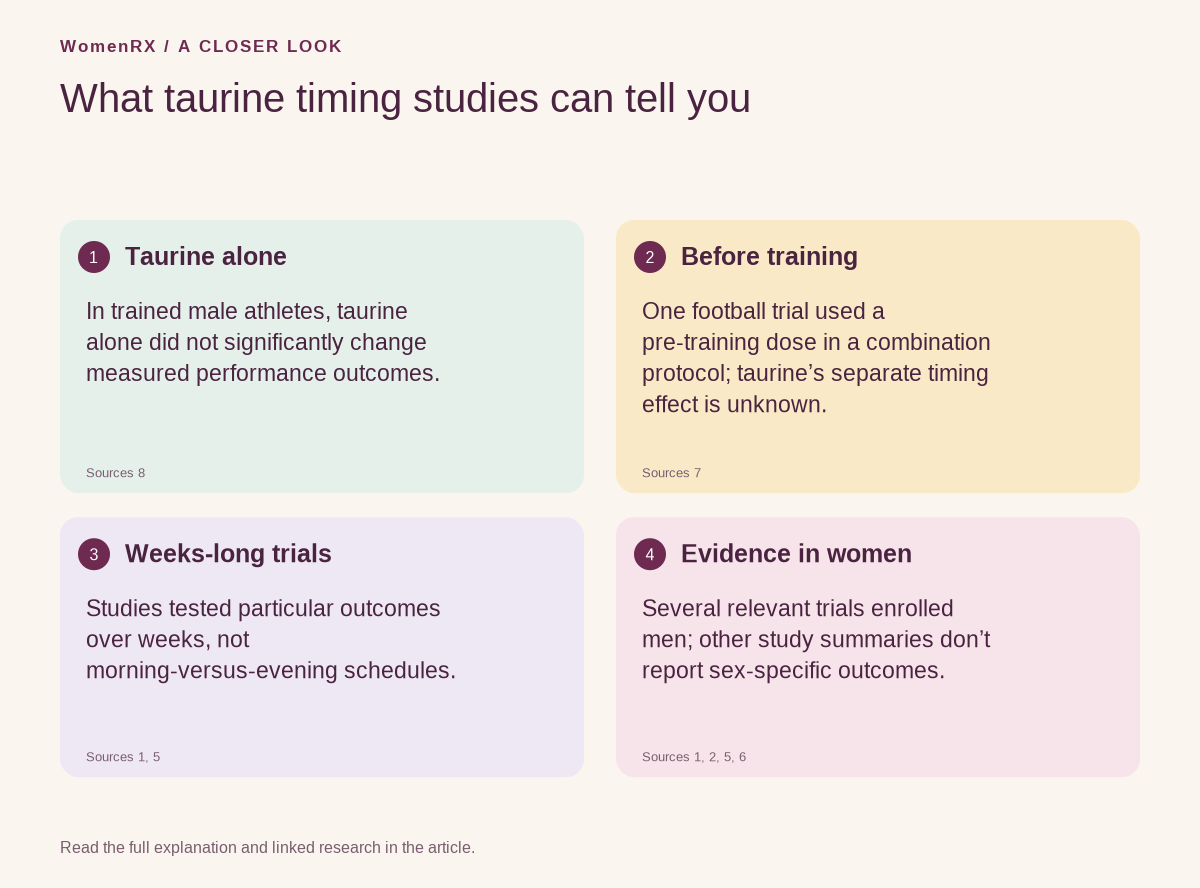
What taurine timing studies can tell you
Taurine alone: In trained male athletes, taurine alone did not significantly change measured performance outcomes.8
Before training: One football trial used a pre-training dose in a combination protocol; taurine’s separate timing effect is unknown.7
Weeks-long trials: Studies tested particular outcomes over weeks, not morning-versus-evening schedules.15
Evidence in women: Several relevant trials enrolled men; other study summaries don’t report sex-specific outcomes.1256
Read the figure as text
Different study designs answer different questions. A protocol’s schedule alone doesn’t show that taurine works best at that time.- Taurine alone: In trained male athletes, taurine alone did not significantly change measured performance outcomes.8
- Before training: One football trial used a pre-training dose in a combination protocol; taurine’s separate timing effect is unknown.7
- Weeks-long trials: Studies tested particular outcomes over weeks, not morning-versus-evening schedules.15
- Evidence in women: Several relevant trials enrolled men; other study summaries don’t report sex-specific outcomes.1256
More questions, answered
Does taking taurine before a workout have proven benefits?
The cited football trial that scheduled a dose 60 minutes before training tested a taurine-and-caffeine combination, with another group also receiving phosphatidylserine. It didn’t compare pre-workout timing with another schedule or show that taurine alone worked better before exercise. 7
Do these studies establish a taurine schedule for women?
No. The obesity and football trials enrolled men, while some other study summaries don’t report sex-specific outcomes. These studies also don’t establish a schedule or safety during pregnancy or breastfeeding. 1 2 5 6
Sources you can check
- Combined Aerobic-Resistance Training and Taurine Supplementation Reduce Asprosin and Elevate Spexin in Men with Obesity: A 12-Week Supplement-Blinded, Randomized Controlled Trial.Saedmocheshi S, Dhahbi W, Saeidi A, Rahmani A. · Nutrients · 2026Return to first citation
- Football-Specific Performance and Cognitive Fatigue Resistance Following Supplementation with Two Phosphatidylserine Doses Combined with Taurine and Caffeine in Professional Male Football Players: A Randomized, Triple-Masked, Placebo-Controlled Trial.Mizera K, Mazurek D, Martínez-Rodríguez A, Kęska A. · Nutrients · 2026Return to first citation
- Could taurine supplementation improve graft functions after liver transplantation? A randomized clinical trial among liver transplant recipients.Mottaghi S, Vazin A, Nikoupour H, Firoozifar SM, Haem E, Heidari R, Shafiekhani M. · Clinical nutrition ESPEN · 2026Return to first citation
- Effects of taurine supplementation on metabolic health and biological aging in healthcare workers: A protocol for a triple-blinded, Bayesian-optimized phase II randomized controlled trial.Chu MHM, Lai JKM, Lee A, Wu WKK, Huang Z, Wong HMK, Ho L, Su H, Ho SSM, Xu X, Pavey W, Morgan DJR, Chan MTV, Ho KM. · PloS one · 2026Return to first citation
- A randomized controlled trial of L-taurine for fatigue in decompensated cirrhosis.Sasidharan S, Philips CA, Philips CA, Tharakan A, Ahamed R, Oommen TT, Menachery J, Varghese R, Augustine P. · Hepatology communications · 2026Return to first citation
- A nutritional blend of taurine, vitamins B6, B9, and B12 improves motivated behaviors in healthy adults-a double-blinded randomized clinical trial.Anlacan VM, Jamora RDG, Krattinger LF, De Longis E, Hartweg M, Steinmann M, Trovò L. · Frontiers in nutrition · 2026Return to first citation
- Effects of Taurine-, Caffeine-, and Phosphatidylserine-Containing Supplementation Protocols on Physical and Cognitive Performance in Professional Male Football Players.Mizera K, Mizgała-Izworska E, Mizera J, Mackiewicz J. · Nutrients · 2026Return to first citation
- Effects of combined low-dose caffeine and taurine on anaerobic, neuromuscular, and cognitive performance: a double-blind randomized placebo-controlled crossover study.Köse Y, Ulaş M, Atay E. · BMC sports science, medicine & rehabilitation · 2026Return to first citation