How to Read a Taurine Supplement Label
A clear taurine amount, a complete ingredient list and a specific testing claim tell you more than a performance promise.
Check how much taurine the label lists per serving, then look for other active ingredients and the details behind any quality-testing claim. Match a performance claim to the formula, people and activity actually studied. Exercise findings from a multi-ingredient drink or a small trial in athletes don’t establish that a particular taurine brand will deliver the same result for you. 1 4 6
First, find the amount you’re comparing
Look for the amount of taurine per serving, then check what the label counts as one serving. If taurine is listed only as part of a blend without its own amount, you can’t make a straightforward amount-to-amount comparison with a study or another product.
That comparison is useful, but it isn’t a dose recommendation. In one randomized trial, 11 trained male cyclists took taurine before a prolonged ride; their subsequent time-trial performance did not differ from the control or placebo conditions. A different, small trial tested several taurine amounts during exhaustive exercise followed by repeated sprints in hot, humid conditions and reported differences on selected measures. Neither setting establishes a general amount for everyday use. 3 4
Read the rest of the formula
Check for caffeine and other active ingredients. A claim about a combination product isn’t automatically a claim about taurine alone.
For example, a randomized trial in professional male football players tested taurine with caffeine, with or without phosphatidylserine. The researchers reported differences on selected performance and cognitive measures, but every taurine group also received caffeine. The findings can’t isolate an effect of taurine. 1 A separate trial gave 16 male football players taurine alone, caffeine alone, both or placebo during exercise in simulated low-oxygen conditions. Caffeine and the combination prolonged time to exhaustion compared with placebo, but neither improved the subsequent repeated-sprint performance measured in that study. The result depends on which activity and outcome you mean. 2
Energy-drink research makes the same point. In a trial of 18 recreational runners, including five women, five-kilometer times were faster after a drink containing caffeine, glucose and taurine than after a noncaffeinated, sugar-free placebo. That comparison doesn’t tell us which ingredient contributed to the difference. 6
Ask what a quality claim actually checks
Ingredient research and product testing answer different questions. A study can examine whether a formula affects an outcome without independently verifying every ingredient amount in the commercial products it uses. In the professional football-player trial, researchers checked the taurine capsules’ stated identity and amount against manufacturer labels and specifications but performed no additional independent laboratory analysis. That check doesn’t verify another brand or a current batch. 1
If a seller says its product is tested, look for what was tested, who performed the test and whether the information applies to the product you’re considering. An ingredient-identity or contents claim is not evidence that the product improves a workout. Conversely, a performance result for a studied formula is not a quality test for every product with taurine on its label.
Check whether the research fits you
Much of the exercise evidence comes from men: the football-player trials, the trained-cyclist trial and a trial of taurine-containing drinks in soldiers enrolled only men. Their results shouldn’t be presented as established effects in women. 1 2 3 5
Women have not been entirely absent from this research. One randomized crossover trial included eight women and eight men exercising in high heat and humidity, and reported some results separately by sex. In its female participants, different tested amounts were associated with better results on different measures. With only eight women in that specific exercise setting, those findings aren’t a reliable basis for choosing a taurine amount for women generally. 4
Pregnancy and breastfeeding call for a different question from exercise performance. These athletic trials don’t establish whether a taurine supplement is beneficial or safe during either period. If that’s your situation, bring the exact product and its full ingredient list to your prenatal or postpartum care team before using it; a study of a workout outcome can’t settle a pregnancy- or breastfeeding-specific decision. 1 2 3 4
A useful final check is to put the product’s promise into a sentence: This formula, at this amount, has been studied for this outcome in people like me. If you can’t fill in those details, you can still assess the label, but the claimed result remains a separate question.
Four checks for a taurine product
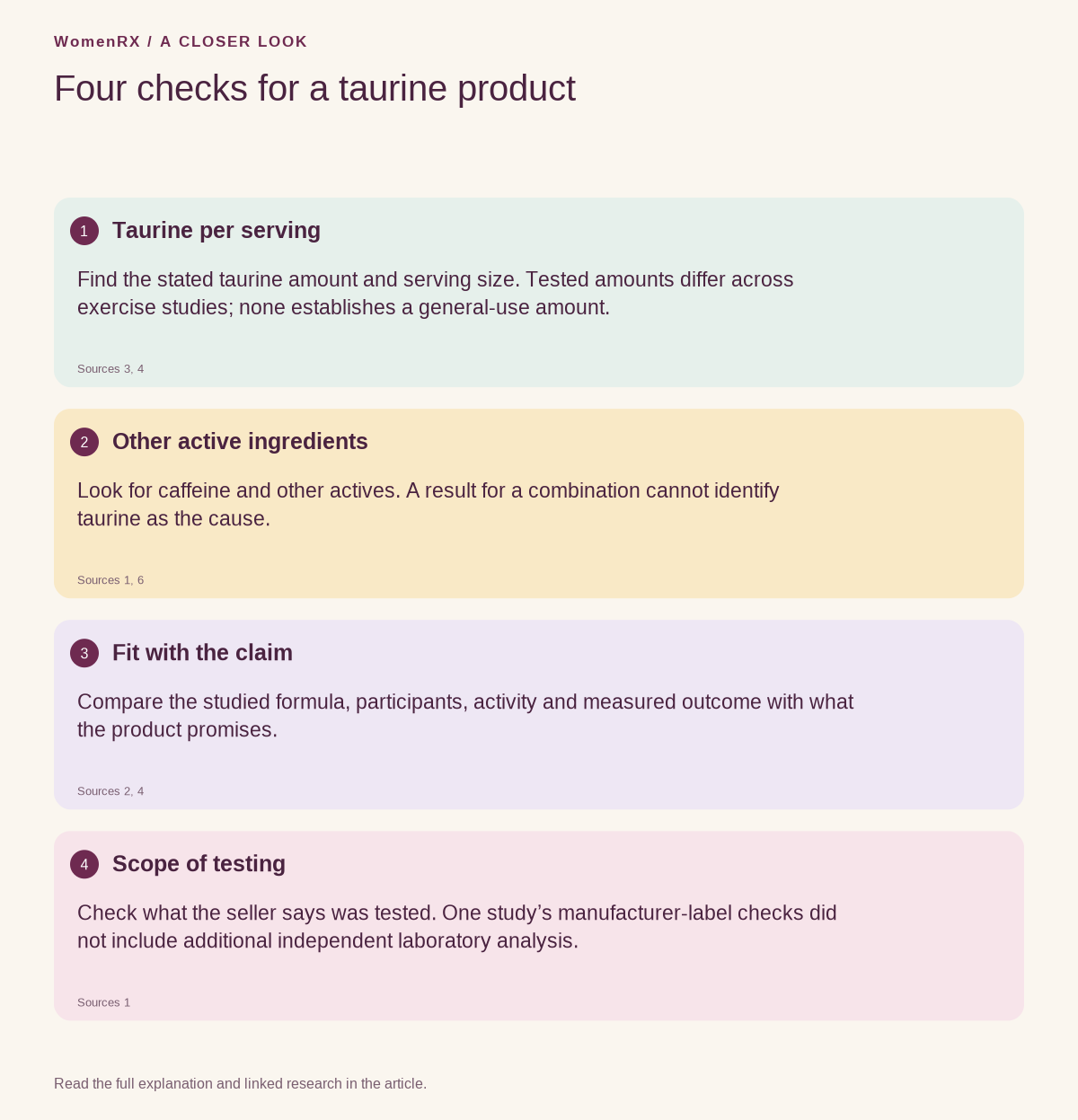
Taurine per serving: Find the stated taurine amount and serving size. Tested amounts differ across exercise studies; none establishes a general-use amount.34
Other active ingredients: Look for caffeine and other actives. A result for a combination cannot identify taurine as the cause.16
Fit with the claim: Compare the studied formula, participants, activity and measured outcome with what the product promises.24
Scope of testing: Check what the seller says was tested. One study’s manufacturer-label checks did not include additional independent laboratory analysis.1
Read the figure as text
Use the label and any supporting information to separate what’s in the product from evidence for its promised result.- Taurine per serving: Find the stated taurine amount and serving size. Tested amounts differ across exercise studies; none establishes a general-use amount.34
- Other active ingredients: Look for caffeine and other actives. A result for a combination cannot identify taurine as the cause.16
- Fit with the claim: Compare the studied formula, participants, activity and measured outcome with what the product promises.24
- Scope of testing: Check what the seller says was tested. One study’s manufacturer-label checks did not include additional independent laboratory analysis.1
Sources you can check
- Football-Specific Performance and Cognitive Fatigue Resistance Following Supplementation with Two Phosphatidylserine Doses Combined with Taurine and Caffeine in Professional Male Football Players: A Randomized, Triple-Masked, Placebo-Controlled Trial.Mizera K, Mazurek D, Martínez-Rodríguez A, Kęska A. · Nutrients · 2026Return to first citation
- Effects of taurine combined with caffeine on repetitive sprint exercise performance and cognition in a hypoxic environment.Liu J, Rong W. · Scientific reports · 2025Return to first citation
- The effect of acute taurine ingestion on endurance performance and metabolism in well-trained cyclists.Rutherford JA, Spriet LL, Stellingwerff T. · International journal of sport nutrition and exercise metabolism · 2010Return to first citation
- Effects of different doses of taurine supplementation on repeated-sprint performance after exhaustive exercise in a high temperature and humidity environment.Cheng X, Lin Y, Li Z. · Frontiers in nutrition · 2026Return to first citation
- Effects of energy drink major bioactive compounds on the performance of young adults in fitness and cognitive tests: a randomized controlled trial.Kammerer M, Jaramillo JA, García A, Calderón JC, Valbuena LH. · Journal of the International Society of Sports Nutrition · 2014Return to first citation
- Energy Drinks Improve Five-Kilometer Running Performance in Recreational Endurance Runners.Prins PJ, Goss FL, Nagle EF, Beals K, Robertson RJ, Lovalekar MT, Welton GL. · Journal of strength and conditioning research · 2016Return to first citation