How to Read a Calcium Supplement Label and Spot a Gap
Compare elemental calcium per serving with what you already get from food and other products before deciding whether a supplement fits.
Start with the Supplement Facts panel: check the serving size and the amount listed as calcium. That amount is elemental calcium, not the full weight of the calcium compound named on the bottle. Then estimate what you get from food, drinks, supplements, and calcium-containing antacids, and compare your total with the recommendation for your age. 1
Find the amount that counts
The front of a bottle may highlight calcium carbonate or calcium citrate. Those names tell you the form of calcium, but the compound’s full weight isn’t the amount of calcium it provides. Calcium carbonate is 40% calcium by weight, while calcium citrate is 21%. You don’t need to do that conversion yourself: the Supplement Facts panel lists elemental calcium. 1
Check the serving size before comparing two products. The calcium amount on the panel applies to that serving, which might contain more than one tablet, capsule, or chew. For example, on a hypothetical label showing 600 mg of calcium per two-tablet serving, one tablet would provide 300 mg. That’s an arithmetic example, not a recommendation for how much to take. More calcium per serving isn’t automatically better; what matters is whether you have an intake gap to fill.
Work out what’s already in your day
Calcium comes from more than supplements. Sources include milk, yogurt, and cheese; some greens; canned sardines or salmon with edible bones; and calcium-fortified drinks, tofu, and cereals. Fortified foods vary, so check their labels rather than assuming a plant-based drink or a particular tofu provides a set amount. 12
Think through a usual day of meals and drinks. Then add calcium from any multivitamin, separate supplement, or calcium-containing antacid you use. Some over-the-counter antacids contain calcium carbonate and contribute to your total. 1
The daily recommendation is a total intake target, not an amount everyone should get from a pill. The recommended dietary allowance (RDA) is 1,000 mg a day for women ages 19-50, including during pregnancy and lactation. It’s 1,300 mg for ages 14-18, including pregnancy and lactation, and 1,200 mg for women ages 51 and older. Food and supplements both count toward these amounts. 1
After menopause, falling estrogen reduces calcium absorption and increases calcium loss through urine and from bone. That helps explain why bone health deserves attention, but it doesn’t tell you how much calcium you eat. The 1,200 mg RDA applies to women older than 50; compare your actual intake with the target for your age before deciding whether a supplement would fill a gap. 1
Choose a form you can use comfortably
Calcium carbonate and calcium citrate are the most common supplement forms. Carbonate depends more on stomach acid for absorption and is absorbed best with food. Citrate is less dependent on stomach acid and can be taken without food. In general, calcium from supplements is absorbed better with food, and the percentage absorbed decreases as the amount of elemental calcium taken at one time increases. 12
Some people experience gas, bloating, or constipation with calcium supplements. Carbonate appears more likely than citrate to cause these effects, particularly in older adults with lower stomach acid. If a product doesn’t agree with you, its form is one meaningful difference to check when comparing labels. 1
Read the rest of the panel, too. Calcium products may also contain vitamin D or other nutrients, and calcium can already be part of a multivitamin. Checking everything you use side by side makes it easier to see both your calcium total and any overlapping ingredients. 1
Put the label and your intake together
When you compare products, use this order:
- Serving size: How many tablets, capsules, or chews does the listed amount cover?
- Elemental calcium: How much calcium does that serving provide? Don’t substitute the full weight of calcium carbonate or citrate.
- What else you take: Does the product add vitamin D or another nutrient you already get from a supplement?
- Your usual intake: What calcium comes from meals, fortified foods and drinks, other supplements, and antacids?
- Your age-based target: Is there a gap between that estimate and your daily recommendation? 12
The label answers how much a product supplies. Looking at the whole day answers the more useful question: whether that amount would add something you’re missing.
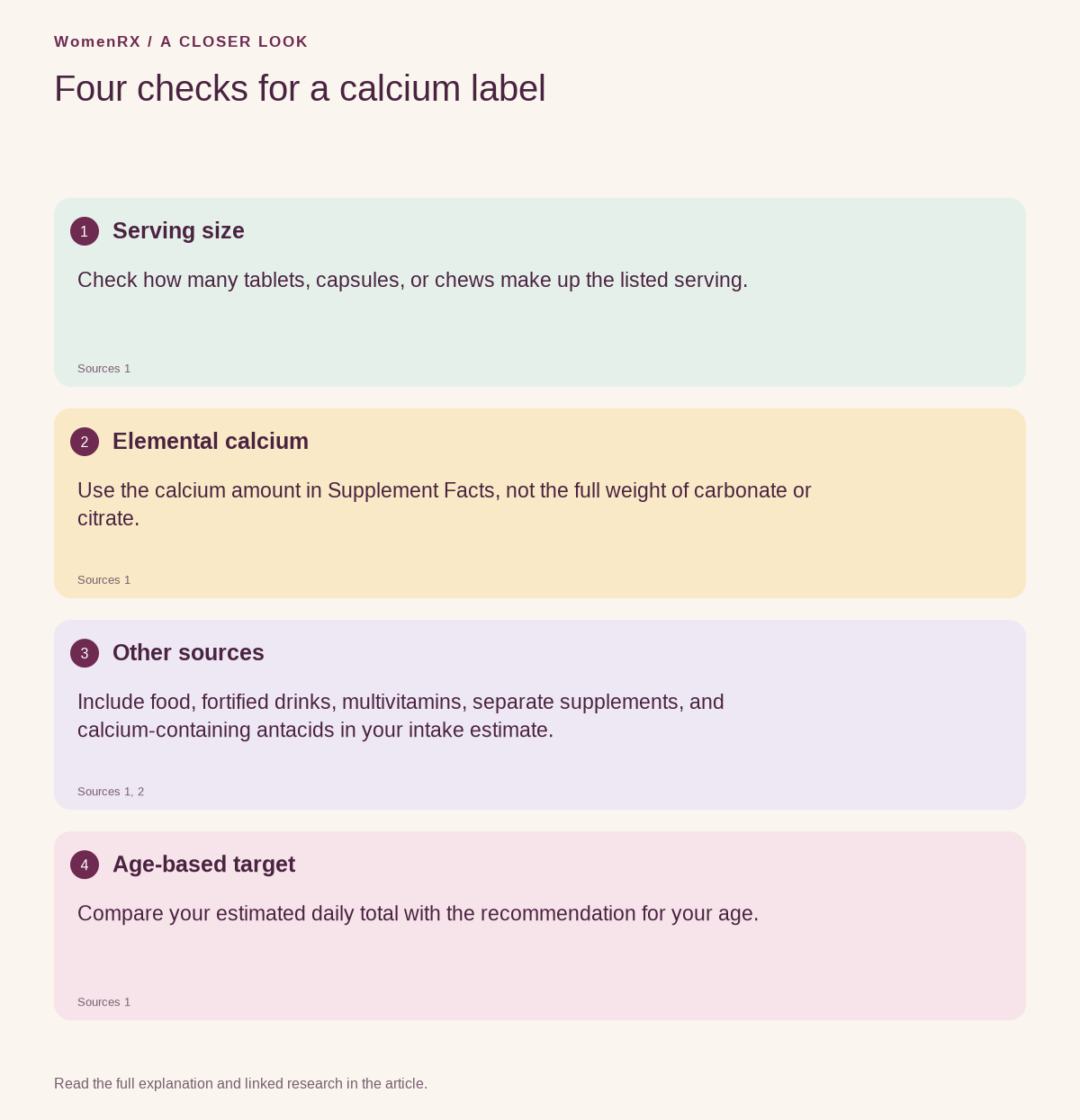
Four checks for a calcium label
Serving size: Check how many tablets, capsules, or chews make up the listed serving.1
Elemental calcium: Use the calcium amount in Supplement Facts, not the full weight of carbonate or citrate.1
Other sources: Include food, fortified drinks, multivitamins, separate supplements, and calcium-containing antacids in your intake estimate.12
Age-based target: Compare your estimated daily total with the recommendation for your age.1
Read the figure as text
Read the amount a serving actually supplies, then place it in the context of your other calcium sources.- Serving size: Check how many tablets, capsules, or chews make up the listed serving.1
- Elemental calcium: Use the calcium amount in Supplement Facts, not the full weight of carbonate or citrate.1
- Other sources: Include food, fortified drinks, multivitamins, separate supplements, and calcium-containing antacids in your intake estimate.12
- Age-based target: Compare your estimated daily total with the recommendation for your age.1
More questions, answered
Does calcium carbonate always provide more calcium than calcium citrate?
No. Equal weights of the compounds contain different amounts of elemental calcium: carbonate is 40% calcium by weight and citrate is 21%. But products can use different amounts and serving sizes. Compare the calcium listed in each product’s Supplement Facts panel. 1
Should I count calcium from antacids?
Yes. Some over-the-counter antacids contain calcium carbonate, so include their calcium when estimating your daily total. 1
Sources you can check
- Calcium - Health Professional Fact SheetAccessed 2026-09-25Return to first citation
- Calcium | MedlinePlusAccessed 2026-09-25Return to first citation