How to Choose a Calcium Supplement That Fits
The best fit depends on how much calcium your food provides, what the label supplies, and whether the form works with your routine.
Start with your usual calcium intake from food and the daily target that applies to you. A supplement only needs to address a remaining gap. Compare products by elemental calcium per serving: carbonate is absorbed best with food, while citrate can be taken with or without it. Calcium is absorbed best in amounts of 500 mg or less at one time. 1
Work out the gap before shopping
A bottle tells you how much calcium it contains, not how much you need. First, look at what you usually eat and drink. Dairy foods, some leafy greens, fish with edible bones, and calcium-fortified foods can all contribute. Check the labels on fortified foods and drinks rather than assuming they contain the same amount. 1
Then use this calculation:
Your daily calcium target − your usual calcium from food = the gap a supplement might fill.
For example, if your own plan sets a 1,000 mg daily target and you estimate 700 mg from food, the arithmetic gap is 300 mg. Those numbers illustrate the subtraction; they aren’t a target or supplement recommendation for you. Calcium may also be present in a multivitamin or a calcium-containing antacid, so include those when you consider what you already take. 1
Don’t assume that being a teenager, pregnant, or postmenopausal automatically calls for the same product or a high dose. Establish the target appropriate to your situation before choosing a bottle. If you’ve had kidney stones, bring that history into the decision rather than choosing an amount from a general shopping guide. For someone past menopause who has osteoporosis, getting enough calcium is one part of a bone-health plan, not a reason to judge the plan by supplement dose alone. 5
Read the serving size and the calcium amount together
Look for elemental calcium, the amount of calcium the product supplies, and check how many tablets or capsules make up the listed serving. The weight of the calcium compound isn’t interchangeable with the amount of elemental calcium.
As a comparison between forms, one clinical trial report describes calcium carbonate as 40% elemental calcium and calcium citrate as 21%. That helps explain why products containing the same amount of elemental calcium may require different amounts of the compound. Compare the calcium stated for each product’s full serving, not the compound name or the biggest number on the front of the bottle. 2
If a serving provides more calcium than your estimated gap, it isn’t automatically a better buy. Check whether a product’s serving size lets you match the amount in your plan without overlooking calcium you get elsewhere.
Carbonate and citrate make different demands on your routine
Calcium carbonate is absorbed best with food. Because it contains more elemental calcium per amount of compound than citrate, an equivalent calcium amount may come in fewer pills. 12
Calcium citrate can be taken with or without food. It may also be easier to absorb than carbonate for someone with low stomach acid. Its lower elemental calcium content can mean more pills for the same calcium amount, so check the serving size. 12
Neither difference proves that one form builds stronger bones. Research has not established whether formulation differences produce meaningful differences in skeletal benefits. The practical choice is the amount you need in a form you can comfortably fit into your day. 2
Check whether the serving needs to be divided
Calcium is absorbed best when taken in amounts of 500 mg or less at one time. If your planned daily supplement amount is higher, MedlinePlus advises dividing it into smaller doses rather than taking it all at once. A label may already spread its listed amount across multiple pills, so check both the calcium per serving and the number of pills in that serving. 1
Calcium supplements can cause gas, bloating, or constipation. Spreading the amount through the day, taking it with meals, or trying another form may help. 1 If you also take iron, timing is worth discussing as part of your routine: in a small trial of 27 fasting women, 800 mg of elemental calcium as citrate reduced non-heme iron absorption compared with calcium chloride. That finding does not establish the effect of every calcium product taken with an ordinary meal. 3
Keep the bone-health goal bigger than the bottle
A higher calcium dose isn’t a guarantee against fractures. A review of 11 randomized trials involving 43,869 postmenopausal women with osteoporosis found that calcium plus vitamin D modestly improved pelvic bone mineral density, but did not significantly reduce overall fracture risk. It also found no significant bone-density improvement at the lumbar spine, femoral neck, or total hip. These results concern combined supplementation in that population, not a head-to-head test of calcium brands. 5
Other parts of a bone-health plan matter too. A separate review of 13 randomized trials in postmenopausal women found greater lumbar spine and femoral neck bone density with exercise plus calcium and vitamin D than with calcium and vitamin D alone. It does not show that every woman needs a supplement. 4 Choose a calcium product to meet an identified intake gap, not to stand in for the rest of your plan.
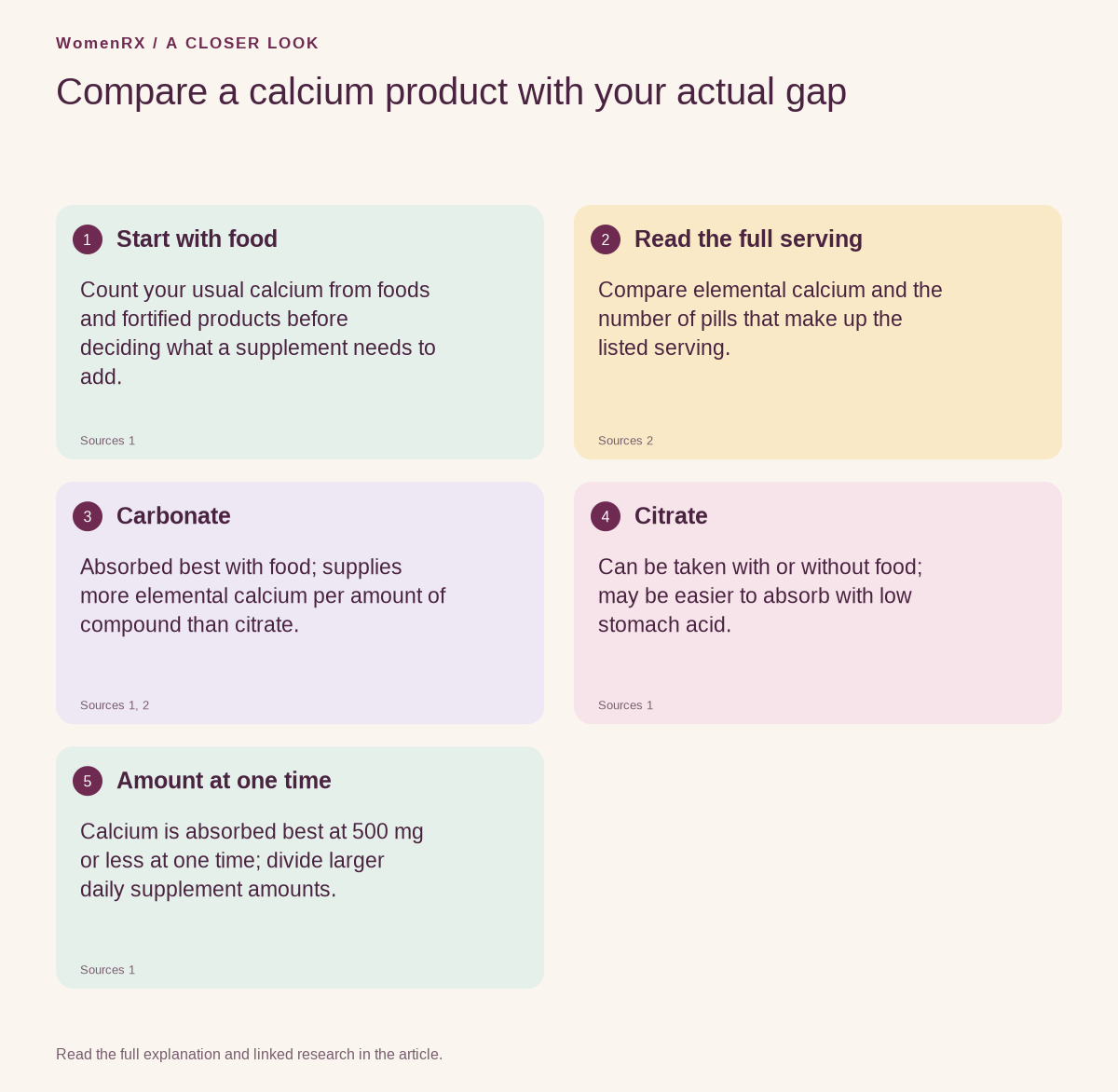
Compare a calcium product with your actual gap
Start with food: Count your usual calcium from foods and fortified products before deciding what a supplement needs to add.1
Read the full serving: Compare elemental calcium and the number of pills that make up the listed serving.2
Carbonate: Absorbed best with food; supplies more elemental calcium per amount of compound than citrate.12
Citrate: Can be taken with or without food; may be easier to absorb with low stomach acid.1
Amount at one time: Calcium is absorbed best at 500 mg or less at one time; divide larger daily supplement amounts.1
Read the figure as text
Use the same checks for each product rather than comparing the largest numbers on the bottles.- Start with food: Count your usual calcium from foods and fortified products before deciding what a supplement needs to add.1
- Read the full serving: Compare elemental calcium and the number of pills that make up the listed serving.2
- Carbonate: Absorbed best with food; supplies more elemental calcium per amount of compound than citrate.12
- Citrate: Can be taken with or without food; may be easier to absorb with low stomach acid.1
- Amount at one time: Calcium is absorbed best at 500 mg or less at one time; divide larger daily supplement amounts.1
Sources you can check
- Calcium | MedlinePlusAccessed 2026-09-25Return to first citation
- Relative bioavailability and pharmacokinetic comparison of calcium glucoheptonate with calcium carbonate.Wiria M, Tran HM, Nguyen PHB, Valencia O, Dutta S, Pouteau E. · Pharmacology research & perspectives · 2020Return to first citation
- Effect of various calcium salts on non-heme iron bioavailability in fasted women of childbearing age.Candia V, Ríos-Castillo I, Carrera-Gil F, Vizcarra B, Olivares M, Chaniotakis S, Pizarro F. · Journal of trace elements in medicine and biology : organ of the Society for Minerals and Trace Elements (GMS) · 2018Return to first citation
- Effects of Combined Exercise and Calcium/Vitamin D Supplementation on Bone Mineral Density in Postmenopausal Women: A Systematic Review and Meta-Analysis.Bai J, Huang W, Yan R, Du X. · Nutrients · 2025Return to first citation
- The effects of combined calcium and vitamin D supplementation on bone mineral density and fracture risk in postmenopausal women with osteoporosis: a systematic review and meta-analysis of randomized controlled trials.Cong B, Zhang H. · BMC musculoskeletal disorders · 2025Return to first citation