Do You Need a Calcium Supplement? Start With Food
Your age and usual food choices matter more than a one-size-fits-all supplement.
Not every woman needs a calcium supplement. First estimate how much you usually get from food and fortified drinks, then compare that with the recommendation for your age. If there’s a consistent gap, a supplement may help fill it. Check the label for elemental calcium per serving, choose a form that suits your needs, and review medication interactions before starting. 1

Start with your usual intake
Calcium is needed for bones, but taking a supplement isn’t automatically better for bone health. Begin by estimating what you get on a typical day from foods, drinks, and calcium-containing antacids. Dairy foods, fortified plant drinks, some tofu, canned fish with edible bones, and certain greens can all contribute. Check labels on fortified products because calcium amounts vary. 12
For a concrete example, an 8-ounce serving of plain low-fat yogurt has about 415 mg of calcium, and a cup of fortified soy milk has about 299 mg. Those amounts can add up across meals and snacks; you don’t need to rely on dairy if you use suitable fortified or other calcium-rich foods. 1
Compare your estimate with the recommendation for your age, not with the supplement bottle’s serving size. The recommended daily amount is 1,300 mg for ages 9-18, 1,000 mg for women ages 19-50, and 1,200 mg for women 51 and older. These totals include food and supplements. A short food log can help you notice a regular gap, but one unusually low day doesn’t tell the whole story. 1
What changes across life stages?
Adolescence: Ages 9-18 have the highest calcium recommendation in this guide, 1,300 mg daily, because calcium supports bone accumulation during growth. A supplement is not automatically needed; first consider food and fortified choices. 1
Pregnancy: The recommended calcium amount follows age: 1,300 mg daily for pregnant teens and 1,000 mg for pregnant adults ages 19-50. Pregnancy can raise a separate question: supplementation may be considered for women with low dietary calcium intake to reduce preeclampsia risk. That is a pregnancy-specific decision, not a reason for every pregnant person to take a high-dose supplement on their own. 1
Perimenopause and after menopause: The general recommendation changes with age, from 1,000 mg through age 50 to 1,200 mg from age 51. Lower estrogen around menopause also speeds bone remodeling and bone loss. Meeting calcium needs supports bone health, but a supplement by itself is not a guarantee against fractures. Research on supplements and fracture prevention in older adults has had mixed findings. 1
If there’s a gap, read the label this way
Look for the amount of calcium, or elemental calcium, in the Supplement Facts panel. That is the useful number for comparing products; the weight of the calcium compound is not the same thing. Calcium carbonate is about 40% calcium by weight and calcium citrate about 21%, but you don’t need to calculate this yourself when the panel lists elemental calcium. Also check how many tablets or chews make up one serving. 1
Then compare the serving’s elemental calcium with your estimated gap. Supplements come in different amounts, and the goal is to fill the gap rather than stack a large dose on top of an already adequate intake. Calcium is absorbed less efficiently as the amount taken at one time rises; absorption is highest at 500 mg or less per dose. 12
The two common forms have practical differences. Calcium carbonate is absorbed best with food and depends more on stomach acid. Calcium citrate is less dependent on stomach acid and can be taken with or without food. Some people get gas, bloating, or constipation, and carbonate may cause more of these effects than citrate, particularly in older adults. If a form doesn’t agree with you, that’s useful information to discuss when choosing another option. 12
Check the total and your medicines
Add the calcium from food and supplements when checking your total. The upper intake level is a safety ceiling, not a target: 2,500 mg daily for adults ages 19-50 and 2,000 mg daily for adults 51 and older. These limits include all sources. 1
Calcium can interfere with the absorption of levothyroxine, dolutegravir, and some quinolone antibiotics. Lithium used long term can raise blood calcium, so adding a supplement may need a medication review. If you take one of these medicines, ask your prescriber or pharmacist how calcium fits with your treatment before choosing a product. 1
One test-related point can prevent confusion: a blood calcium result is tightly regulated and doesn’t show whether your usual diet provides enough calcium. Bone-density testing answers a different question about bone mineral density; it isn’t a substitute for estimating dietary intake. 1
A simple decision path
Estimate your usual intake first. If it meets the recommendation for your age, a supplement may not be needed just for calcium. If it appears consistently low, look for food or fortified options you can use, then consider whether a supplement could fill the remaining gap. In pregnancy, low intake may warrant a separate discussion about supplementation and preeclampsia prevention. For any supplement, compare elemental calcium, serving size, form, total daily intake, and medication interactions.
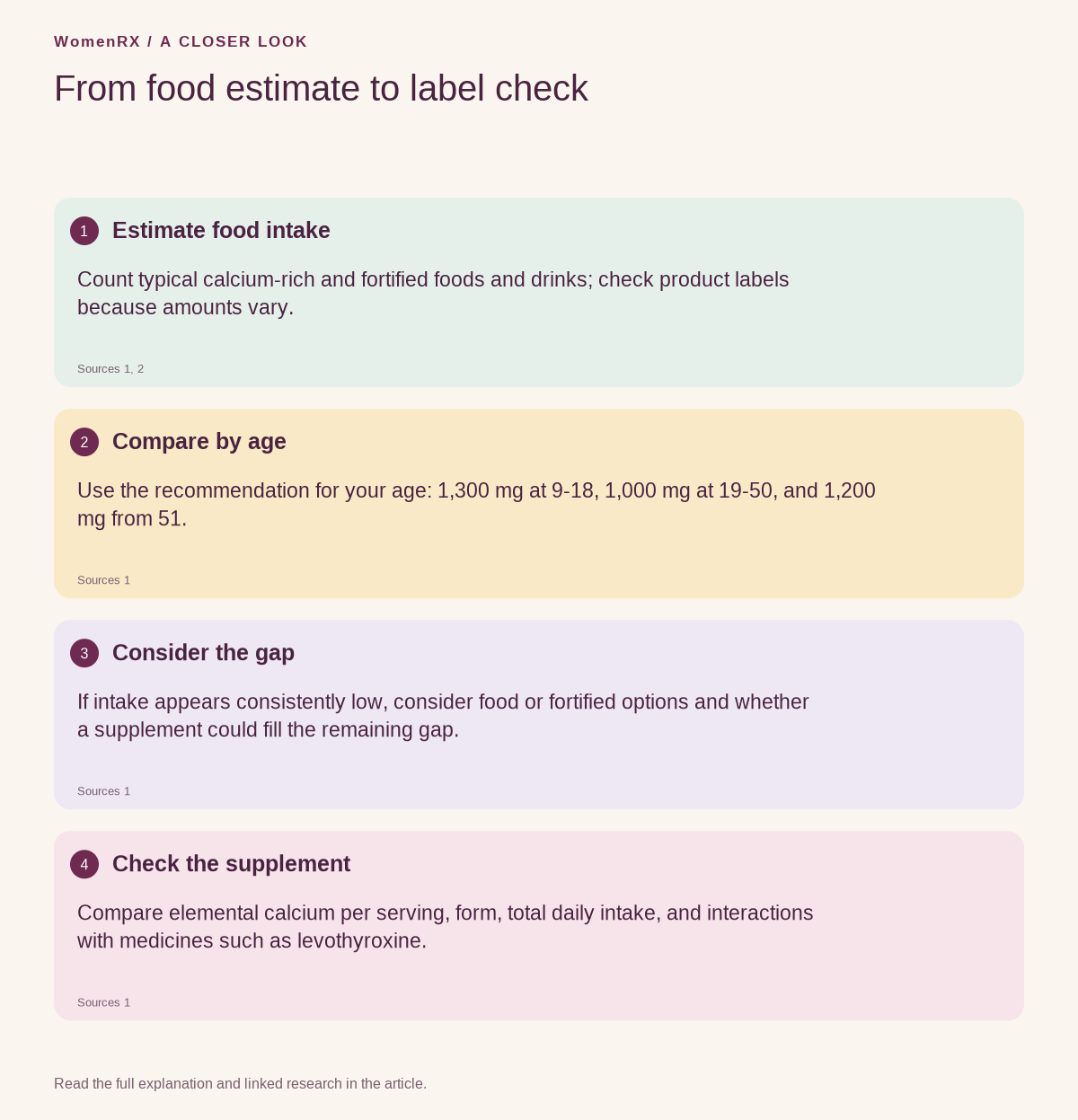
From food estimate to label check
Estimate food intake: Count typical calcium-rich and fortified foods and drinks; check product labels because amounts vary.12
Compare by age: Use the recommendation for your age: 1,300 mg at 9-18, 1,000 mg at 19-50, and 1,200 mg from 51.1
Consider the gap: If intake appears consistently low, consider food or fortified options and whether a supplement could fill the remaining gap.1
Check the supplement: Compare elemental calcium per serving, form, total daily intake, and interactions with medicines such as levothyroxine.1
Read the figure as text
Use this path to decide whether a calcium supplement may fill a dietary gap, then compare the details that matter.- Estimate food intake: Count typical calcium-rich and fortified foods and drinks; check product labels because amounts vary.12
- Compare by age: Use the recommendation for your age: 1,300 mg at 9-18, 1,000 mg at 19-50, and 1,200 mg from 51.1
- Consider the gap: If intake appears consistently low, consider food or fortified options and whether a supplement could fill the remaining gap.1
- Check the supplement: Compare elemental calcium per serving, form, total daily intake, and interactions with medicines such as levothyroxine.1
More questions, answered
Can a blood calcium test tell me if I get enough from food?
No. Blood calcium is kept within a narrow range and isn’t a good measure of your dietary calcium intake. A food estimate addresses intake; a bone-density scan measures bone mineral density. 1
Is calcium citrate always better than calcium carbonate?
Not for everyone. Citrate is less dependent on stomach acid, while carbonate is absorbed best with food. The amount of elemental calcium and your tolerance also matter. 12 Calcium can interfere with some medicines, so check specific interactions before choosing a product. 1
Sources you can check
- Calcium - Health Professional Fact SheetAccessed 2026-09-25Return to first citation
- Calcium | MedlinePlusAccessed 2026-09-25Return to first citation