Calcium Citrate or Calcium Carbonate: How to Choose
The right fit depends on meals, stomach acid, the label’s elemental-calcium amount, and what your stomach tolerates.
Calcium carbonate contains more elemental calcium by weight and is best taken with food. Calcium citrate depends less on stomach acid and can be taken with or without food, which may make it more convenient if you have low stomach acid. Neither form is best for every woman: compare elemental calcium on the label and consider your meals, comfort, and medication timing. 12
First, check how much calcium you need
The choice between citrate and carbonate isn’t a women-specific one. A useful first step is to consider how much calcium you get from food, then look at the elemental calcium amount in a supplement’s Supplement Facts panel. That number is the calcium the product provides, not the total weight of the calcium compound. 1
For women ages 19-50, the recommended daily intake is 1,000 mg from food and supplements combined. For women over 50, it’s 1,200 mg. These are total daily amounts, not automatic supplement targets. Calcium-rich foods include dairy products, some fortified drinks and foods, tofu made with calcium sulfate, and certain vegetables. 1
How the two forms compare
| Calcium citrate | Calcium carbonate | |
|---|---|---|
| With food | Can be taken with or without food | Best taken with food |
| Stomach acid | Less dependent on stomach acid for absorption | Low stomach acid may reduce its solubility and absorption, particularly without a meal |
| Elemental calcium in the compound | About 21% by weight | About 40% by weight |
| Digestive comfort | May cause gas, bloating, or constipation | May cause these symptoms more often for some people |
Those percentages describe the compound, not the amount in a particular tablet. You don’t need to calculate them: compare the elemental-calcium amount listed on the label. 1
Meals and acid-reducing medicines
If you take calcium carbonate, having it with a meal matters, especially if your stomach acid is low. Calcium citrate is less dependent on stomach acid and can be taken without food. Calcium supplements are generally absorbed better with food, though, regardless of form. 12
If you take a medicine meant to reduce stomach acid, ask a pharmacist whether the form or timing of calcium matters for your specific medication. The general distinction is that low stomach acid can make carbonate less soluble; it doesn’t establish a universal rule for every medicine or schedule. 12
Compare the calcium amount, not the tablet weight
Carbonate contains a higher percentage of elemental calcium by weight than citrate. That doesn’t mean a carbonate tablet always provides more calcium than a citrate product: serving sizes and formulations vary. Use the Supplement Facts panel to compare the actual elemental calcium per serving, and include calcium from foods and calcium-containing antacids when estimating your intake. 1
The amount taken at one time also matters. A larger elemental-calcium amount is absorbed at a lower percentage than a smaller amount; absorption is highest with amounts of 500 mg or less at one time. If a product’s serving is larger, ask a pharmacist or clinician how it fits your needs rather than setting a schedule based on the compound name alone. 12
Let tolerability count
Either form can cause gas, bloating, or constipation. Calcium carbonate appears more likely to cause these effects than citrate, especially in older adults with lower stomach acid. Taking calcium with meals, splitting amounts across the day, or trying another form may help. 12
If carbonate works for you and taking it with a meal is easy, there may be no practical reason to change. If it bothers your stomach or you need an option that can be taken without food, citrate may be worth considering. These are practical trade-offs, not proof that one form produces better health outcomes for adults generally. 12
If you also take iron
Calcium and iron timing is worth checking rather than guessing. In a small trial of 27 women ages 35-45, 800 mg of elemental calcium as citrate taken with iron while fasting reduced non-heme iron bioavailability compared with calcium chloride. The study did not test an everyday schedule or show that citrate is worse than carbonate, so it doesn’t establish a specific timing interval. Ask a pharmacist to review your actual products and routine. 5
If you’ve had bariatric surgery, ask your care team about the form and amount that fit your procedure. Studies in people after bariatric surgery have reported differing results, and those findings don’t establish a preferred form for everyone else. 34
A practical way to choose
Consider carbonate if you take calcium with meals and tolerate it. Consider citrate if taking it without food is useful, stomach acid is low, or carbonate causes digestive symptoms. For either form, compare elemental calcium per serving, account for dietary sources and calcium-containing antacids, and get a medication-timing check if you also take iron or a medicine that reduces stomach acid. 125
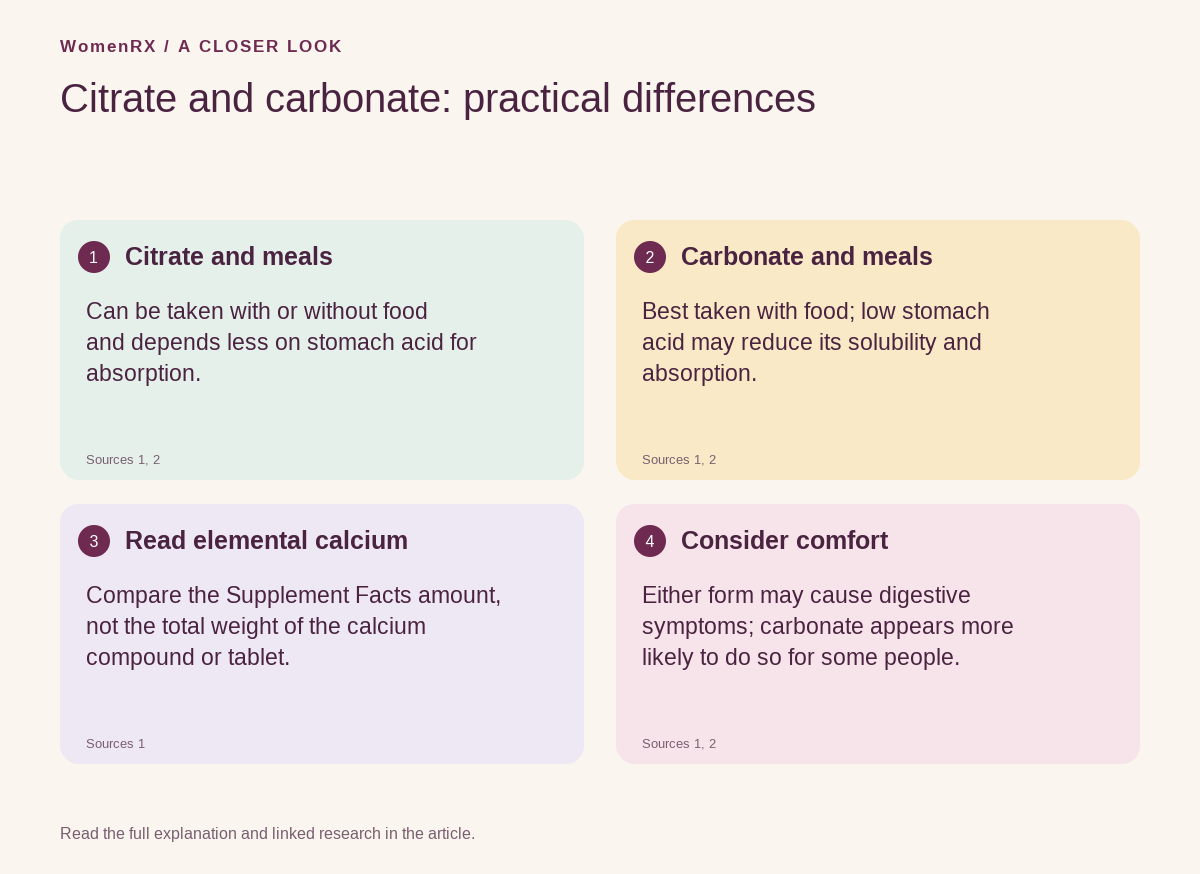
Citrate and carbonate: practical differences
Citrate and meals: Can be taken with or without food and depends less on stomach acid for absorption.12
Carbonate and meals: Best taken with food; low stomach acid may reduce its solubility and absorption.12
Read elemental calcium: Compare the Supplement Facts amount, not the total weight of the calcium compound or tablet.1
Consider comfort: Either form may cause digestive symptoms; carbonate appears more likely to do so for some people.12
Read the figure as text
Compare food needs, stomach-acid considerations, label amounts, and digestive comfort before choosing a form.- Citrate and meals: Can be taken with or without food and depends less on stomach acid for absorption.12
- Carbonate and meals: Best taken with food; low stomach acid may reduce its solubility and absorption.12
- Read elemental calcium: Compare the Supplement Facts amount, not the total weight of the calcium compound or tablet.1
- Consider comfort: Either form may cause digestive symptoms; carbonate appears more likely to do so for some people.12
More questions, answered
Does being postmenopausal mean I should choose calcium citrate?
No. The recommended total calcium intake increases for women over 50, but that doesn’t make citrate the preferred form. Choose based on elemental calcium, food and stomach-acid considerations, tolerability, and any medication-timing questions. 1
Should I compare products by the total weight of the tablet?
No. Tablet weight includes the calcium compound and other ingredients. Compare the elemental-calcium amount listed in Supplement Facts instead. 1
Sources you can check
- Calcium - Health Professional Fact SheetAccessed 2026-09-25Return to first citation
- Calcium | MedlinePlusAccessed 2026-09-25Return to first citation
- Comparison of calcium citrate and calcium carbonate absorption in patients with a Roux-en-Y gastric bypass, sleeve gastrectomy, and one-anastomosis gastric bypass: a double-blind, randomized cross-over trial.Hany M, Wuyts S, Abouelnasr AA, Zidan A, Demerdash HM, Hussein HASM, Arida RE, Elsharkawi SM, Kramers C, Torensma B. · Surgery for obesity and related diseases : official journal of the American Society for Bariatric Surgery · 2025Return to first citation
- Effect of calcium citrate vs calcium carbonate on elevated parathyroid hormone after Roux-en-Y gastric bypass. A double-blinded, randomized trial.Ring Madsen L, Espersen R, Rejnmark L, Richelsen B, Richelsen B. · Clinical endocrinology · 2018Return to first citation
- Effect of various calcium salts on non-heme iron bioavailability in fasted women of childbearing age.Candia V, Ríos-Castillo I, Carrera-Gil F, Vizcarra B, Olivares M, Chaniotakis S, Pizarro F. · Journal of trace elements in medicine and biology : organ of the Society for Minerals and Trace Elements (GMS) · 2018Return to first citation