How Much Calcium Do Women Need at Each Age?
Your calcium target changes with age, but pregnancy and breastfeeding don’t raise it above the usual target for your age.
Most women need 1,000 mg of calcium daily from all sources between ages 19 and 50, and 1,200 mg starting at 51. Teens need 1,300 mg; pregnancy and breastfeeding don’t change those age-based targets. Add food, fortified drinks, supplements, and calcium-containing antacids before deciding whether there’s a gap, and compare the total with the upper limit for your age. 1
Your target depends on age, not just pregnancy
Calcium recommendations are daily totals from food, fortified foods, drinks, and supplements. For most women, the target is 1,000 mg a day from ages 19 through 50 and 1,200 mg a day from age 51 onward. Girls ages 14 through 18 need 1,300 mg. During pregnancy or breastfeeding, the recommended amount stays the same as for other people in that age group. 1
| Life stage | Recommended daily amount | Upper limit per day |
|---|---|---|
| Ages 14-18, including pregnancy or breastfeeding | 1,300 mg | 3,000 mg |
| Ages 19-50, including pregnancy or breastfeeding | 1,000 mg | 2,500 mg |
| Women ages 51-70 | 1,200 mg | 2,000 mg |
| Adults over 70 | 1,200 mg | 2,000 mg |
The recommended amount is a planning target intended to meet the needs of nearly all healthy people. The upper limit is not a goal: it’s the maximum daily intake unlikely to cause harm, counting calcium from all sources. 1
The age change at 51 reflects higher calcium guidance for women in later adulthood. That doesn’t mean a supplement is automatically needed: the useful question is how much calcium you already get from your usual food and drinks. 1
Add up a day before reaching for a supplement
Start with foods and drinks you have regularly. Milk, yogurt, cheese, calcium-fortified soy milk and juice, and tofu made with calcium sulfate can all contribute. Check labels on fortified products because amounts vary. 1
For example, one day’s tally might include 8 ounces of plain low-fat yogurt (415 mg), a cup of calcium-fortified soymilk (299 mg), and half a cup of firm tofu made with calcium sulfate (253 mg). Together, that’s 967 mg. It’s an illustration, not a complete daily menu; other foods and drinks would change the total. 1
Then check any supplement label and count its calcium amount, not the weight of the compound used to make it. The Supplement Facts panel lists elemental calcium, which is the amount to add to your food total. Some antacids also contain calcium, so include them when you’re estimating intake. 1
If your usual total is below your age-based target, a supplement may help fill the estimated shortfall; it doesn’t have to replace calcium you already get from food. Keep the upper limit in view when adding everything together. 1
Form and timing can affect absorption and comfort
Calcium carbonate and calcium citrate are common supplement forms. Carbonate depends more on stomach acid and is generally taken with a meal; citrate is less dependent on stomach acid and can be taken without food. Absorption is generally better with food for either form. 1
The amount taken at one time matters, too: the proportion absorbed decreases as a single dose gets larger, and absorption is highest with amounts of 500 mg or less at one time. If a supplement upsets your stomach, calcium carbonate is more likely than citrate to cause gas, bloating, or constipation, especially in older adults. Smaller amounts taken more often or trying another form may help. 1
Calcium can also interfere with some medicines. For example, calcium carbonate can reduce absorption of levothyroxine, and calcium can affect absorption of some antibiotics. If you take a prescription medicine, check its directions or ask a pharmacist how to time calcium around it. 1
A useful way to make the decision
Estimate a typical day, rather than trying to make every single day exact. If food and fortified drinks usually bring you close to your target, a large supplement may push your total higher than intended. If there’s a consistent gap, use the label to see how much calcium a supplement would add, then count that toward both your target and your age-based upper limit. 1
These reference amounts are for healthy people. They’re not a personalized plan for a medical condition or treatment. A longitudinal observational study followed 586 older women, median age 67; 67 were taking antiresorptive osteoporosis medicines, while 418 were taking no osteoporosis medicine. In the calcium-replete group, calcium intake and supplement use were not significantly associated with the measured hip bone outcomes. The finding doesn’t establish that supplements are unnecessary or apply equally to women taking osteoporosis medicine. 2
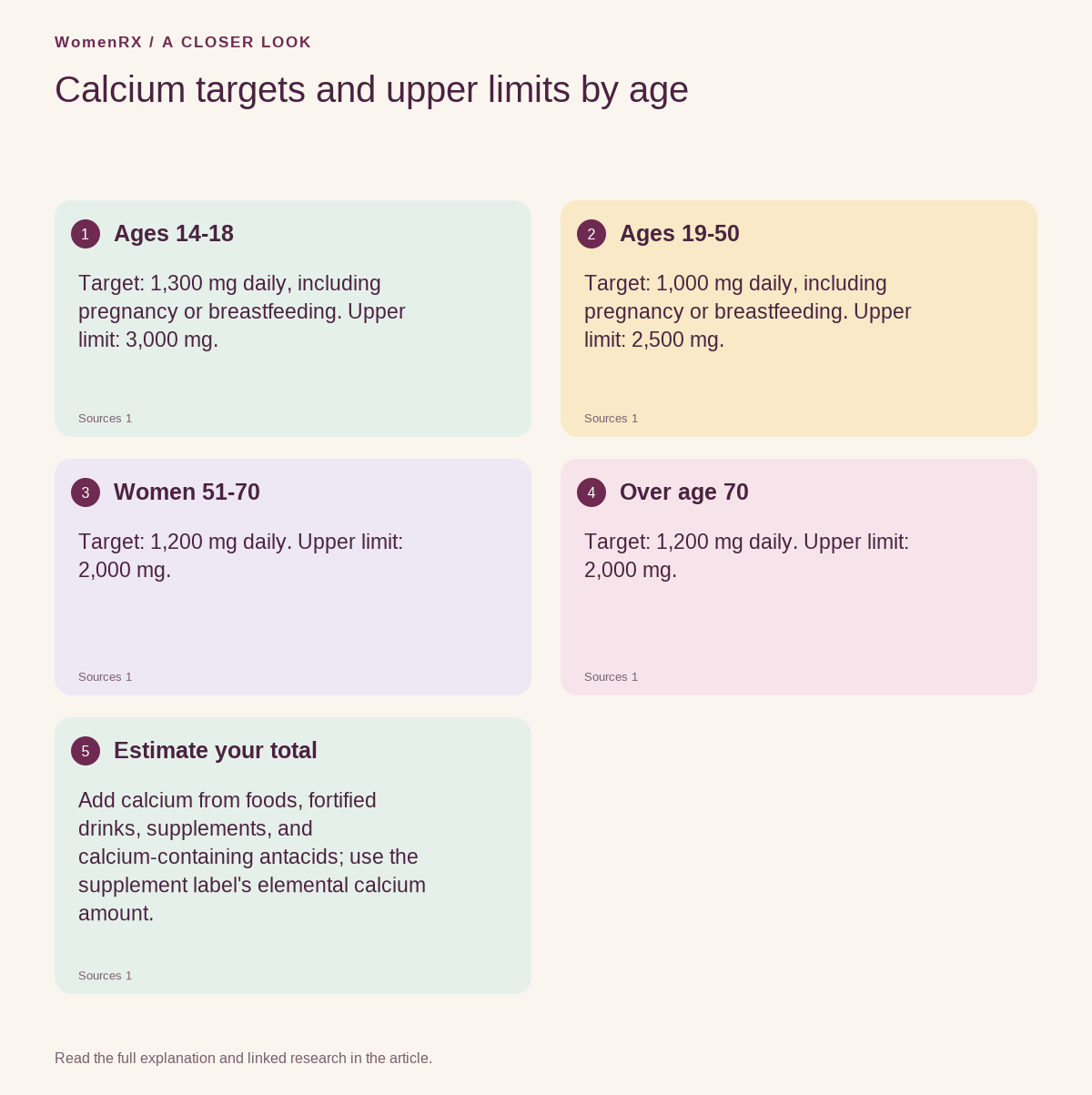
Calcium targets and upper limits by age
Ages 14-18: Target: 1,300 mg daily, including pregnancy or breastfeeding. Upper limit: 3,000 mg.1
Ages 19-50: Target: 1,000 mg daily, including pregnancy or breastfeeding. Upper limit: 2,500 mg.1
Women 51-70: Target: 1,200 mg daily. Upper limit: 2,000 mg.1
Over age 70: Target: 1,200 mg daily. Upper limit: 2,000 mg.1
Estimate your total: Add calcium from foods, fortified drinks, supplements, and calcium-containing antacids; use the supplement label's elemental calcium amount.1
Read the figure as text
Compare the daily calcium target with the upper limit, then count food, fortified products, supplements, and calcium-containing antacids toward your total.- Ages 14-18: Target: 1,300 mg daily, including pregnancy or breastfeeding. Upper limit: 3,000 mg.1
- Ages 19-50: Target: 1,000 mg daily, including pregnancy or breastfeeding. Upper limit: 2,500 mg.1
- Women 51-70: Target: 1,200 mg daily. Upper limit: 2,000 mg.1
- Over age 70: Target: 1,200 mg daily. Upper limit: 2,000 mg.1
- Estimate your total: Add calcium from foods, fortified drinks, supplements, and calcium-containing antacids; use the supplement label's elemental calcium amount.1
More questions, answered
Do calcium-containing antacids count toward my daily total?
Yes. Some antacids contain calcium carbonate, so check the product label and include that calcium when adding up food, drinks, and supplements. 1
Sources you can check
- Calcium - Health Professional Fact SheetAccessed 2026-09-25Return to first citation
- Dietary and supplemental calcium intake and bone changes during antiresorptive osteoporosis treatment in older women: a longitudinal observational study.Papageorgiou M, Gugler Y, Ferrari S, Rizzoli R, Zysset P, Biver E. · Osteoporosis international : a journal established as result of cooperation between the European Foundation for Osteoporosis and the National Osteoporosis Foundation of the USA · 2026Return to first citation