Calcium Supplements: When They Help and What to Check
Add up calcium from food, supplements, multivitamins, and antacids before deciding whether you need more.
A calcium supplement may help fill a gap when food and fortified foods don’t provide enough, but it isn’t automatically needed. Daily goals vary: 1,300 mg for ages 14-18, 1,000 mg for adults 19-50, and 1,200 mg for women over 50. Count calcium from every source. If you’ve had kidney stones, discuss a supplement with a clinician or pharmacist first; trial findings don’t establish your individual risk. 12
Start with your daily goal, not the bottle
Calcium needs change with age. The recommended daily amount is 1,300 mg for girls ages 14-18, 1,000 mg for women ages 19-50, and 1,200 mg for women over 50. During pregnancy and breastfeeding, the target is 1,300 mg for ages 14-18 and 1,000 mg for ages 19-50, the same as for others in those age groups. 1
These are totals from food, fortified foods, supplements, and calcium-containing medicines, not supplement doses. For an example, if your food and drinks add up to about 800 mg and a multivitamin provides 250 mg, you’re already at about 1,050 mg before counting an antacid or another calcium product. The Supplement Facts panel lists the amount of calcium itself. Check it alongside labels for multivitamins, fortified drinks, and chewable antacids, which can contribute meaningful amounts too. 1
Here are a few serving-size examples to help estimate food intake: an 8-ounce serving of plain low-fat yogurt has about 415 mg; a cup of nonfat milk or calcium-fortified soy milk has about 299 mg; 3 ounces of canned sardines with bones has about 325 mg; and a half-cup of tofu made with calcium sulfate has about 253 mg. Amounts can vary, so use the package label when one is available. 1
For example, a cup of nonfat milk, an 8-ounce yogurt, and a half-cup of calcium-set tofu add up to about 967 mg. If a multivitamin adds 250 mg, the day’s total is about 1,217 mg before counting other foods or medicines. This kind of estimate can show whether you’re near your age-specific goal without assuming a supplement is needed. 1
What changes at different life stages?
In adolescence, the recommended amount is higher, at 1,300 mg daily for ages 14-18. That target applies during pregnancy and breastfeeding at those ages as well. 1
During pregnancy, the usual calcium goal for adults ages 19-50 remains 1,000 mg daily. Separately, some pregnancy guidance considers calcium supplementation for people with low dietary calcium to reduce preeclampsia risk. The evidence has limitations, so this is a specific pregnancy-care decision, not a reason for everyone who is pregnant to add a supplement. 1
After age 50, the recommended amount rises to 1,200 mg daily for women. Menopause is associated with changes in bone remodeling and calcium handling, but a higher target doesn’t mean every woman needs a pill. In trials of generally healthy, community-dwelling adults without known osteoporosis, vitamin D deficiency, or a prior fracture, calcium and vitamin D supplements did not reduce fractures overall; that evidence does not settle treatment decisions for someone with diagnosed osteoporosis or another specific medical need. 12
Check the label and the form
Look for the amount of calcium on the Supplement Facts panel, rather than relying on the weight of the compound listed in the product name. Calcium carbonate and calcium citrate are common forms. Carbonate is less easily absorbed when stomach acid is low; citrate is less dependent on stomach acid. Calcium supplements can cause gas, bloating, or constipation, and carbonate appears more likely than citrate to cause these symptoms, particularly in older adults. 1
Calcium carbonate is also used in some chewable antacids. If you use them, include their calcium in your total rather than counting only products sold as supplements. 1
Kidney stones and heart risk: what the evidence says
Kidney-stone findings differ by supplement combination. In a review of trials in adults over 50, combined calcium and vitamin D was associated with a small absolute increase in kidney stones, while calcium alone was not associated with an increase in the limited trials that studied it. In the combined-supplement trials, the increase was 0.33 percentage points. These results don’t prove that calcium alone is risk-free for every person, and the trials don’t establish what the findings mean for people with a prior history of stones. If you’ve had kidney stones, discuss a new calcium supplement with a clinician or pharmacist before starting; the trial results aren’t a personal risk estimate. 2
Cardiovascular concerns are also debated. Some analyses have suggested more cardiovascular events with calcium supplements, while other trials and reviews have found no increase. An expert panel concluded that calcium intake from food or supplements within the upper intake limit neither increases nor decreases cardiovascular risk. Taken together, this isn’t a settled reason to avoid a supplement you need, but it is another reason not to add extra calcium without checking your total intake. 1
Review medicines before adding calcium
Calcium supplements can interfere with the absorption of levothyroxine, dolutegravir, and some quinolone antibiotics. Lithium can raise blood calcium with long-term use, making extra calcium worth reviewing. If you take one of these medicines, ask a pharmacist or prescriber how to handle timing or whether a supplement fits your situation. Don’t guess at spacing based on a general rule, since medicine instructions differ. 1
A practical decision is to estimate your usual food and fortified-food intake, add calcium from every product, and compare the total with your age-specific goal. If there’s still a gap, or if pregnancy, osteoporosis, a history of kidney stones, or a medicine interaction makes the choice less straightforward, use that information to discuss whether a supplement is appropriate and how much would fill the gap.
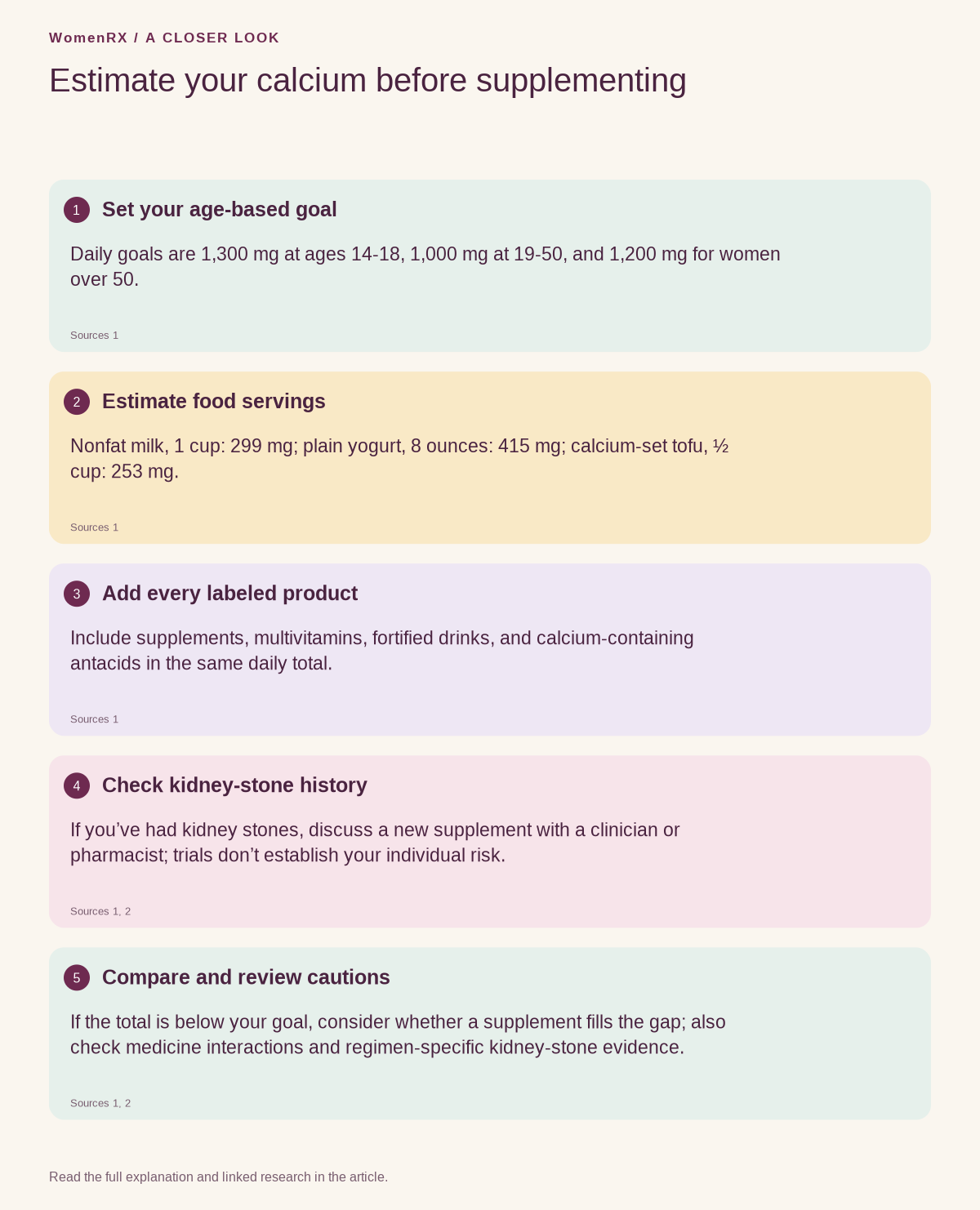
Estimate your calcium before supplementing
Set your age-based goal: Daily goals are 1,300 mg at ages 14-18, 1,000 mg at 19-50, and 1,200 mg for women over 50.1
Estimate food servings: Nonfat milk, 1 cup: 299 mg; plain yogurt, 8 ounces: 415 mg; calcium-set tofu, ½ cup: 253 mg.1
Add every labeled product: Include supplements, multivitamins, fortified drinks, and calcium-containing antacids in the same daily total.1
Check kidney-stone history: If you’ve had kidney stones, discuss a new supplement with a clinician or pharmacist; trials don’t establish your individual risk.12
Compare and review cautions: If the total is below your goal, consider whether a supplement fills the gap; also check medicine interactions and regimen-specific kidney-stone evidence.12
Read the figure as text
Use a simple intake total to compare your usual food and products with your age-specific goal, then review the cautions that apply.- Set your age-based goal: Daily goals are 1,300 mg at ages 14-18, 1,000 mg at 19-50, and 1,200 mg for women over 50.1
- Estimate food servings: Nonfat milk, 1 cup: 299 mg; plain yogurt, 8 ounces: 415 mg; calcium-set tofu, ½ cup: 253 mg.1
- Add every labeled product: Include supplements, multivitamins, fortified drinks, and calcium-containing antacids in the same daily total.1
- Check kidney-stone history: If you’ve had kidney stones, discuss a new supplement with a clinician or pharmacist; trials don’t establish your individual risk.12
- Compare and review cautions: If the total is below your goal, consider whether a supplement fills the gap; also check medicine interactions and regimen-specific kidney-stone evidence.12
More questions, answered
Can a blood calcium test show whether I need a supplement?
A blood calcium level is tightly regulated and isn’t a good reflection of how much calcium you get from food or whether your long-term intake is adequate. Intake is better estimated from your diet and products; bone-density testing answers a different question about bone. 1
Does calcium from food count toward the upper limit?
Yes. The upper intake limit applies to total calcium from food, drinks, supplements, and medicines. For adults, it ranges from 2,000 to 2,500 mg daily depending on age; it’s a ceiling, not a target. 1
Sources you can check
- Calcium - Health Professional Fact SheetAccessed 2026-09-25Return to first citation
- Vitamin D, Calcium, or Combined Supplementation for the Primary Prevention of Fractures in Community-Dwelling Adults: Evidence Report and Systematic Review for the US Preventive Services Task Force.Kahwati LC, Weber RP, Pan H, Gourlay M, LeBlanc E, Coker-Schwimmer M, Viswanathan M. · JAMA · 2018Return to first citation