How Much Calcium Do You Need, and When Should You Supplement?
Your age sets the daily calcium target, but food and fortified drinks count toward it before you decide whether a supplement fills a real gap.
For most adult women, the recommended daily intake is 1,000 mg through age 50 and 1,200 mg after 50. Pregnancy and breastfeeding do not raise the target for adults ages 19-50. Add calcium from food, fortified products, supplements, and calcium-containing antacids; consider a supplement only if your usual intake falls short, and get individualized advice when health conditions or medicines complicate the picture. 1

Start with your age, not a supplement label
The recommended daily calcium intake is 1,000 mg for women ages 19-50 and 1,200 mg for women ages 51 and older. For girls ages 14-18, it is 1,300 mg. Pregnancy and breastfeeding do not change the recommendation: it remains 1,000 mg for adults ages 19-50 and 1,300 mg for ages 14-18. These are total daily intake targets, not doses to take as a supplement. 1
The higher target after age 50 reflects the need to account for changes in bone health around and after menopause. Falling estrogen levels after menopause can reduce calcium absorption and increase calcium loss and bone breakdown. Meeting the calcium target supports bone maintenance, but it is not a personal treatment dose or a guarantee against osteoporosis. 1
Add up a usual day
Make a rough tally from the foods and drinks you commonly have. Calcium varies by product, so use the package label for fortified drinks, tofu, cereals, and other packaged foods. Labels list calcium in milligrams or as a percentage of the Daily Value. The Daily Value is 1,300 mg; it helps you compare products, but it is not the age-specific target for every woman. 1
Here are examples of amounts in a serving: an 8-ounce plain low-fat yogurt has about 415 mg; a cup of milk or calcium-fortified soymilk has about 299 mg; and half a cup of firm tofu made with calcium sulfate has about 253 mg. Other options include canned sardines or salmon with edible bones, kale, broccoli, and fortified foods. Tofu made with a different salt may contain much less calcium, so check the label. 1
Example tally, not a prescribed menu: if breakfast and lunch together provide about 600 mg and dinner and snacks provide about 300 mg, the day’s food total is about 900 mg. A woman whose target is 1,000 mg would have an estimated 100 mg gap on that example day. Check more than one ordinary day before deciding whether that gap is typical.
Count calcium from every source. Some antacids contain calcium carbonate, so frequent use can add to your total; the amount depends on the product. If you take an antacid regularly, include its label information rather than treating it as separate from your calcium intake. 1
If there’s a gap, compare it with the supplement label
A supplement may be useful when a regular diet does not provide enough, including when you avoid dairy and have few calcium-fortified foods. It is not automatically needed just because you are a woman, approaching menopause, or taking a multivitamin. Food, fortified products, and supplements all contribute to the same daily total. 12
On a supplement label, look for the amount of calcium per serving, not the total weight of the calcium compound. For example, the amount listed in Supplement Facts reflects elemental calcium, which is the figure to add to your tally. Check whether the serving is one pill or more, and whether your multivitamin or another product already contains calcium. 1
The form can affect how a supplement fits into your day. Calcium carbonate is less readily absorbed when stomach acid is low and is generally taken with food; calcium citrate is less dependent on stomach acid. Calcium supplements may cause gas, bloating, or constipation for some people. If you notice these effects, the form, amount taken at once, or taking it with meals may be worth discussing with a pharmacist or clinician. 12
When to get advice before adding one
Check with a clinician or pharmacist if a health condition or medication affects how calcium is managed, or if you have been told your blood calcium is abnormal. Low blood calcium can have several causes, including vitamin D or magnesium deficiency, problems with parathyroid hormone, critical illness, and certain medicines. The NIH reference lists proton pump inhibitors, bisphosphonates, and cisplatin among medicines associated with low blood calcium in some circumstances. That is a reason to review your situation, not a reason to start a supplement on your own. 1
A useful next step is to bring your age, a few days of food and drink estimates, and the labels for supplements and antacids you use. That gives you and your care team a clearer answer to the practical question: is there a recurring gap, and if so, what is an appropriate way to fill it?
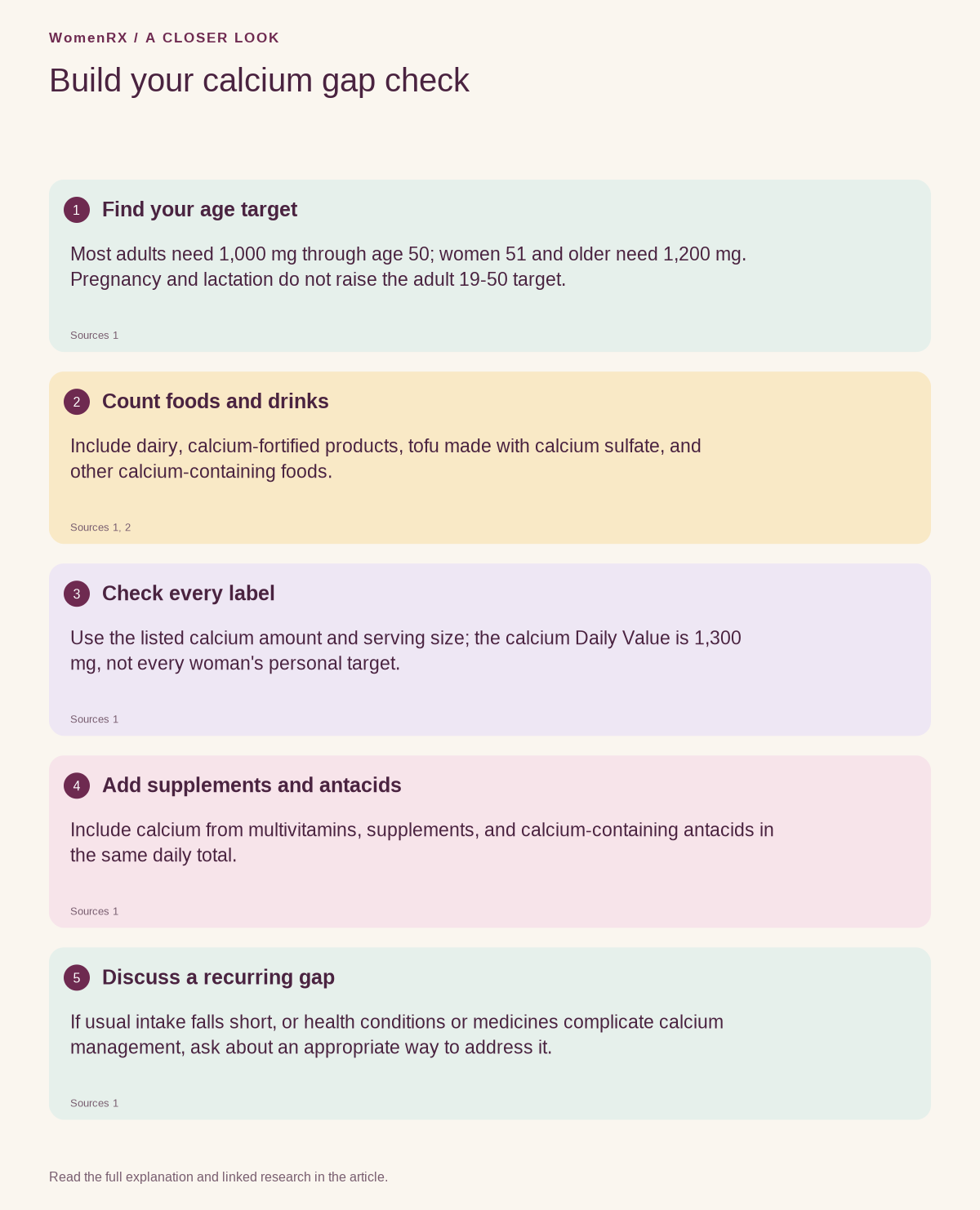
Build your calcium gap check
Find your age target: Most adults need 1,000 mg through age 50; women 51 and older need 1,200 mg. Pregnancy and lactation do not raise the adult 19-50 target.1
Count foods and drinks: Include dairy, calcium-fortified products, tofu made with calcium sulfate, and other calcium-containing foods.12
Check every label: Use the listed calcium amount and serving size; the calcium Daily Value is 1,300 mg, not every woman's personal target.1
Add supplements and antacids: Include calcium from multivitamins, supplements, and calcium-containing antacids in the same daily total.1
Discuss a recurring gap: If usual intake falls short, or health conditions or medicines complicate calcium management, ask about an appropriate way to address it.1
Read the figure as text
Use this food-first sequence to estimate total intake against the target for your age, then identify when the result deserves individualized advice.- Find your age target: Most adults need 1,000 mg through age 50; women 51 and older need 1,200 mg. Pregnancy and lactation do not raise the adult 19-50 target.1
- Count foods and drinks: Include dairy, calcium-fortified products, tofu made with calcium sulfate, and other calcium-containing foods.12
- Check every label: Use the listed calcium amount and serving size; the calcium Daily Value is 1,300 mg, not every woman's personal target.1
- Add supplements and antacids: Include calcium from multivitamins, supplements, and calcium-containing antacids in the same daily total.1
- Discuss a recurring gap: If usual intake falls short, or health conditions or medicines complicate calcium management, ask about an appropriate way to address it.1
More questions, answered
Does the calcium in fortified plant milk count?
Yes. Calcium-fortified soy and other milk substitutes count toward your daily total. Check the carton because amounts vary by product; calcium-fortified soymilk provides about 299 mg per cup in the NIH reference example. 1
Does a calcium supplement replace food sources?
Both count toward the same intake target. Start by estimating calcium from food and fortified products, then consider whether a supplement fills a regular shortfall. If you take more than one calcium-containing product, add them together. 12
Sources you can check
- Calcium - Health Professional Fact SheetAccessed 2026-09-25Return to first citation
- Calcium | MedlinePlusAccessed 2026-09-25Return to first citation