How Much Magnesium Do You Need, and When Might You Supplement?
Your daily magnesium target includes food, while the upper limit applies to supplements and magnesium-containing medicines.
For most adult women, the recommended amount is 310-320 mg of magnesium a day from all sources, with different targets during pregnancy and adolescence. That’s not a suggested supplement dose: count food first, then use the elemental magnesium amount on the Supplement Facts panel to see what a product adds. A supplement may be worth discussing if health conditions or medicines put you at risk of low magnesium. 1
Your target is a total, not a pill dose
Recommended Dietary Allowances (RDAs) are daily intake targets for healthy people. They count magnesium from food and beverages as well as supplements. For adult women, the RDA is 310 mg a day at ages 19-30 and 320 mg at ages 31 and older. Pregnancy raises the target to 350 mg at ages 19-30 and 360 mg at ages 31-50. During lactation, the target is 310 mg at ages 19-30 and 320 mg at ages 31-50. For ages 14-18, it’s 360 mg when not pregnant or lactating, 400 mg during pregnancy, and 360 mg during lactation. 1
These are reference amounts, not a test of whether your diet is adequate on any single day. A useful first step is to look at your usual meals and any supplements or magnesium-containing medicines rather than assume you need to add a pill.
| Life stage | Recommended total per day |
|---|---|
| Ages 14-18, not pregnant or lactating | 360 mg |
| Ages 14-18, pregnant | 400 mg |
| Ages 14-18, lactating | 360 mg |
| Ages 19-30, not pregnant or lactating | 310 mg |
| Ages 19-30, pregnant | 350 mg |
| Ages 19-30, lactating | 310 mg |
| Ages 31-50, not pregnant or lactating | 320 mg |
| Ages 31-50, pregnant | 360 mg |
| Ages 31-50, lactating | 320 mg |
| Ages 51 and older | 320 mg |
The RDA is the reference amount for planning intake, not a supplement recommendation. Magnesium needs vary by age and life stage; the reference values do not suggest that women generally need supplements more often than men. 1
Count food before adding a supplement
Magnesium is found in leafy greens, beans and other legumes, nuts, seeds, and whole grains. For a concrete example, an ounce of pumpkin seeds provides 156 mg, while half a cup of cooked spinach provides 78 mg. Those amounts count toward your daily total. Food labels don’t have to list magnesium unless it has been added, so a missing number on a label doesn’t mean the food contains none. 1
You don’t need to calculate every bite to use the reference. If your usual meals include several magnesium-containing foods, they may contribute meaningfully before you consider a supplement. The amount in drinking water can also vary, but it’s usually easier to start with foods and any products whose labels state magnesium content. 1
Read the amount of magnesium, not the compound weight
On a supplement label, look at the Supplement Facts panel and find the magnesium amount per serving. It lists elemental magnesium, not the weight of the whole compound, such as magnesium citrate or magnesium oxide. Check the serving size too: the listed amount applies to that serving, which may include more than one pill. Add that elemental amount to your estimate from food and other products. 1
The form matters for absorption: NIH’s Office of Dietary Supplements notes that small studies found aspartate, citrate, lactate, and chloride more bioavailable than oxide and sulfate. That comparison doesn’t establish that one form is the right choice for every person or reason. 1
The upper limit is a separate safety number
For adults, the tolerable upper intake level is 350 mg per day from supplements and medicines. It does not include magnesium naturally present in food and beverages, and it isn’t a target to aim for. Magnesium in some antacids and laxatives counts here too, so check those labels as well as a supplement bottle. High supplemental amounts can cause diarrhea, nausea, and abdominal cramping. 1
If you have reduced kidney function or kidney failure, excess magnesium can be more dangerous because the kidneys may not remove it effectively. Don’t use the general upper limit as a personal safety guarantee in that situation. 1
When to get guidance before supplementing
A supplement decision deserves extra care if you have kidney disease, ongoing diarrhea or a condition that affects absorption, type 2 diabetes, or alcohol dependence. These situations can raise the chance of low magnesium or change how the body handles it. Older adults may also have greater risk because intake, absorption, kidney handling, health conditions, and medicines can all play a part. 1
If you’re pregnant, check with your pregnancy-care provider before starting a supplement; pregnancy guidance includes herbs and supplements among products to review. Also check the magnesium in a prenatal vitamin before adding another product, so you can count the combined amount. 2
For most people, the practical sequence is simple: identify your life-stage target, count magnesium from regular foods and labeled products, and consider a supplement only if there’s a specific reason. If a health condition or medication changes the picture, ask about your situation rather than treating the RDA as a dose.
Magnesium: total intake versus supplement amount
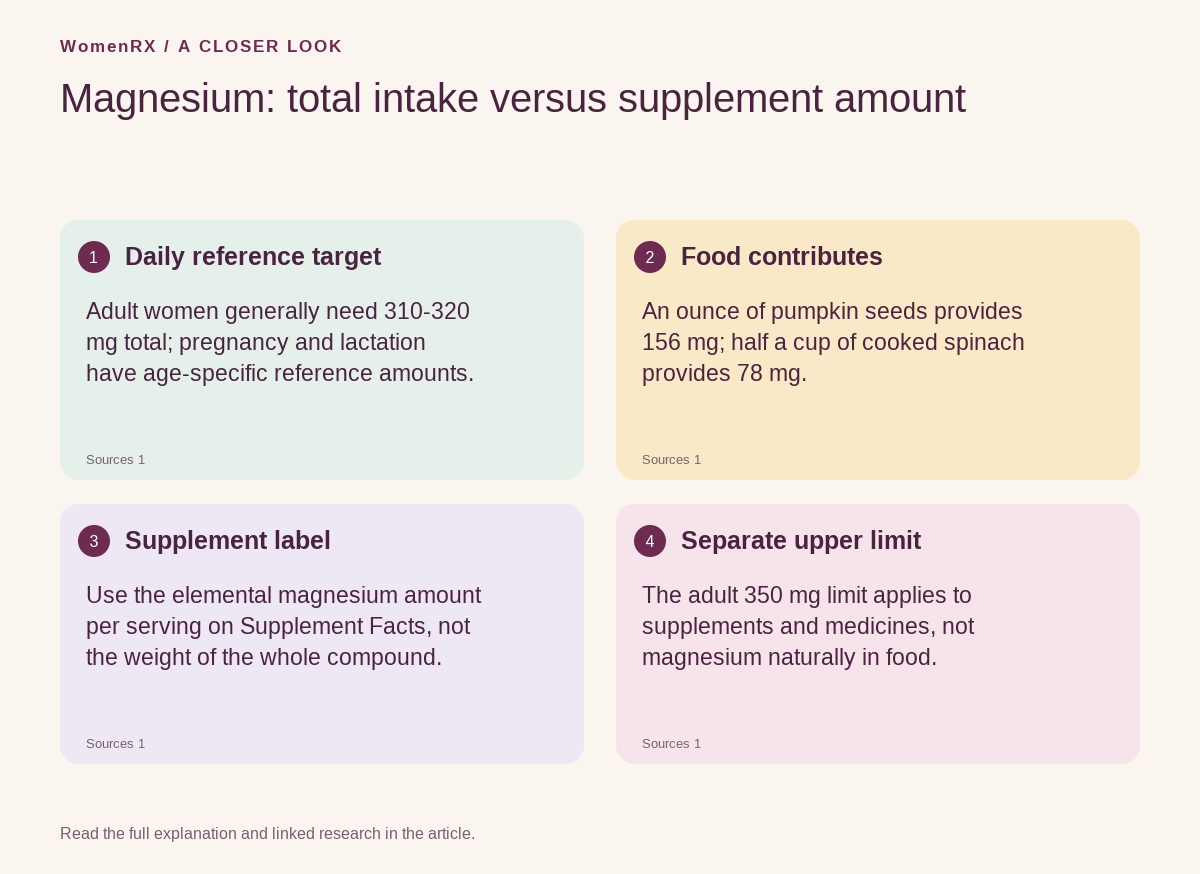
Daily reference target: Adult women generally need 310-320 mg total; pregnancy and lactation have age-specific reference amounts.1
Food contributes: An ounce of pumpkin seeds provides 156 mg; half a cup of cooked spinach provides 78 mg.1
Supplement label: Use the elemental magnesium amount per serving on Supplement Facts, not the weight of the whole compound.1
Separate upper limit: The adult 350 mg limit applies to supplements and medicines, not magnesium naturally in food.1
Read the figure as text
Use the life-stage target to think about total intake, then read supplement and medicine labels for elemental magnesium.- Daily reference target: Adult women generally need 310-320 mg total; pregnancy and lactation have age-specific reference amounts.1
- Food contributes: An ounce of pumpkin seeds provides 156 mg; half a cup of cooked spinach provides 78 mg.1
- Supplement label: Use the elemental magnesium amount per serving on Supplement Facts, not the weight of the whole compound.1
- Separate upper limit: The adult 350 mg limit applies to supplements and medicines, not magnesium naturally in food.1
More questions, answered
Does magnesium in food count toward the upper limit?
No. The adult upper limit of 350 mg per day applies to magnesium from supplements and medicines, not magnesium naturally present in food and beverages. The RDA, by contrast, is a total-intake target. 1
Can antacids or laxatives add magnesium?
Yes. Some antacids and laxatives contain magnesium, and their labels may list an elemental amount. Include these products when considering magnesium from medicines and supplements. 1
Sources you can check
- Magnesium - Health Professional Fact SheetAccessed 2026-09-25Return to first citation
- Pregnancy and Medicines | MedlinePlusAccessed 2026-09-25Return to first citation