Can You Get Enough Magnesium From Food?
For many women, ordinary foods can add up to the daily magnesium target, but a low-looking food log is not a diagnosis or an automatic reason to supplement.
Food can provide enough magnesium for many women. The recommended intake is 310 mg a day at ages 19-30 and 320 mg from 31 onward; pregnancy raises those targets to 350 or 360 mg, while lactation targets stay at 310 or 320 mg. Seeds, beans, spinach, and whole grains make useful contributions, but intake estimates alone can’t diagnose a deficiency. 1
Start with the right target
For adult women, the magnesium Recommended Dietary Allowance (RDA) is 310 mg per day from ages 19 to 30 and 320 mg from ages 31 onward. During pregnancy, it is 350 mg at ages 19 to 30 and 360 mg at ages 31 to 50. During lactation, it is 310 mg and 320 mg for those age groups, respectively. For teens ages 14 to 18, the RDA is 360 mg; it is 400 mg during pregnancy and 360 mg during lactation. 1
These are population reference values for planning diets, not a test result or a personalized prescription. An RDA is set to meet the needs of nearly all healthy people in a group. Falling short on a particular day, or even estimating a low average, does not by itself show that you have a clinical deficiency. 1
A few familiar foods can add up
Magnesium is spread across many foods, so you don’t have to rely on one “superfood.” For example, an ounce of pumpkin seeds provides about 156 mg, half a cup of cooked black beans about 60 mg, half a cup of cooked spinach about 78 mg, and half a cup of cooked brown rice about 42 mg. Together, those portions provide about 336 mg. 1
That’s a sample combination, not a required menu. You could also get magnesium from chia seeds, almonds, edamame, peanut butter, oatmeal, whole-wheat bread, yogurt, or other foods. Whole grains, beans, nuts, seeds, and leafy greens are especially useful sources. Refined grains can have less magnesium when processing removes the bran and germ. 1
Food labels don’t always make a quick estimate easy: magnesium content is not required on a label unless it has been added to the food. The figures above are typical amounts for the listed portions, so products and serving sizes can differ. 1
What a food estimate can, and can’t, tell you
A short food record can help you spot whether your usual pattern includes magnesium-rich foods. It can’t show how much magnesium your body has or diagnose deficiency. In U.S. dietary survey data from 2013-2016, 48% of people across all ages consumed less magnesium from food and drinks than their age-specific Estimated Average Requirement (EAR). That figure is not the percentage with deficiency, and the cited result does not give a separate estimate for women. 1
The EAR and RDA answer different questions: the EAR estimates the intake that meets the needs of half of healthy people in a group, while the RDA is set higher to cover nearly all of them. Group intake data can identify patterns, but they don’t tell you whether an individual has a deficiency. Magnesium status can also be difficult to assess; a review describes assessment as drawing on dietary intake alongside serum and urine measures. 1 2
Symptoms such as fatigue, weakness, nausea, or muscle cramps can have many possible causes, so they are not a reliable way to confirm low magnesium on their own. If symptoms persist, or if you have a condition that can affect absorption or losses, such as chronic diarrhea, celiac disease, Crohn’s disease, or type 2 diabetes, it’s reasonable to ask whether an individual assessment is warranted. 1
When a supplement deserves a closer look
A supplement isn’t automatically needed just because an estimate falls below the RDA. First consider whether your regular meals include a few of the food sources above. If a health condition, ongoing digestive losses, or a restricted diet makes adequate intake difficult, discuss the situation with a clinician rather than treating a food log as a diagnosis. 1
Check labels on supplements and some antacids or laxatives, which can also contain magnesium. For adults, the upper limit of 350 mg per day applies to magnesium from supplements and medications, not the magnesium naturally present in food. It is a safety limit, not a target. Higher supplemental or medication amounts can cause diarrhea, nausea, or abdominal cramping; the risk of excess is greater when kidney function is impaired. 1
A practical next move is to compare your usual meals with the age- and life-stage target, then look for one or two food sources you’d actually enjoy adding. If a medical condition or persistent symptoms are part of the picture, ask about assessment rather than trying to diagnose yourself from intake or symptoms alone. 1 2
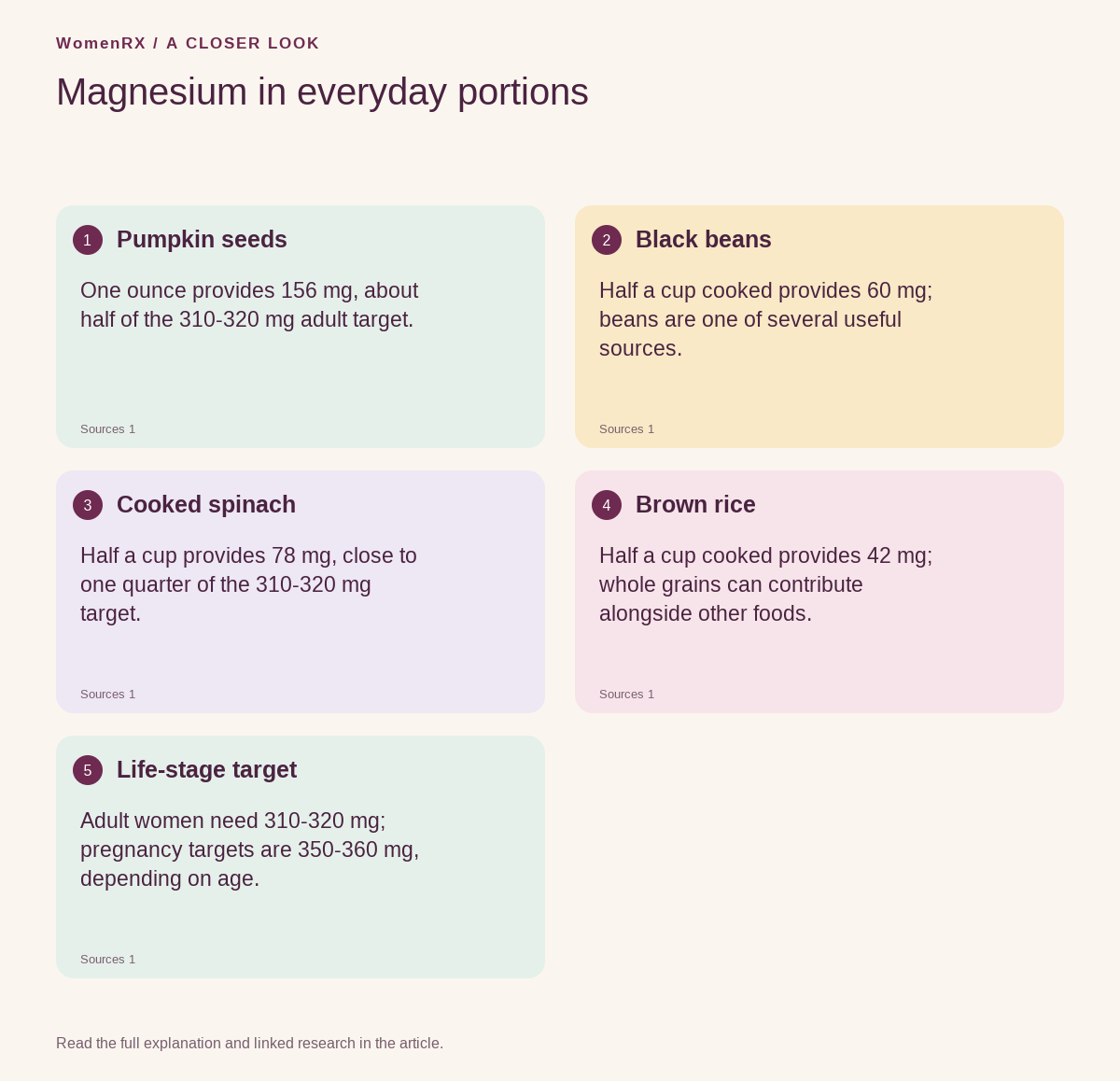
Magnesium in everyday portions
Pumpkin seeds: One ounce provides 156 mg, about half of the 310-320 mg adult target.1
Black beans: Half a cup cooked provides 60 mg; beans are one of several useful sources.1
Cooked spinach: Half a cup provides 78 mg, close to one quarter of the 310-320 mg target.1
Brown rice: Half a cup cooked provides 42 mg; whole grains can contribute alongside other foods.1
Life-stage target: Adult women need 310-320 mg; pregnancy targets are 350-360 mg, depending on age.1
Read the figure as text
Compare several practical food portions with adult women’s intake targets. The foods are examples, not a prescribed meal plan.- Pumpkin seeds: One ounce provides 156 mg, about half of the 310-320 mg adult target.1
- Black beans: Half a cup cooked provides 60 mg; beans are one of several useful sources.1
- Cooked spinach: Half a cup provides 78 mg, close to one quarter of the 310-320 mg target.1
- Brown rice: Half a cup cooked provides 42 mg; whole grains can contribute alongside other foods.1
- Life-stage target: Adult women need 310-320 mg; pregnancy targets are 350-360 mg, depending on age.1
More questions, answered
Does being below the RDA mean I’m deficient?
No. The RDA is a planning target designed to cover nearly all healthy people in a group. An estimated intake below it can flag a possible dietary gap, but it does not diagnose deficiency. 1
Do pregnancy and breastfeeding change the target?
Yes. For women ages 19-30, the RDA is 350 mg during pregnancy and 310 mg during lactation. For ages 31-50, it is 360 mg during pregnancy and 320 mg during lactation. 1
Sources you can check
- Magnesium - Health Professional Fact SheetAccessed 2026-09-25Return to first citation
- Magnesium: Hype and Health Benefits.Sankararaman S, Memel Z, Dubroff J, Rocha JP. · Current nutrition reports · 2026Return to first citation