Can You Get Enough Vitamin B12 From Food?
Animal foods and labeled fortified products can provide B12, but what you eat and what your body absorbs are separate questions.
Yes, food can provide vitamin B12 if your diet regularly includes B12-containing animal foods or products fortified with B12. Fish, meat, eggs, and dairy contain it naturally; some cereals and nutritional yeasts have it added. Unfortified plant foods aren’t reliable sources. If you eat vegan, plan a dependable fortified source or supplement, and remember that digestive problems can affect absorption. 1 2
Check the food, not just the food category
Vitamin B12 occurs naturally in foods from animals, including fish, meat, poultry, eggs, and dairy. Some breakfast cereals and nutritional yeasts have B12 added. Plant foods don’t naturally provide reliable B12, so a vegan diet needs a dependable source from fortified foods or supplements. 1
A useful first check is the Nutrition Facts label on products you eat regularly. Look for the B12 amount per serving and whether the product is fortified. The label’s Daily Value for B12 is 2.4 micrograms, which can help you compare products; it is a reference for daily intake, not a measure of how much your body absorbs. 1
For example, if you rely on fortified cereal, use the amount in the portion you actually eat, not an assumed serving. Check nutritional yeast, too: some products are fortified and some may not be. Product labels are more useful than the food name alone because the amount added can vary. 1
Three kinds of sources, with different tradeoffs
Animal foods provide B12 naturally. A mixed diet that regularly includes them may meet intake needs, but the amount depends on the foods and portions you eat. Eggs contain B12, though a review reports that it may be less readily absorbed from eggs than from some other animal foods. 1 5
Fortified foods can help fill the gap when you eat little or no animal food. Fortified cereals and nutritional yeasts are established examples. B12 added to fortified foods is already in a free form, so it does not need the same initial digestive step as B12 bound within food. 1
Unfortified plant foods aren’t dependable B12 sources. Some algae and other plant foods have been reported to contain B12 compounds, but the forms and activity can vary; some algae contain pseudovitamin B12, which is inactive in humans. Don’t rely on algae or ordinary vegetables in place of labeled fortified foods or a supplement. 1 3
Intake and absorption are separate checks
A label tally can help you see whether your usual diet includes B12, but it can’t tell you whether your body absorbs enough. B12 naturally present in food must be released during digestion, then bind to intrinsic factor, a protein made in the stomach, before absorption in the small intestine. 1
Some stomach or intestinal conditions, certain medicines, and stomach surgery can interfere with absorption. If one of these applies to you, simply adding more B12-rich foods may not address the problem. Food sources and absorption are different parts of the picture, and a food tally alone can’t establish B12 status. 1 2
Make a life-stage check if you’re pregnant or breastfeeding
The adult recommended dietary allowance is 2.4 micrograms per day, but intake recommendations vary by life stage. Don’t assume the adult figure is the right target during pregnancy or breastfeeding; use a reference specific to that stage. 1
Diet pattern still matters: a review of micronutrients in women of reproductive potential identifies vegetarians as at greater risk of dietary B12 deficiency because natural food sources are limited to animal foods. If you eat vegetarian or vegan while pregnant or breastfeeding, make sure your plan includes a dependable B12 source and uses a life-stage-appropriate target. 1 4
A practical source check
Write down the B12 amounts in the servings of fortified products you actually eat, and note whether your diet includes animal foods. If you eat no animal foods and don’t routinely use a product labeled with added B12, your diet may lack a dependable source. If you do eat B12-containing foods but have a condition or history that may affect absorption, a label-based intake check cannot answer the absorption question. 1 2
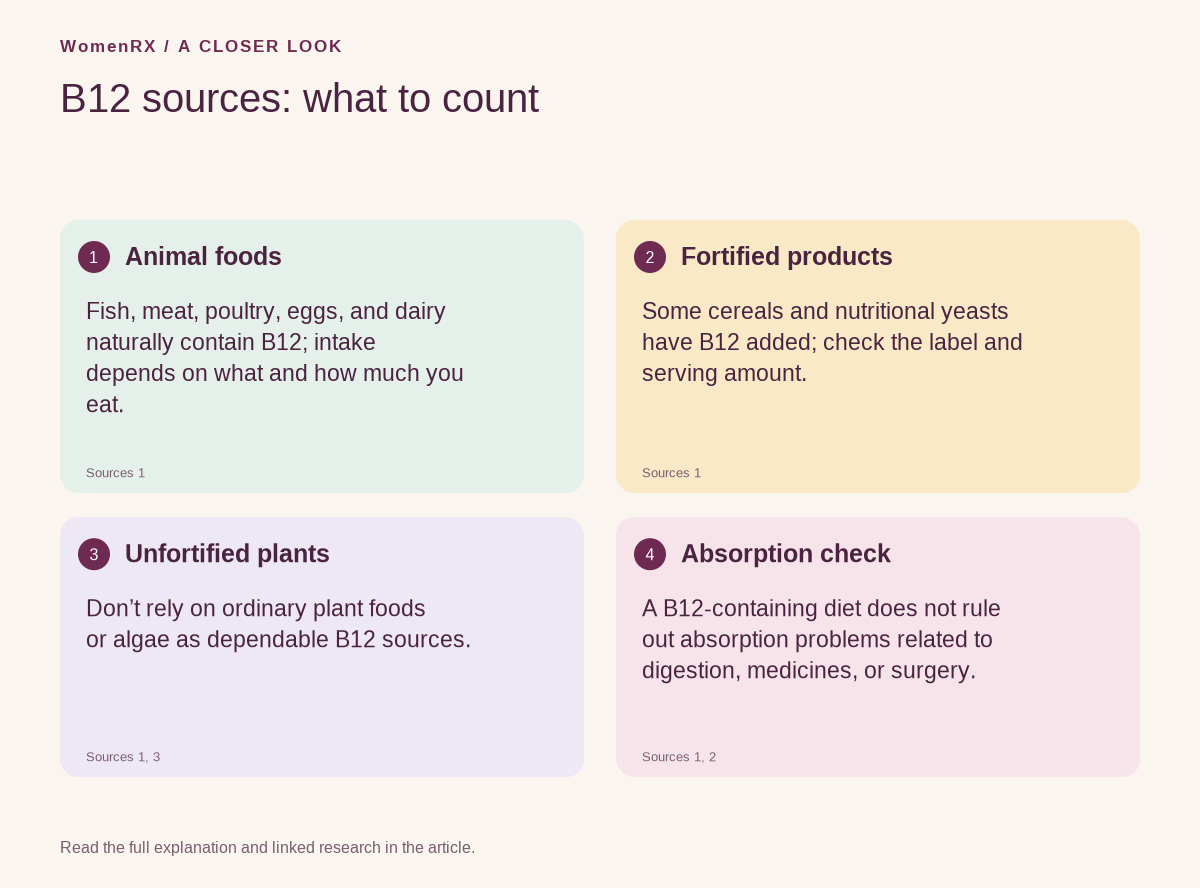
B12 sources: what to count
Animal foods: Fish, meat, poultry, eggs, and dairy naturally contain B12; intake depends on what and how much you eat.1
Fortified products: Some cereals and nutritional yeasts have B12 added; check the label and serving amount.1
Unfortified plants: Don’t rely on ordinary plant foods or algae as dependable B12 sources.13
Absorption check: A B12-containing diet does not rule out absorption problems related to digestion, medicines, or surgery.12
Read the figure as text
Compare natural sources, fortified choices, and the separate question of absorption.- Animal foods: Fish, meat, poultry, eggs, and dairy naturally contain B12; intake depends on what and how much you eat.1
- Fortified products: Some cereals and nutritional yeasts have B12 added; check the label and serving amount.1
- Unfortified plants: Don’t rely on ordinary plant foods or algae as dependable B12 sources.13
- Absorption check: A B12-containing diet does not rule out absorption problems related to digestion, medicines, or surgery.12
More questions, answered
Can nutritional yeast provide vitamin B12?
Yes, if it’s fortified. Check the package for added B12 and the amount per serving rather than assuming every nutritional yeast product contains it. 1
Does eating B12-rich foods prove you’re absorbing enough?
No. A food tally shows what you eat, not what your body absorbs. Some digestive conditions and surgeries can interfere with absorption. 1 2
Sources you can check
- Vitamin B12 - Health Professional Fact SheetAccessed 2026-09-25Return to first citation
- About cyanocobalamin - NHSAccessed 2026-09-25Return to first citation
- Biologically active vitamin B12 compounds in foods for preventing deficiency among vegetarians and elderly subjects.Watanabe F, Yabuta Y, Tanioka Y, Bito T. · Journal of agricultural and food chemistry · 2013Return to first citation
- Micronutrients and women of reproductive potential: required dietary intake and consequences of dietary deficiency or excess. Part I--Folate, Vitamin B12, Vitamin B6.Simpson JL, Bailey LB, Pietrzik K, Shane B, Holzgreve W. · The journal of maternal-fetal & neonatal medicine : the official journal of the European Association of Perinatal Medicine, the Federation of Asia and Oceania Perinatal Societies, the International Society of Perinatal Obstetricians · 2010Return to first citation
- Vitamin B12 sources and bioavailability.Watanabe F. · Experimental biology and medicine (Maywood, N.J.) · 2007Return to first citation