Does Turning 40 Mean You Need Vitamin B12?
Your diet and ability to absorb B12 matter more than turning 40.
No. Turning 40 alone doesn’t mean you need a B12 supplement or a blood test. A more useful check is whether you regularly eat B12-containing foods, have a condition or surgery that can affect absorption, or have symptoms that warrant assessment. B12 levels can be checked with a blood test, and another marker may help clarify a borderline result. 1 2
Start with what could affect your B12
Vitamin B12 helps your body make red blood cells and keep your nervous system healthy. The decision about testing or taking a supplement is less about a particular birthday and more about whether you get B12 from food and can absorb it. 2
Diet is one useful place to start. B12 is found in animal foods such as meat, fish, eggs, and dairy. People who eat vegan diets are among the groups at greater risk of inadequate B12 intake; people who eat little or no animal food may also want to review how they get B12. 1 3
Absorption can matter as much as intake. The NIH Office of Dietary Supplements identifies pernicious anemia, gastrointestinal disorders, and gastrointestinal surgery as risk factors. Stomach conditions that affect acid or intrinsic factor can also make it harder to absorb B12 from food. Some medicines can affect absorption, too, so include your regular medicines when reviewing possible risks. 1 2
Age-related absorption concerns are generally discussed for older adults, not as a reason to treat everyone over 40. In US survey data from 2007-2018, B12 deficiency, defined as a blood level below 200 pg/mL, affected about 3.6% of adults 19 and older and 3.7% of adults 60 and older. Those estimates don’t establish a special threshold for women in their 40s. 1
Fatigue is a clue, not a diagnosis
Low B12 can cause symptoms such as tiredness, but tiredness by itself doesn’t show that B12 is the cause. A supplement is expected to help symptoms only when they’re related to low B12. That makes testing more useful than guessing from a symptom or an age milestone when deficiency is a concern. 3
Perimenopause and menopause don’t create a separate B12 rule in the recognized risk factors described here. If you’re in that stage and feeling tired, consider the same practical questions: Is your intake limited? Could a health condition, surgery, or medicine affect absorption? Is there a reason to check your level rather than assume a supplement will address the symptom? 1 3
Testing and taking a supplement are different decisions
A blood test measures B12 status; supplementation adds B12. They aren’t interchangeable. Serum or plasma B12 is commonly used for assessment. If the result falls in a borderline range, methylmalonic acid (MMA), a B12-related marker, can help clarify whether deficiency is present. The NIH fact sheet describes MMA as a way to confirm deficiency when B12 is between 150 and 399 pg/mL. Test results need to be interpreted in context rather than treated as a self-diagnosis. 1
If a test confirms low B12, treatment can raise B12 levels. But the reason for the low level matters: an intake gap and an absorption problem are not the same situation. Food sources may help address low dietary intake, while a condition that interferes with absorption may need a different treatment approach. 1 3
For a practical next step, note whether you regularly eat B12-containing foods, any digestive condition or surgery, your medicines, and symptoms that prompted the question. If one of these raises concern, ask whether testing makes sense. If none does, turning 40 alone isn’t a reason to assume you need a supplement.
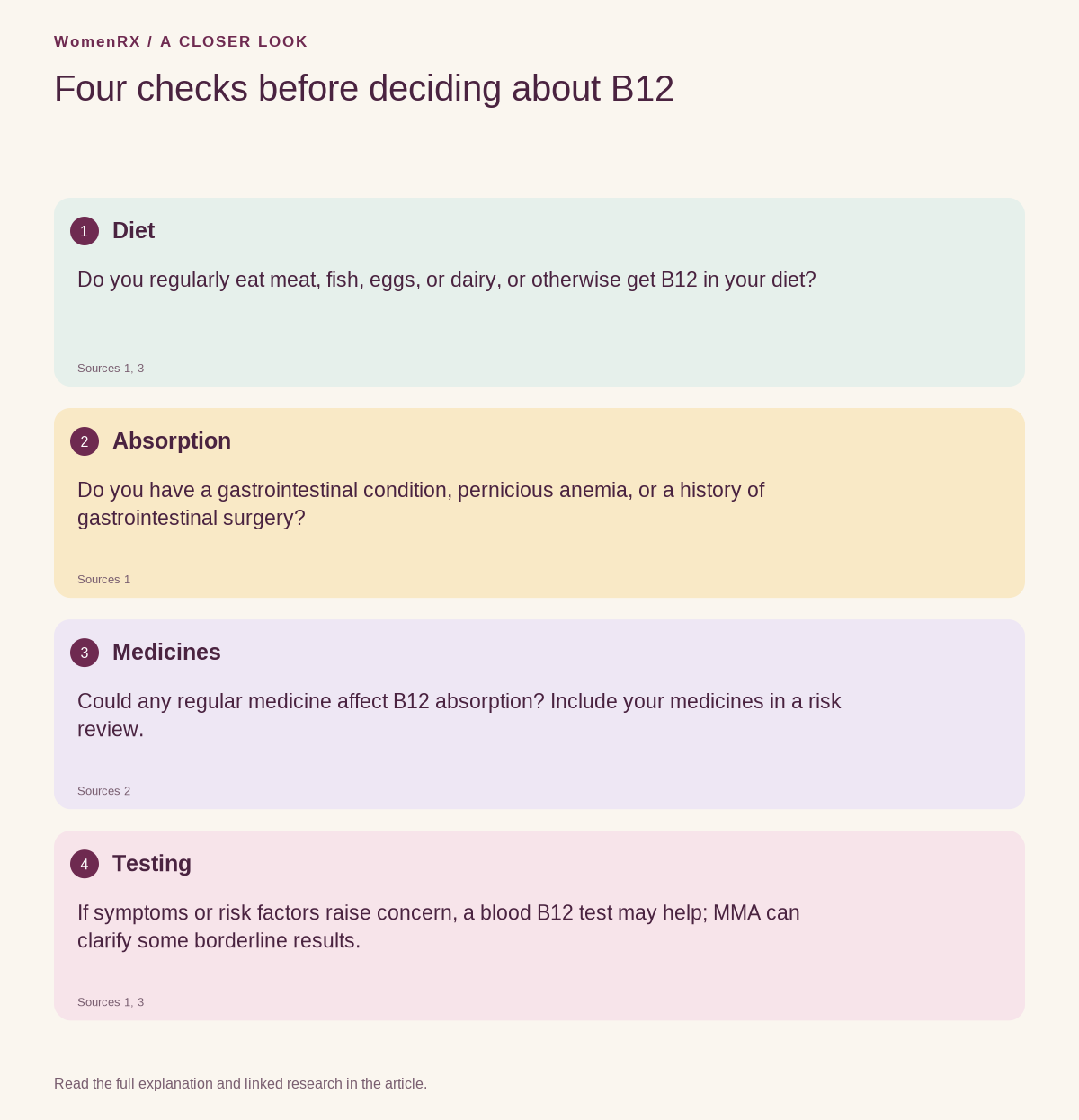
Four checks before deciding about B12
Diet: Do you regularly eat meat, fish, eggs, or dairy, or otherwise get B12 in your diet?13
Absorption: Do you have a gastrointestinal condition, pernicious anemia, or a history of gastrointestinal surgery?1
Medicines: Could any regular medicine affect B12 absorption? Include your medicines in a risk review.2
Testing: If symptoms or risk factors raise concern, a blood B12 test may help; MMA can clarify some borderline results.13
Read the figure as text
Use these questions to separate a possible dietary gap, an absorption concern, a symptom, and the role of testing.- Diet: Do you regularly eat meat, fish, eggs, or dairy, or otherwise get B12 in your diet?13
- Absorption: Do you have a gastrointestinal condition, pernicious anemia, or a history of gastrointestinal surgery?1
- Medicines: Could any regular medicine affect B12 absorption? Include your medicines in a risk review.2
- Testing: If symptoms or risk factors raise concern, a blood B12 test may help; MMA can clarify some borderline results.13
More questions, answered
Can I take B12 just in case?
A supplement can increase B12 levels, but it may not address symptoms that aren’t caused by low B12. If you have a possible absorption problem or symptoms you’re trying to explain, checking whether deficiency is present is more informative than assuming a supplement will help. 1 3
Does menopause mean I should take B12?
Menopause alone isn’t identified as a B12 risk factor in the clinical risk groups described here. Diet, certain health conditions, gastrointestinal surgery, and possible absorption problems are more useful factors to consider. 1
Sources you can check
- Vitamin B12 - Health Professional Fact SheetAccessed 2026-09-25Return to first citation
- About cyanocobalamin - NHSAccessed 2026-09-25Return to first citation
- Common questions about cyanocobalamin - NHSAccessed 2026-09-25Return to first citation