Vitamin B12 Food Sources: What Counts and When to Check
Fish, meat, eggs, dairy, and clearly labeled fortified foods are dependable food sources of B12; ordinary plant foods aren’t.
Vitamin B12 occurs naturally in animal foods such as fish, meat, eggs, and dairy. For a plant-based diet, look for B12 added to foods such as some breakfast cereals or nutritional yeast, and check the label because amounts vary. Adults need 2.4 mcg daily; the recommendation is higher during pregnancy and breastfeeding. Symptoms alone can’t confirm deficiency, and absorption problems can matter even when your diet includes B12. 1
The dependable food sources
B12 is naturally present in foods from animals, including fish, meat, poultry, eggs, and dairy. Some examples of the amount in a serving are 2.6 mcg in 3 ounces of cooked salmon, 2.5 mcg in 3 ounces of canned light tuna, 1.3 mcg in a cup of milk, and 0.5 mcg in one large egg. The amounts vary by food and serving, so these examples are a guide, not a menu you need to follow. 1
Some foods provide much more B12 per serving. Three ounces of cooked clams contains 17 mcg, while 3 ounces of cooked beef liver contains 70.7 mcg. You don’t have to choose these foods specifically: the practical question is whether your usual eating pattern includes a dependable source. 1
Fortified foods can work, but check the label
B12 isn’t naturally present in ordinary plant foods, but manufacturers add it to some products, including breakfast cereals and nutritional yeast. Fortified products can be useful sources, including for people who don’t eat animal foods. The amount depends on the product: in the NIH fact sheet’s examples, a serving of cereal fortified with 25% of the Daily Value provides 0.6 mcg, while about a quarter cup of fortified nutritional yeast provides 8.3 to 24 mcg, depending on the brand. Read the label rather than assuming every cereal or yeast product contains B12. 1
Some seaweeds, mushrooms, and fermented foods have also been studied for B12. A systematic review found measurable amounts in some samples but reported wide variation across foods and called for better standardization. That makes these foods less predictable than products specifically fortified with B12; don’t assume an unfortified plant food will reliably cover your needs. 1 2
| Source | What to look for | The useful distinction |
|---|---|---|
| Animal foods | Fish, meat, eggs, dairy | Naturally occurring B12; amounts vary by food and serving. 1 |
| Fortified foods | Check cereal or nutritional-yeast labels | B12 is added, and the amount varies by product. 1 |
| Unfortified plant foods | Ordinary fruits, vegetables, grains, and beans | They aren’t dependable natural B12 sources. 1 |
| Supplements | Check the product label | They provide B12 without relying on food sources; whether one is needed depends on diet and absorption. 1 |
Needs change with life stage, not with a single “women’s diet”
For adults age 19 and older, the recommended dietary allowance is 2.4 mcg a day. It’s 2.6 mcg during pregnancy and 2.8 mcg while breastfeeding. These are daily intake recommendations, not a requirement to get the vitamin from any particular food. 1
Pregnancy can affect how B12 looks on a blood test: levels may fall during pregnancy and usually return toward normal after delivery. That change doesn’t by itself establish deficiency. If you’re pregnant or breastfeeding and eat vegan, have a limited range of B12 sources, or have been told you may not absorb B12 well, it’s worth discussing a reliable food or supplement source with your care team. B12 in breast milk is related to the mother’s intake, and an exclusively breastfed infant of a mother who consumes no animal products may have limited B12 reserves if the mother is deficient. 1
A vegan diet means no natural animal-food sources, so regularly relying on labeled fortified foods or a supplement is especially relevant. Vegetarians who eat eggs or dairy may get some B12 from those foods, but whether that is enough depends on what and how much they eat. Older adults aren’t automatically deficient, but some develop stomach changes that reduce absorption of B12 from food. 1
Food intake and absorption are different questions
B12 in food is attached to protein. Stomach acid and digestive enzymes help release it before it can be absorbed. B12 added to fortified foods and supplements is already in free form, so it doesn’t need that release step. This is one reason someone can eat B12-containing foods and still have trouble getting enough: the issue may be absorption rather than food choice. 1
Pernicious anemia, some stomach or intestinal conditions, and some gastrointestinal surgeries can interfere with absorption. Long-term use of metformin or acid-reducing medicines such as proton pump inhibitors may also affect B12 status. These factors don’t mean you have a deficiency, but they can make diet alone an incomplete answer. 1
When testing may be more useful than guessing
Tiredness, tingling or numbness, and other symptoms can occur with B12 deficiency, but none of them proves that B12 is the cause. Symptoms can take years to appear, and nerve symptoms may occur without anemia. If you have symptoms alongside a vegan diet, a known absorption concern, gastrointestinal surgery, or long-term use of a medicine that can affect B12, ask whether testing makes sense rather than trying to diagnose yourself from symptoms or food intake alone. 1
Blood B12 is commonly checked. If the result is in a borderline range, a clinician may use methylmalonic acid, or MMA, to help clarify the picture; MMA can also rise for reasons such as reduced kidney function, so it needs context. Food can help meet a dietary need, but it won’t fix every cause of low B12, especially when absorption is impaired. 1
The useful comparison is straightforward: animal foods contain B12 naturally, fortified foods offer a labeled plant-based source, and supplements provide another source when food choices or absorption make them useful. Which route fits depends on your diet, life stage, and ability to absorb the vitamin, not on symptoms alone.
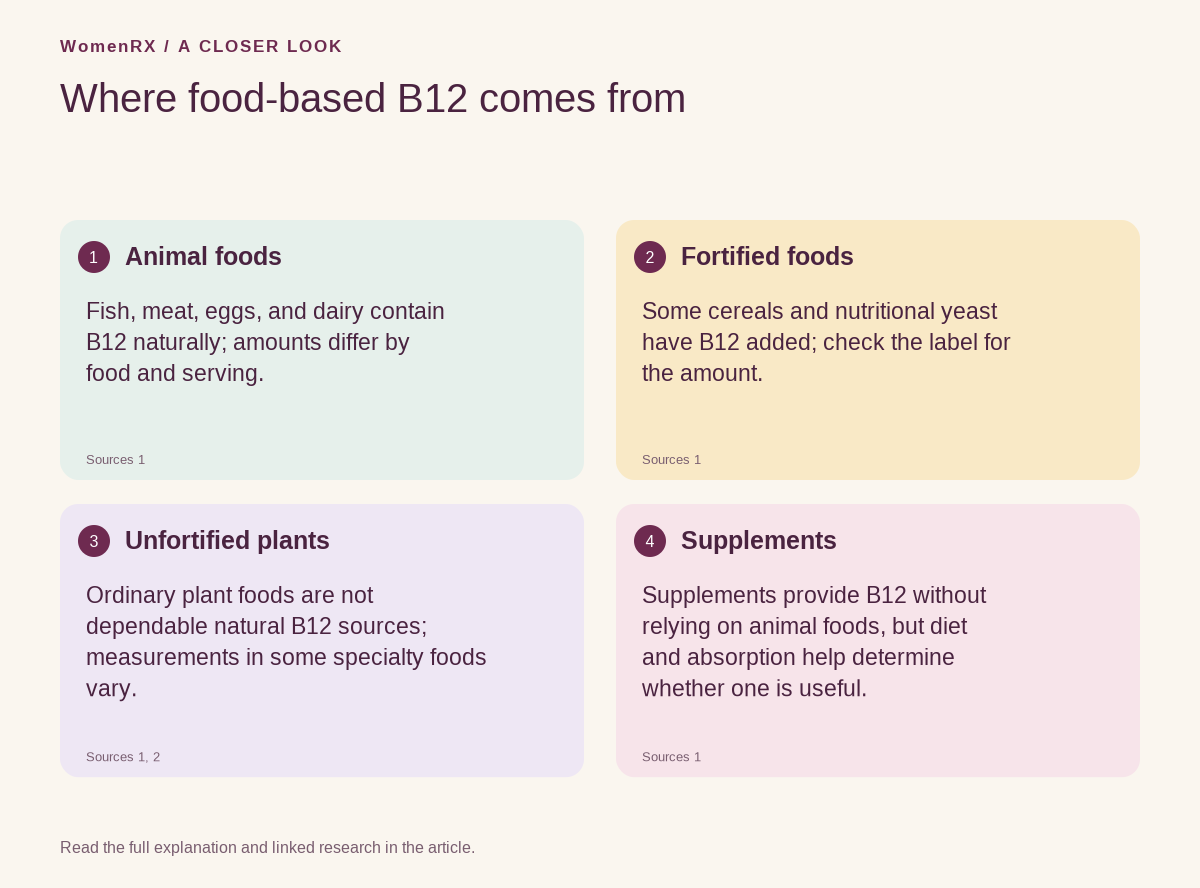
Where food-based B12 comes from
Animal foods: Fish, meat, eggs, and dairy contain B12 naturally; amounts differ by food and serving.1
Fortified foods: Some cereals and nutritional yeast have B12 added; check the label for the amount.1
Unfortified plants: Ordinary plant foods are not dependable natural B12 sources; measurements in some specialty foods vary.12
Supplements: Supplements provide B12 without relying on animal foods, but diet and absorption help determine whether one is useful.1
Read the figure as text
Compare natural animal-food sources with B12 added to foods, less predictable unfortified plant foods, and supplements.- Animal foods: Fish, meat, eggs, and dairy contain B12 naturally; amounts differ by food and serving.1
- Fortified foods: Some cereals and nutritional yeast have B12 added; check the label for the amount.1
- Unfortified plants: Ordinary plant foods are not dependable natural B12 sources; measurements in some specialty foods vary.12
- Supplements: Supplements provide B12 without relying on animal foods, but diet and absorption help determine whether one is useful.1
More questions, answered
Can eggs provide enough B12 on their own?
One large cooked egg contains about 0.5 mcg of B12, compared with the 2.4 mcg daily recommendation for most adults. Eggs contribute, but whether your overall diet provides enough depends on your other food sources and how much you eat. 1
Does a B12 supplement help if tiredness is the only symptom?
Tiredness can have many causes and doesn’t establish B12 deficiency. Testing may be more useful when tiredness occurs alongside a risk factor such as a vegan diet or a problem with absorption. 1
Sources you can check
- Vitamin B12 - Health Professional Fact SheetAccessed 2026-09-25Return to first citation
- Vitamin B12 sources in non-animal foods: a systematic review.Marques de Brito B, Campos VM, Neves FJ, Ramos LR, Tomita LY. · Critical reviews in food science and nutrition · 2023Return to first citation