Vitamin B12 Deficiency: Food, Testing, and Treatment
If your diet or health could affect B12, the next step depends on whether you’re preventing a shortfall or treating a confirmed deficiency.
Vitamin B12 comes naturally from animal foods; plant-based eaters can get it from foods fortified with B12 or supplements. But low intake isn’t the only reason levels fall: digestive conditions or surgery can impair absorption, while prolonged use of certain medicines can contribute to deficiency. Testing and treatment depend on symptoms and the likely cause, so a supplement meant for prevention isn’t automatically enough to treat a deficiency. 1 2
Start with where B12 comes from
Vitamin B12 is naturally present in foods such as fish, meat, poultry, eggs, and dairy. Plant foods don’t naturally provide it, but some breakfast cereals and nutritional yeasts are fortified. If you eat vegan or rarely eat animal foods, check labels and consider how fortified foods or a supplement fit into your regular routine. 1
For context, the recommended daily amount for most adults is 2.4 micrograms. It’s 2.6 micrograms during pregnancy and 2.8 micrograms while breastfeeding. These are intake recommendations for generally healthy people, not treatment doses for a diagnosed deficiency. 1
Low intake is only one possible cause
B12 in food has to be released from the food and absorbed through a process involving stomach acid and intrinsic factor. Problems with this process can occur with conditions such as pernicious anemia or atrophic gastritis, some gastrointestinal diseases, or surgery involving the digestive tract. So eating B12-rich foods doesn’t guarantee you’ll absorb enough. 1 2
Long-term use of certain medicines, including metformin and proton pump inhibitors, is also associated with deficiency. That’s a reason to mention these medicines when discussing possible symptoms or testing, not a reason to stop a prescription on your own. 1
Age alone doesn’t establish a deficiency. Digestive history and medication use may be relevant at any age, so a history of these factors can help make sense of a test result. 1 2
When testing may be part of the conversation
Fatigue, anemia, tongue soreness, and numbness or tingling can occur with B12 deficiency, but they can also have other causes. Nerve symptoms can happen even without anemia. If you have symptoms, a diet with little B12, or a condition or medication that could affect absorption, tell your clinician about the pattern and how long it has been going on. 1 2
A blood B12 level is commonly used as a screening marker. If the result doesn’t clearly fit the symptoms or clinical picture, methylmalonic acid or homocysteine may help support the assessment. These additional markers have limitations, including the effect of kidney problems on their levels. 2
There isn’t one universally agreed B12 cutoff across the research literature. Results also depend on the marker and measurement method. That’s why a number is best interpreted alongside symptoms, health history, and any follow-up testing rather than treated as a diagnosis by itself. 2 3
Prevention and treatment are different jobs
If the issue is simply a low-B12 diet, fortified foods or a supplement may help you maintain intake. Supplements come in forms including cyanocobalamin and methylcobalamin. The NIH Office of Dietary Supplements notes that there’s no evidence that absorption rates differ by form; it also reports no demonstrated efficacy advantage for sublingual over oral B12. 1
If testing suggests a deficiency, the key question is why it happened. Treatment choice depends on the cause and the severity of symptoms. Expert consensus favors initial B12 given by injection for acute, severe symptoms, while high-dose oral B12 may be considered for longer-term treatment. Research comparing oral and injected treatment in adults is limited, so this isn’t a one-formulation-fits-everyone decision. 1 2
Don’t assume that an over-the-counter supplement will address a suspected absorption problem or replace an evaluation. A useful discussion is whether your pattern points to low intake, impaired absorption, or both, and what follow-up would show that the plan is working. 1 2
Pregnancy, breastfeeding, and plant-based eating
Pregnancy and breastfeeding have higher recommended B12 intakes than other adult years. Blood B12 levels can also fall during pregnancy and commonly return toward normal after delivery, so a result needs to be understood in context. If you eat little or no animal food, make sure your clinician knows, especially if you’re pregnant or breastfeeding. B12 deficiency during these periods can affect the baby as well as the parent. 1
For a plant-based routine, look for B12 listed on fortified-food labels rather than assuming that an unfortified plant food contains it. If you already have symptoms or a low test result, treat that as a separate question from how to prevent low intake. 1
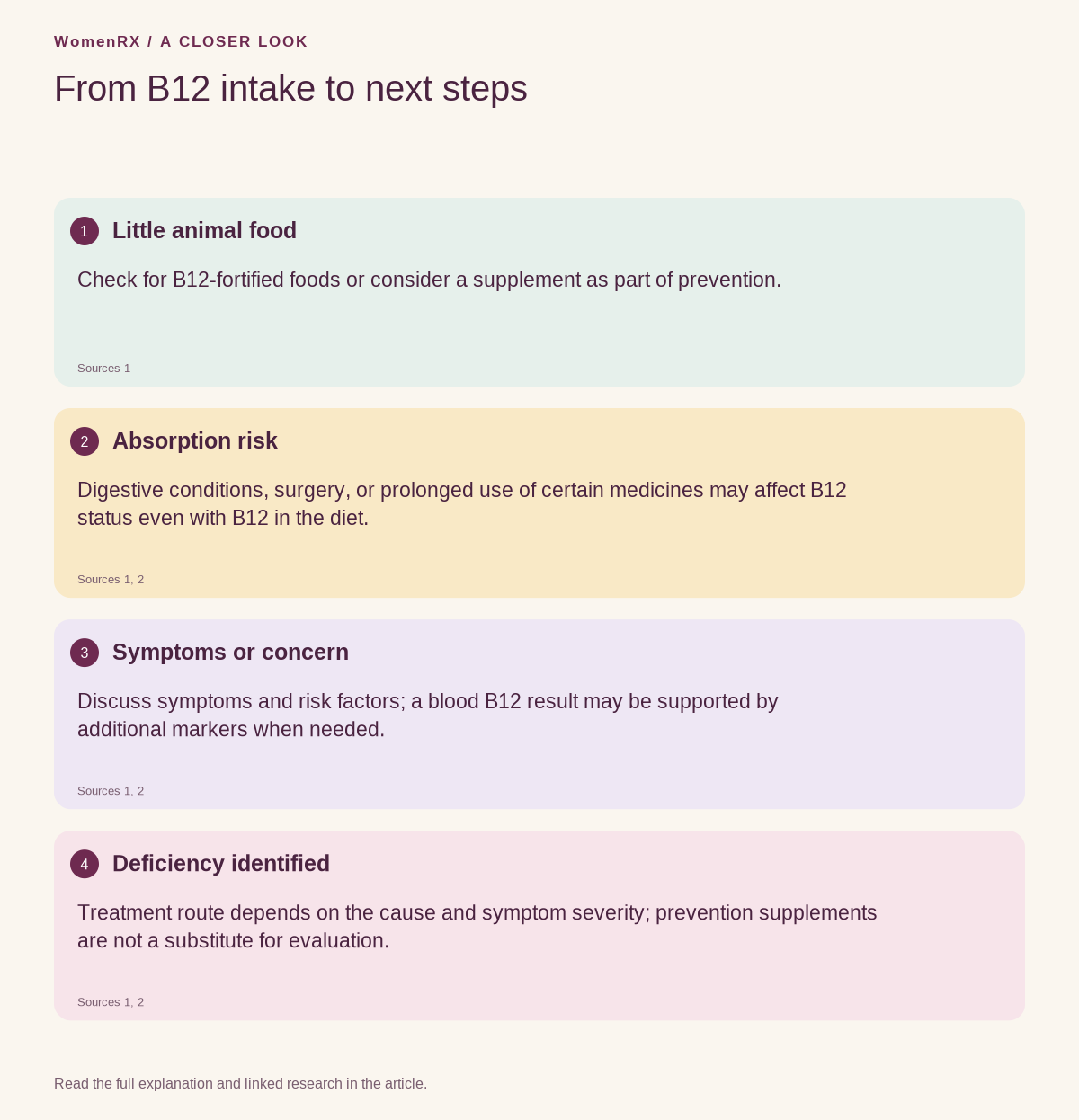
From B12 intake to next steps
Little animal food: Check for B12-fortified foods or consider a supplement as part of prevention.1
Absorption risk: Digestive conditions, surgery, or prolonged use of certain medicines may affect B12 status even with B12 in the diet.12
Symptoms or concern: Discuss symptoms and risk factors; a blood B12 result may be supported by additional markers when needed.12
Deficiency identified: Treatment route depends on the cause and symptom severity; prevention supplements are not a substitute for evaluation.12
Read the figure as text
Use the distinction between low dietary intake and possible absorption problems to frame a conversation about testing and treatment.- Little animal food: Check for B12-fortified foods or consider a supplement as part of prevention.1
- Absorption risk: Digestive conditions, surgery, or prolonged use of certain medicines may affect B12 status even with B12 in the diet.12
- Symptoms or concern: Discuss symptoms and risk factors; a blood B12 result may be supported by additional markers when needed.12
- Deficiency identified: Treatment route depends on the cause and symptom severity; prevention supplements are not a substitute for evaluation.12
More questions, answered
Can B12 deficiency cause tingling without anemia?
Yes. Numbness or tingling can occur even when anemia isn’t present. 1
Is methylcobalamin better absorbed than cyanocobalamin?
The NIH Office of Dietary Supplements reports no evidence that supplement absorption differs by B12 form. The cause and severity of a deficiency matter more to treatment decisions than choosing a form based on an assumed absorption advantage. 1 2
Does taking a B12 supplement prove my levels are adequate?
No. Intake and absorption are separate issues, and some people have difficulty absorbing B12 from food. If symptoms or risk factors remain, discuss whether testing is appropriate rather than relying on supplement use alone. 1 2
Sources you can check
- Vitamin B12 - Health Professional Fact SheetAccessed 2026-09-25Return to first citation
- Diagnosis, Treatment and Long-Term Management of Vitamin B12 Deficiency in Adults: A Delphi Expert Consensus.Obeid R, Andrès E, Češka R, Hooshmand B, Guéant-Rodriguez RM, Prada GI, Sławek J, Traykov L, Ta Van B, Várkonyi T, Reiners K, The Vitamin B Consensus Panelists Group. · Journal of clinical medicine · 2024Return to first citation
- A review of the cut-off points for the diagnosis of vitamin B12 deficiency in the general population.Aparicio-Ugarriza R, Palacios G, Alder M, González-Gross M. · Clinical chemistry and laboratory medicine · 2015Return to first citation