Vitamin B12 in Midlife: When Testing and Supplements Help
Fatigue alone can’t tell you whether B12 is low; symptoms, risk factors and the right follow-up tests help put a result in context.
Menopause itself doesn’t establish that you have a B12 deficiency. Fatigue has many possible causes, while B12 deficiency can also cause anemia or nerve symptoms, sometimes without anemia. Testing is especially worth discussing if you have symptoms plus risk factors such as a vegan diet, digestive conditions or surgery, or long-term use of metformin or acid-reducing medicines. A borderline blood result may need a follow-up test. 1 2
Symptoms can raise the question, but they can’t answer it
Vitamin B12 deficiency can cause fatigue, anemia, changes in sensation or other neurological symptoms, a sore or inflamed tongue, and palpitations. Nerve symptoms can occur even when anemia is absent. Symptoms may take years to appear, and fatigue on its own is nonspecific: sleep problems, stress and many health conditions can contribute to it. So a symptom that shows up in midlife doesn’t, by itself, identify either menopause or B12 deficiency as the cause. 1 2
Persistent numbness, tingling or other new nerve changes deserve evaluation rather than a trial of supplements alone. Delayed recognition of neurological B12 deficiency can matter because some effects may become irreversible. 1 3
Risk factors help decide whether to test
B12 deficiency isn’t always about not eating enough. Some people have trouble absorbing the vitamin because of pernicious anemia, digestive conditions or surgery involving the gastrointestinal tract. A vegan diet can also put someone at risk, and prolonged use of certain medicines, including metformin and proton pump inhibitors, is another reason to raise B12 with a clinician. 1
These clues don’t confirm a deficiency. They help make sense of symptoms and decide whether testing is appropriate. For example, mention any digestive surgery or condition, your usual diet, and medicines you’ve taken over time, including metformin or an acid-reducing medicine. 1 3
A blood result may need a second look
A serum B12 blood test is commonly used as an initial marker, but the number doesn’t always settle the question. An expert consensus notes that B12 may not be low in every person with deficiency, so clinicians interpret results alongside symptoms, health history and other findings. 3
If serum B12 is in the 150-399 pg/mL range, the NIH Office of Dietary Supplements describes checking methylmalonic acid (MMA) as one way to help confirm deficiency. Homocysteine is another possible marker, but it is less specific: folate levels and kidney function can affect it. 1
Ask what your result means in your situation: Is it clearly low or in a borderline range? Would an MMA test help? Could another condition or medicine be contributing? These questions are more useful than treating one number as a diagnosis on its own.
The reason for low B12 shapes replacement
The next decision is not simply “pill or shot.” It depends on how severe the symptoms are and why B12 is low. The expert consensus describes injections as a preferred initial approach for acute, severe manifestations. It also says high-dose oral B12 may be considered for longer-term treatment in many people, while noting that evidence comparing oral and injected treatment is low quality. 3
Absorption matters. The NIH fact sheet describes injections as commonly used when deficiency results from pernicious anemia or other causes of impaired absorption and severe deficiency. That’s why it’s useful to ask not only how B12 will be replaced, but whether the likely cause has been identified and whether follow-up testing is planned. 1
A practical conversation could include: “Could my symptoms or health history point to B12 deficiency? Is my result borderline, and would MMA clarify it? Could my diet, digestion or medicines explain it? Given the likely cause and severity, what replacement approach and follow-up make sense?”
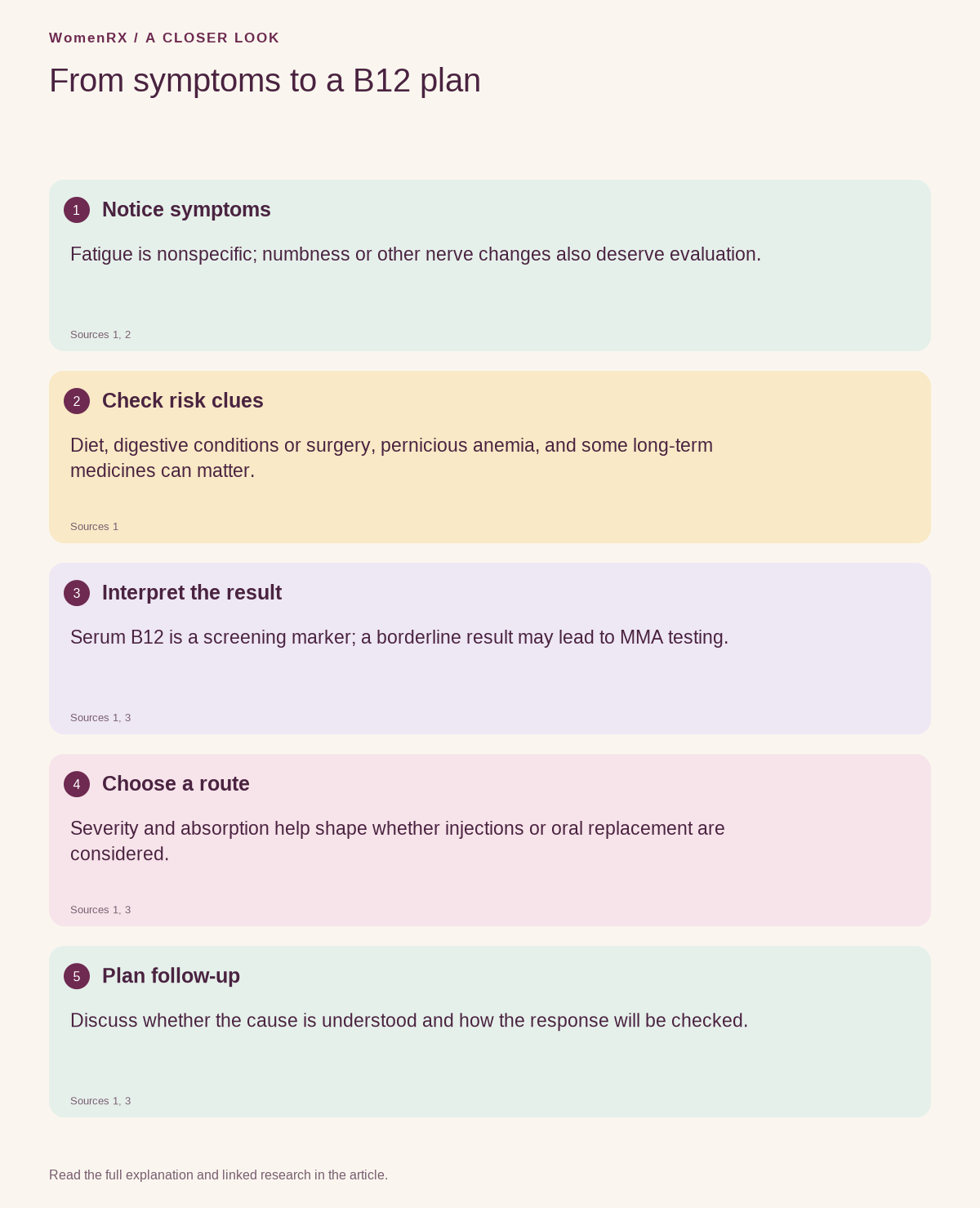
From symptoms to a B12 plan
Notice symptoms: Fatigue is nonspecific; numbness or other nerve changes also deserve evaluation.12
Check risk clues: Diet, digestive conditions or surgery, pernicious anemia, and some long-term medicines can matter.1
Interpret the result: Serum B12 is a screening marker; a borderline result may lead to MMA testing.13
Choose a route: Severity and absorption help shape whether injections or oral replacement are considered.13
Plan follow-up: Discuss whether the cause is understood and how the response will be checked.13
Read the figure as text
A symptom or risk factor can prompt testing, but the result and likely cause guide what comes next.- Notice symptoms: Fatigue is nonspecific; numbness or other nerve changes also deserve evaluation.12
- Check risk clues: Diet, digestive conditions or surgery, pernicious anemia, and some long-term medicines can matter.1
- Interpret the result: Serum B12 is a screening marker; a borderline result may lead to MMA testing.13
- Choose a route: Severity and absorption help shape whether injections or oral replacement are considered.13
- Plan follow-up: Discuss whether the cause is understood and how the response will be checked.13
More questions, answered
Can a normal blood count rule out B12-related nerve symptoms?
Not necessarily. Neurological symptoms can occur without anemia, so a blood count alone may not settle whether B12 deficiency is involved. Symptoms and B12-related testing need to be considered together. 1 3
Does taking metformin mean I have B12 deficiency?
No. Metformin use is a risk clue, not a diagnosis. A 2024 expert consensus describes an association between metformin and lower B12 levels; it also says symptoms, medical history and laboratory markers all matter in diagnosis. 1 3
Sources you can check
- Vitamin B12 - Health Professional Fact SheetAccessed 2026-09-25Return to first citation
- Fatigue: MedlinePlusAccessed 2026-09-25Return to first citation
- Diagnosis, Treatment and Long-Term Management of Vitamin B12 Deficiency in Adults: A Delphi Expert Consensus.Obeid R, Andrès E, Češka R, Hooshmand B, Guéant-Rodriguez RM, Prada GI, Sławek J, Traykov L, Ta Van B, Várkonyi T, Reiners K, The Vitamin B Consensus Panelists Group. · Journal of clinical medicine · 2024Return to first citation