Vitamin B12 Treatment: What Changes First?
Symptoms, blood counts, and B12-related tests measure different things, so improvement may not arrive all at once.
There isn’t one reliable countdown for feeling better after B12 treatment. A blood count can show an early response, while symptoms and B12-related markers answer different questions and may not change in lockstep. The cause of deficiency matters too: diet-related deficiency and problems absorbing B12 can call for different treatment routes and ongoing plans. Follow-up should make sense for your symptoms, test results, and cause. 1 5
Think of response as three separate checks
If you’ve started B12 treatment and still feel tired, it can be hard to tell whether it’s working. One useful distinction: symptoms, blood-cell changes, and B12-related laboratory tests aren’t interchangeable measures of recovery.
Symptoms tell you how you’re functioning. A blood count can show whether anemia or related blood-cell changes are improving. B12 and methylmalonic acid (MMA) tests help assess B12 status; MMA can be useful when a B12 result is borderline, though kidney function can also affect it. Neurological symptoms such as tingling may occur even without anemia, so a normal-looking blood count alone doesn’t answer every question. 1 3
That means a change in one measure doesn’t automatically tell you what’s happening in the others. Symptom review and test results are separate parts of follow-up, and the pace of change can vary with the problem being treated.
What follow-up can look like
Follow-up schedules vary. One UK clinical treatment pathway says a blood test is often done around 7 to 10 days after treatment starts, with another around 8 weeks to check whether treatment has worked. These are examples of monitoring intervals, not a universal schedule for people receiving care in the United States. The specific tests and timing depend on the clinical situation. 5
A randomized trial in 153 adults with B12-deficiency anemia checked blood-cell measures on days 7, 14, and 28. By day 28, the intranasal, intravenous, and intramuscular groups all showed hematologic recovery; after adjustment, the study found no statistically significant differences between routes in hemoglobin change. This tells us about short-term blood results in adults with anemia, not how quickly every person will feel better or recover from neurological symptoms. 7
If symptoms are continuing or worsening, tell the person managing your treatment rather than relying on a lab value alone. That gives them a chance to consider whether the original cause, treatment plan, or another explanation for the symptoms needs attention.
Why the cause and route matter
B12 deficiency can result from low intake, but it can also happen when the body has trouble absorbing the vitamin. For example, pernicious anemia affects intrinsic factor, which is needed for absorption. Stomach or intestinal conditions and some gastrointestinal surgeries can also interfere with absorption. In these situations, simply changing food choices may not address the cause. 1
Treatment route is chosen with that cause and the clinical picture in mind. Injections are commonly used when deficiency involves pernicious anemia or other significant absorption problems. High-dose oral treatment can also raise B12 levels, but the NIH Office of Dietary Supplements describes the evidence comparing oral and injection treatment as low quality. A route that suits one person therefore shouldn’t be treated as a guarantee about another person’s timeline. 1
The underlying cause can also affect how long treatment continues. Some people need ongoing treatment when the cause persists; a deficiency linked to diet may call for a different longer-term plan. Ask what cause is being treated and what result or symptom will be used to judge progress. 3 5
Pregnancy and heavy periods add context
During pregnancy, serum B12 levels tend to fall and may sometimes reach values considered subnormal; they usually return to normal after delivery. A result during pregnancy should therefore be considered in that context, rather than interpreted as a timeline for treatment response by itself. B12 needs are also higher during pregnancy than for nonpregnant adults. 1
Heavy menstrual bleeding can contribute to iron deficiency, which can cause fatigue. It doesn’t establish that B12 is low, and it can coexist with another cause of fatigue. If fatigue is the main symptom, testing and interpretation need to distinguish among possible causes rather than assume B12 is the answer. 2 6
A useful question for your follow-up
Ask: “Which part of my response are we checking next: symptoms, blood count, or B12 status, and when?” If you have new or worsening neurological symptoms, such as numbness or tingling, let your treatment team know rather than waiting for a routine lab check. B12-related neurological changes can occur without anemia, and untreated deficiency can cause problems that may not fully reverse. 1 4
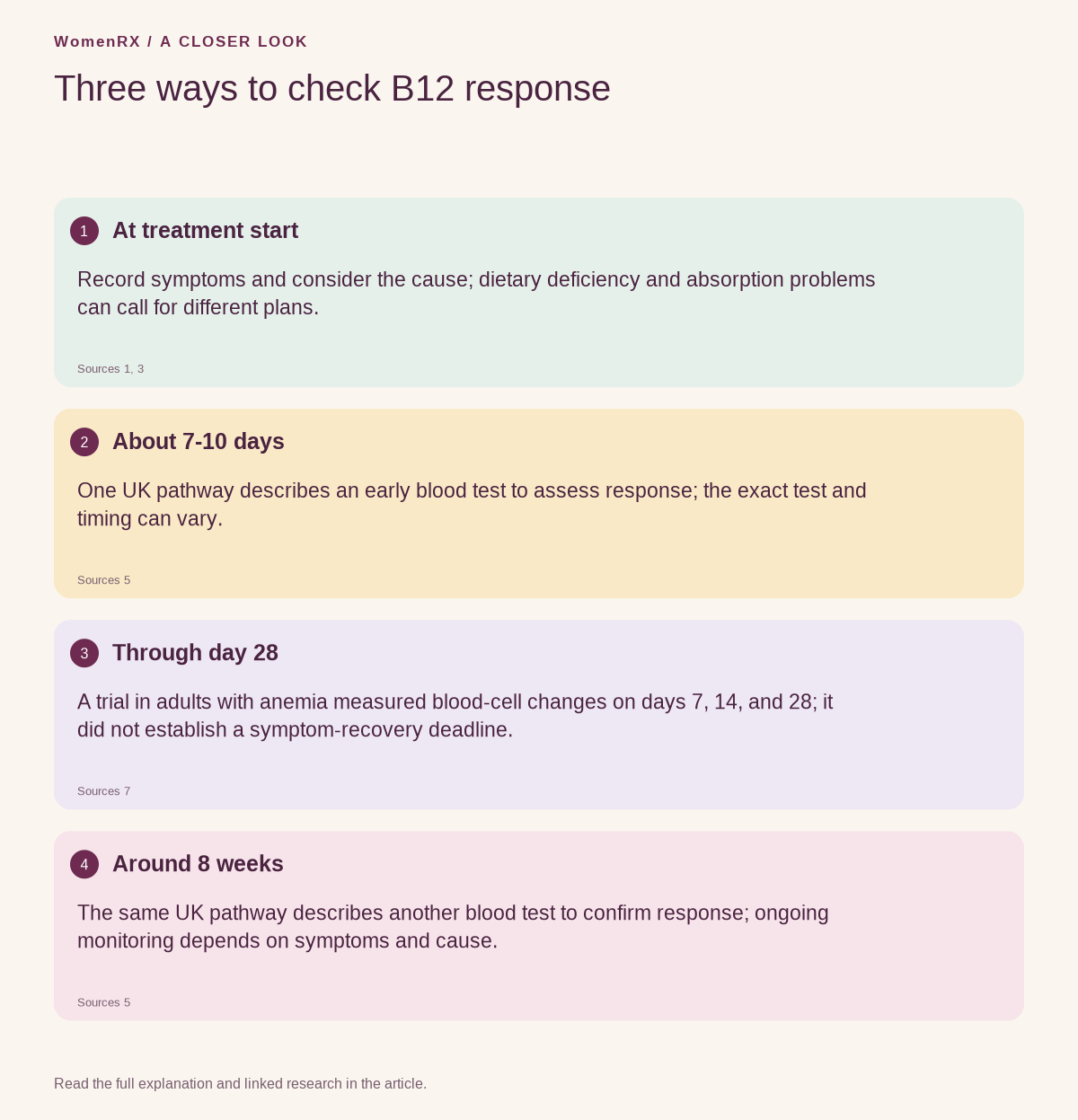
Three ways to check B12 response
At treatment start: Record symptoms and consider the cause; dietary deficiency and absorption problems can call for different plans.13
About 7-10 days: One UK pathway describes an early blood test to assess response; the exact test and timing can vary.5
Through day 28: A trial in adults with anemia measured blood-cell changes on days 7, 14, and 28; it did not establish a symptom-recovery deadline.7
Around 8 weeks: The same UK pathway describes another blood test to confirm response; ongoing monitoring depends on symptoms and cause.5
Read the figure as text
These are examples of when symptoms or blood tests may be reviewed, not a universal US treatment schedule. The measures answer different questions.- At treatment start: Record symptoms and consider the cause; dietary deficiency and absorption problems can call for different plans.13
- About 7-10 days: One UK pathway describes an early blood test to assess response; the exact test and timing can vary.5
- Through day 28: A trial in adults with anemia measured blood-cell changes on days 7, 14, and 28; it did not establish a symptom-recovery deadline.7
- Around 8 weeks: The same UK pathway describes another blood test to confirm response; ongoing monitoring depends on symptoms and cause.5
More questions, answered
If my B12 level rises, should I feel better right away?
Not necessarily. A B12-related test, blood count, and symptoms measure different aspects of the situation. Ask which result is being followed and how it relates to your symptoms; a higher lab value alone doesn’t tell the whole story. 1 5
Can heavy periods be the reason I’m tired?
Heavy menstrual bleeding is a risk factor for iron deficiency, which can cause fatigue. It doesn’t show whether your B12 is low, and more than one issue can contribute to fatigue. 2 6
Sources you can check
- Vitamin B12 - Health Professional Fact SheetAccessed 2026-09-25Return to first citation
- Iron deficiency anaemia - NHSAccessed 2026-09-25Return to first citation
- Vitamin B12 or folate deficiency anaemia - NHSAccessed 2026-09-25Return to first citation
- Vitamin B12 or folate deficiency anaemia - Symptoms - NHSAccessed 2026-09-25Return to first citation
- Vitamin B12 or folate deficiency anaemia - Treatment - NHSAccessed 2026-09-25Return to first citation
- Iron Deficiency in Adults: A Review.Auerbach M, DeLoughery TG, Tirnauer JS. · JAMA · 2025Return to first citation
- Comparative Efficacy of Intranasal, Intramuscular, and Intravenous Vitamin B12 Therapy for Hematological Recovery in Vitamin B12 Deficiency Anemia: A Randomized Controlled Trial.Singh SK, Arora R, Pramanik SK, Kumar A, Singh A, Khanna S, Malhotra N, Juneja P, Upadhyay N, Yanamandra U. · American journal of hematology · 2026Return to first citation