Vitamin B12 for Women: Daily Needs, Pregnancy, and Supplements
Most adult women need 2.4 micrograms of vitamin B12 a day, but pregnancy, breastfeeding, diet, and absorption can change what that reference amount means for you.
For women age 19 and older, the recommended intake is 2.4 micrograms (mcg) daily, rising to 2.6 mcg during pregnancy and 2.8 mcg while breastfeeding. Those amounts are population reference intakes, not treatment doses. A low intake of animal foods, an absorption problem, or long-term use of certain medicines may make food estimates alone an incomplete guide. 2
The daily amount depends on life stage, not sex alone
For adults age 19 and older, the recommended dietary allowance (RDA) for vitamin B12 is 2.4 mcg per day. It is the same for adult women and men. The RDA is 2.6 mcg during pregnancy and 2.8 mcg while breastfeeding. For girls ages 14-18, the standard amount is 2.4 mcg; the pregnancy and lactation amounts are 2.6 and 2.8 mcg. 2
These are reference amounts for healthy people. They help with planning a diet, but they don't tell you what dose will treat a confirmed deficiency or overcome a particular absorption problem. 2
Check what your food actually provides
Vitamin B12 occurs naturally in animal foods such as fish, meat, poultry, eggs, and dairy. Plant foods don't naturally provide it, though some cereals and nutritional yeasts are fortified. If you eat vegan, or rarely eat animal foods, check whether fortified foods are a regular part of your diet rather than assuming that plant foods contain B12. 2
A label can help: the amount in fortified foods varies, and the B12 amount may not appear on a food label unless B12 has been added. Supplements also vary widely in their B12 content. Some contain far more than the daily RDA, which doesn't mean that amount is necessary for everyone. 2
For someone with a low intake, a B12-containing supplement or reliably fortified foods may be a way to meet dietary needs. The right approach depends on the whole picture, especially if you could have trouble absorbing B12. Cyanocobalamin is a common supplement form; the NIH Office of Dietary Supplements reports no evidence that supplement forms differ in absorption. 2
When eating enough may not be enough
B12 deficiency isn't always caused by diet. The body may have trouble absorbing B12 because of pernicious anemia, gastrointestinal surgery, or conditions affecting the digestive tract. Prolonged use of medicines such as metformin or proton pump inhibitors is also a recognized risk factor. 2
That distinction matters because a person can eat B12-containing foods and still become deficient. If you take one of these medicines long term, have had stomach or intestinal surgery, or have a condition affecting absorption, ask whether your B12 status should be assessed. Don't stop a prescribed medicine on your own. 2
Fatigue by itself doesn't establish B12 deficiency. Deficiency can cause fatigue and anemia, but it can also cause tingling or numbness, and neurological symptoms may occur even without anemia. If you have persistent symptoms or a relevant risk factor, testing is more informative than guessing from symptoms or choosing a high-dose supplement. 12
Pregnancy and breastfeeding call for a closer look
The higher pregnancy and breastfeeding RDAs reflect those life stages; they don't mean every pregnant or breastfeeding woman needs a high-dose B12 supplement. During pregnancy, blood B12 levels can fall, sometimes into a low range, and may return to normal after delivery. A 2026 review of testing notes that active B12 may be considered during pregnancy when testing is needed, because results should be interpreted in that context. 24
Diet and absorption still matter. A predominantly vegetarian diet can make low B12 intake more likely, and a small prospective study of 69 pregnant women after bariatric surgery found B12 deficiency in 38 participants. That study doesn't establish what dose every pregnant woman needs, but it illustrates why prior surgery calls for individualized nutritional follow-up. 25
A randomized trial in 531 predominantly vegetarian pregnant women in India and Nepal compared two daily methylcobalamin amounts, 250 mcg and 50 mcg, from the first trimester through six months postpartum. The higher-dose group had a higher average infant mental development score at 9-12 months; motor scores did not differ significantly. This finding applies to that study population and comparison. Neither dose is a general US pregnancy recommendation, and the trial doesn't replace assessment of an individual's diet, blood results, or absorption. 3
Testing and treatment are different questions
When symptoms or risk factors raise a reasonable concern, total serum B12 is commonly the first test. If the result is unclear, a clinician may consider active B12 or other tests; methylmalonic acid and homocysteine can also be affected by conditions besides B12 deficiency. Pregnancy can affect which test is useful. 4
Treatment doses can be much higher than the RDA. Studies reviewed by the NIH compared oral doses of 1,000-2,000 mcg with injections for confirmed deficiency, but the evidence was low quality. These were treatment comparisons, not instructions for routine prevention. The appropriate formulation, dose, and duration depend on the cause and severity of deficiency. 24
A useful conversation can start with four details: your usual sources of B12, whether you are pregnant or breastfeeding, medicines you take long term, and any digestive condition or surgery that could affect absorption. If you already take a multivitamin or B12 supplement, bring the label so the amount can be considered alongside your diet and any test results.
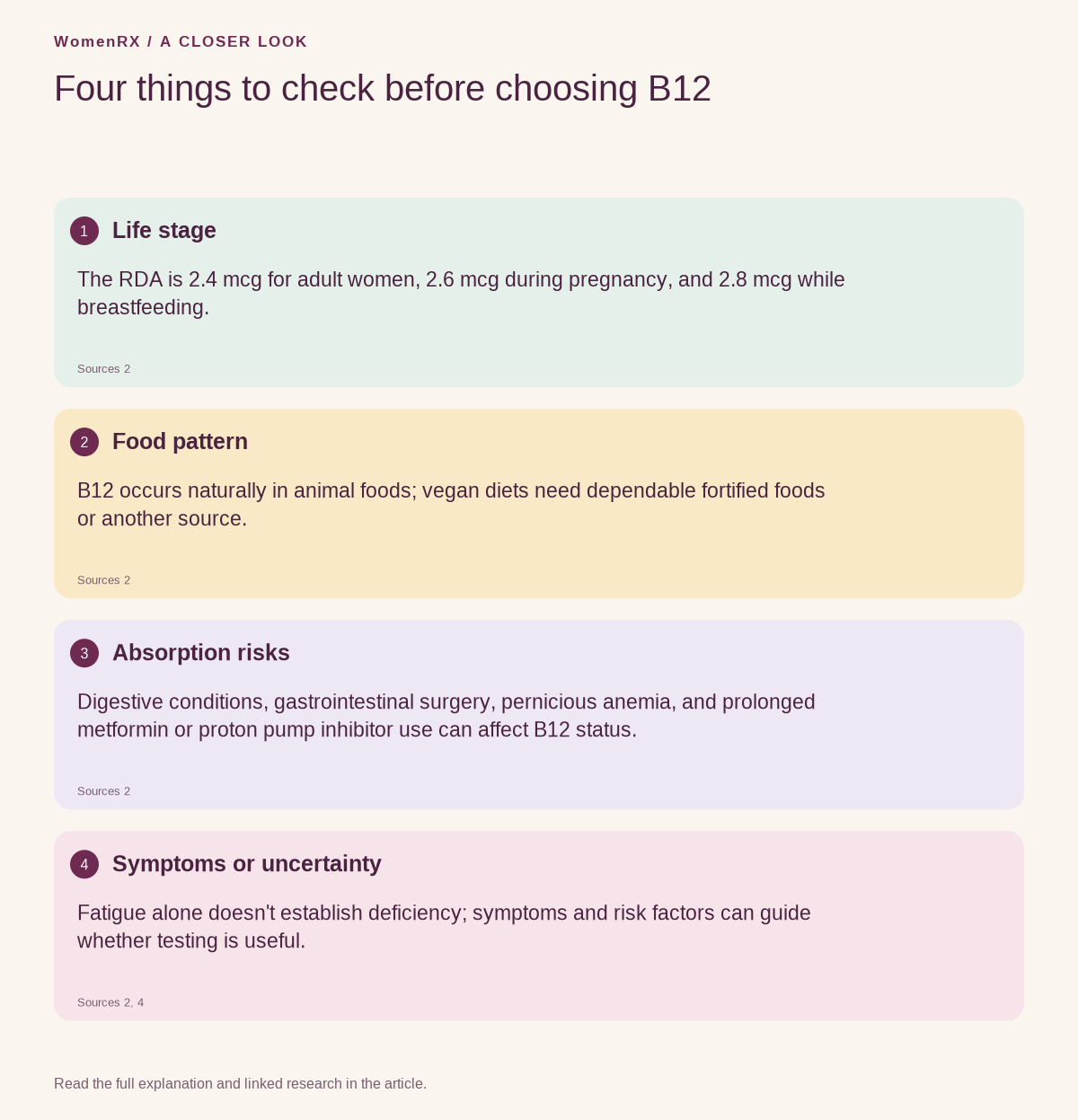
Four things to check before choosing B12
Life stage: The RDA is 2.4 mcg for adult women, 2.6 mcg during pregnancy, and 2.8 mcg while breastfeeding.2
Food pattern: B12 occurs naturally in animal foods; vegan diets need dependable fortified foods or another source.2
Absorption risks: Digestive conditions, gastrointestinal surgery, pernicious anemia, and prolonged metformin or proton pump inhibitor use can affect B12 status.2
Symptoms or uncertainty: Fatigue alone doesn't establish deficiency; symptoms and risk factors can guide whether testing is useful.24
Read the figure as text
Use these distinctions to work out whether the daily reference intake answers your question or whether diet, life stage, or absorption deserves a closer look.- Life stage: The RDA is 2.4 mcg for adult women, 2.6 mcg during pregnancy, and 2.8 mcg while breastfeeding.2
- Food pattern: B12 occurs naturally in animal foods; vegan diets need dependable fortified foods or another source.2
- Absorption risks: Digestive conditions, gastrointestinal surgery, pernicious anemia, and prolonged metformin or proton pump inhibitor use can affect B12 status.2
- Symptoms or uncertainty: Fatigue alone doesn't establish deficiency; symptoms and risk factors can guide whether testing is useful.24
More questions, answered
Does fatigue mean I should take B12?
No. Fatigue can have many causes, and it doesn't confirm B12 deficiency. B12 deficiency can cause fatigue, but it may also cause anemia or neurological symptoms such as numbness and tingling. Risk factors and, when appropriate, blood testing help distinguish it from other causes. 12
Is methylcobalamin better than cyanocobalamin?
The NIH Office of Dietary Supplements reports no evidence that B12 supplement forms differ in absorption. Cyanocobalamin is a common form; the best choice and amount depend more on why you need B12 and whether absorption is affected. 2
Sources you can check
- Anemia | MedlinePlusAccessed 2026-09-25Return to first citation
- Vitamin B12 - Health Professional Fact SheetAccessed 2026-09-25Return to first citation
- Maternal supplementation of vitamin B12 in predominantly vegetarian pregnant women improves their vitamin B12 status and the neurodevelopment of their infants: the MATCOBIND multicentric double-blind randomised control trial.Nagpal J, Mathur M, Rawat S, Singhal A, Pant R, Shah A, Nixon L, Mishra VK, Nagrath D, Heys M, Cortina-Borja M, Michie C, Gautam J, Karmacharya SB, Rai S, Lakhanpaul M. · BMJ paediatrics open · 2026Return to first citation
- Vitamin B12 deficiency: testing and treatment.Bedz D, Forsyth C. · Australian prescriber · 2026Return to first citation
- Micronutrient Deficiency During Pregnancy After Bariatric Surgery: The Role of Micronutrient Supplements and Dietary Intake.Guthrie T, Eccles-Smith J, Lee S, Kothari A, Pinzon Perez W, Truby H, de Jersey S. · Obesity surgery · 2026Return to first citation