Vitamin B12 supplements: when high doses need a closer look
B12 is useful when you need to prevent or treat a shortfall, but taking several products at once can add up without offering extra benefits.
For most people, B12 supplements are well tolerated, and a high label amount does not automatically mean you’ll absorb a high amount. Still, routine high-dose use hasn’t shown consistent benefits for people without deficiency. Before starting or continuing, check why you take B12, whether your diet or medicines raise deficiency risk, and how much is in your prenatal, multivitamin, and any standalone supplement. 1 3
Start with the reason, not the dose
Vitamin B12 helps your body make red blood cells and maintain the nervous system. A supplement can be a practical way to prevent or treat deficiency, but that’s different from taking a large amount for a general energy or wellness boost. In people without established deficiency, supplementation hasn’t shown consistent improvements in fatigue, mood, cognition, or cardiovascular outcomes. 1 3
A large number on a bottle isn’t automatically a sign of danger. Your body absorbs only a small share of doses far above the amount that can bind to intrinsic factor, the protein involved in B12 absorption. NIH reports that absorption is about 2% at 500 micrograms and 1.3% at 1,000 micrograms. That doesn’t make every high-dose product useful or risk-free; it does help explain why the amount listed isn’t the same as the amount your body absorbs. 1
When your diet or health raises the stakes
B12 occurs naturally in foods such as fish, meat, eggs, and dairy, but not in unfortified plant foods. If you eat vegan, check whether fortified foods or a supplement reliably provide B12. During pregnancy, the recommended intake is 2.6 micrograms a day; during breastfeeding, it’s 2.8 micrograms. Those reference amounts can help you review a prenatal or other supplement, but they don’t tell you what treatment dose to use if you have a deficiency. 1
Some people may have trouble absorbing B12 even when their diet contains it. Causes include pernicious anemia, some stomach or intestinal conditions, gastrointestinal surgery, and prolonged use of certain medicines, including metformin and proton pump inhibitors. If you take one of these medicines, don’t stop it on your own; consider asking whether your symptoms or health history warrant checking B12 status. 1
Fatigue can have many causes. B12 deficiency can also involve numbness or tingling, changes in blood counts, or other symptoms, and nerve symptoms can occur even without anemia. These symptoms don’t prove you’re deficient, but they are a reason not to rely on a supplement alone to explain what’s going on. 1
Review every product that contains B12
Before adding a standalone B12 pill, gather the labels for your prenatal, multivitamin, B-complex, and any other supplements. Find the B12 amount on each label and add the amounts together to see your daily total. Look for the ingredient name too: cyanocobalamin and methylcobalamin are forms of B12. NIH reports no evidence that supplement absorption differs by form. 1
As a rough label-reading example, NIH reports that multivitamins commonly contain 5 to 25 micrograms of B12, B-complex products 50 to 500 micrograms, and standalone B12 supplements 500 to 1,000 micrograms. These are examples of what products may contain, not recommended doses. If a clinician has recommended a particular product or amount to treat a deficiency, include that in your review rather than replacing it with a general supplement. 1
What “safe” means in practice
B12 is generally well tolerated, but side effects can happen. Rare reports include acne-like skin reactions and hypersensitivity; a reaction may also involve an ingredient other than B12. Cyanocobalamin contains cobalt, so people with cobalt allergy can have a sensitivity reaction. If you develop a rash or hives after taking it, get medical advice. Sudden swelling of the mouth or throat or difficulty breathing can signal a serious allergic reaction and calls for emergency care. 2 3
High B12 levels or supplement use have been linked with cancer in some observational research, but the findings are inconsistent and don’t establish that B12 supplements cause cancer. That uncertainty isn’t a reason to stop a prescribed treatment. It is another reason not to assume that more B12 will improve health when you don’t have a clear need. 1 3
A useful next step
Write down why you take B12, any relevant diet or medicines, and the amount listed on each product. If you have symptoms, a known absorption problem, or a clinician has raised concern about deficiency, ask what testing or follow-up makes sense before changing a treatment plan. If you’re pregnant or breastfeeding, include your prenatal and any separate B12 product in the label review. The goal is to match the supplement to your reason for taking it, not to chase the biggest dose.
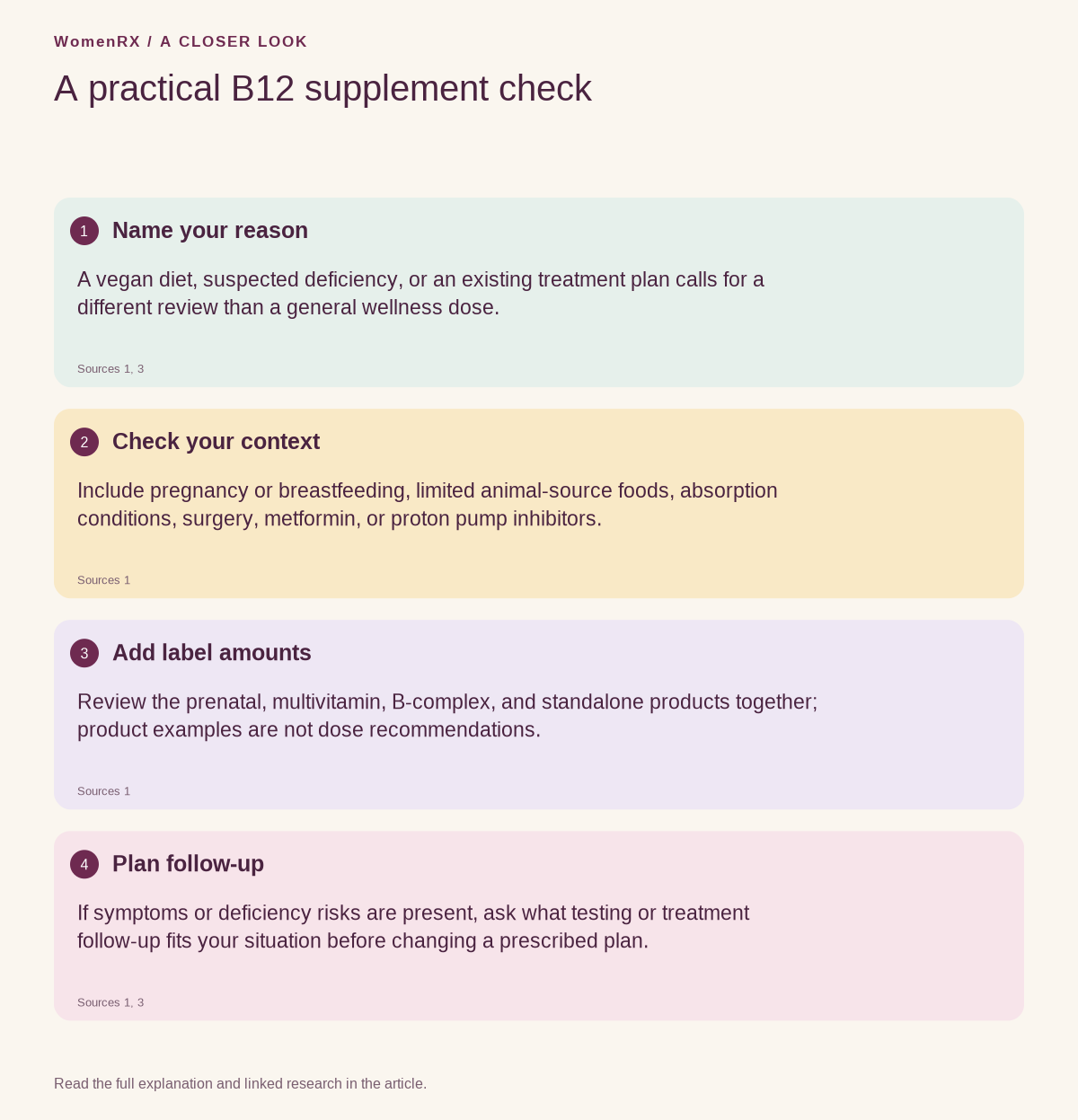
A practical B12 supplement check
Name your reason: A vegan diet, suspected deficiency, or an existing treatment plan calls for a different review than a general wellness dose.13
Check your context: Include pregnancy or breastfeeding, limited animal-source foods, absorption conditions, surgery, metformin, or proton pump inhibitors.1
Add label amounts: Review the prenatal, multivitamin, B-complex, and standalone products together; product examples are not dose recommendations.1
Plan follow-up: If symptoms or deficiency risks are present, ask what testing or treatment follow-up fits your situation before changing a prescribed plan.13
Read the figure as text
Use this path to separate prevention or deficiency treatment from routine high-dose use, then review overlapping products and follow-up.- Name your reason: A vegan diet, suspected deficiency, or an existing treatment plan calls for a different review than a general wellness dose.13
- Check your context: Include pregnancy or breastfeeding, limited animal-source foods, absorption conditions, surgery, metformin, or proton pump inhibitors.1
- Add label amounts: Review the prenatal, multivitamin, B-complex, and standalone products together; product examples are not dose recommendations.1
- Plan follow-up: If symptoms or deficiency risks are present, ask what testing or treatment follow-up fits your situation before changing a prescribed plan.13
More questions, answered
Does methylcobalamin work better than cyanocobalamin?
The NIH fact sheet reports no evidence that B12 absorption differs by supplement form. Check the amount and purpose of a product rather than assuming one form is more effective. 1
Should I stop B12 before a blood test?
Don’t assume you need to stop. Tell the person arranging your test what B12 products you take and ask whether they want you to make any changes beforehand.
Sources you can check
- Vitamin B12 - Health Professional Fact SheetAccessed 2026-09-25Return to first citation
- Side effects of cyanocobalamin - NHSAccessed 2026-09-25Return to first citation
- Vitamin B12 Supplementation: Is More Always Better?Yepes-Calderón M, Doorenbos CSE, Stegmann ME, Touw DJ, Harmsen HJM, Heiner-Fokkema MR, van Spronsen FJ, Corpeleijn E, Bakker SJL. · Nutrients · 2026Return to first citation