When Can Vitamin B12 Supplements Help?
B12 supplements can treat a deficiency, but diet, absorption risks, symptoms, and pregnancy all shape whether they’re useful for you.
Vitamin B12 supplements treat a confirmed deficiency. Eating few animal foods or having trouble absorbing B12 can instead be reasons to discuss testing, reliable dietary intake, or supplementation, depending on your situation. Fatigue alone doesn’t establish a deficiency. Numbness or tingling deserves assessment even if you don’t have anemia. During pregnancy, a vegan or vegetarian diet is a good reason to discuss reliable B12 intake and whether testing makes sense. 14
Vitamin B12 supplements can help when they correct a deficiency. They aren’t automatically needed just because you’re tired, take a multivitamin, or are a woman. The useful question is whether you’re getting enough B12 and absorbing it, and whether symptoms or health history call for testing.
Start with where B12 comes from
B12 occurs naturally in foods from animals, including fish, meat, eggs, and dairy. Plant foods don’t naturally contain it, though some breakfast cereals and nutritional yeasts are fortified. If you’re vegan, regular, reliable fortified foods or a supplement are ways to include B12; check labels rather than assuming a plant-based product contains it. A vegetarian diet can provide B12 through dairy or eggs, but intake depends on what you actually eat. 1
For adults, the recommended dietary allowance is 2.4 micrograms a day. It’s 2.6 micrograms during pregnancy and 2.8 micrograms while breastfeeding. These are recommended total daily intakes, not instructions for how much supplement to take. 1
Food intake isn’t the whole story
You can have a B12 deficiency even if your diet includes B12. The body may not absorb it well because of conditions such as pernicious anemia, surgery involving the digestive tract, or prolonged use of medicines such as metformin or proton pump inhibitors. These are reasons to raise B12 with your clinician, not reasons to stop a prescribed medicine on your own. 1
That difference matters because a supplement may not address the underlying problem in the same way for everyone. The treatment choice depends on the cause and severity of the deficiency; some people are treated with injections, while high-dose oral B12 may also work for some. Evidence comparing these approaches is limited, so the route is a treatment decision, not a reason to choose the biggest bottle on the shelf. 14
Symptoms can point to assessment, not a diagnosis
Fatigue can occur with B12 deficiency, but it doesn’t tell you by itself that B12 is low. Other possible signs include a sore or inflamed tongue, pale skin, palpitations, and neurological changes such as numbness or tingling in the hands or feet. Those neurological symptoms can occur without anemia. Because B12-related nerve damage can become irreversible, don’t wait for an anemia diagnosis before asking about new numbness or tingling. 1
When symptoms or risk factors create a reasonable concern, a clinician may start with a blood B12 test. If the result is unclear, additional tests may be considered; pregnancy can also affect which B12 test is used. A test result needs to be interpreted in context rather than treated as a stand-alone answer. 4
Pregnancy changes the conversation
Pregnancy raises the recommended B12 intake modestly, from 2.4 to 2.6 micrograms daily, and breastfeeding raises it to 2.8 micrograms. If you’re pregnant and vegan, vegetarian, or have an absorption risk, bring your usual diet and any supplements into the discussion with your prenatal care team. The goal is to address a real intake or deficiency concern, not to assume that every pregnant woman needs extra B12 beyond her overall prenatal plan. 1
Research on pregnancy outcomes is still developing. A systematic review found only four studies of B12 among the studies it included on maternal nutrients and child development, with limited intervention evidence. One randomized trial in predominantly vegetarian pregnant women in India and Nepal compared two daily B12 supplement amounts, not a supplement with no supplement. The higher-amount group had a higher average infant mental developmental score, while motor scores didn’t differ significantly. That finding is relevant to that study population, but it doesn’t establish what every pregnant woman should take. 23
A practical way to decide what to ask
If you eat little or no animal food, ask how to reliably meet B12 needs through fortified foods or supplementation. If you have digestive surgery, a condition affecting absorption, or prolonged metformin or acid-reducing medicine use, ask whether your history warrants testing. If you have numbness or tingling, mention it directly even if you haven’t been told you’re anemic. If you’re pregnant, include your diet and current prenatal supplement in that conversation. 14
The useful next step isn’t guessing whether B12 will boost your energy. It’s matching the question to the reason: intake, absorption, symptoms, or pregnancy. When deficiency is confirmed, B12 treatment is needed. 4
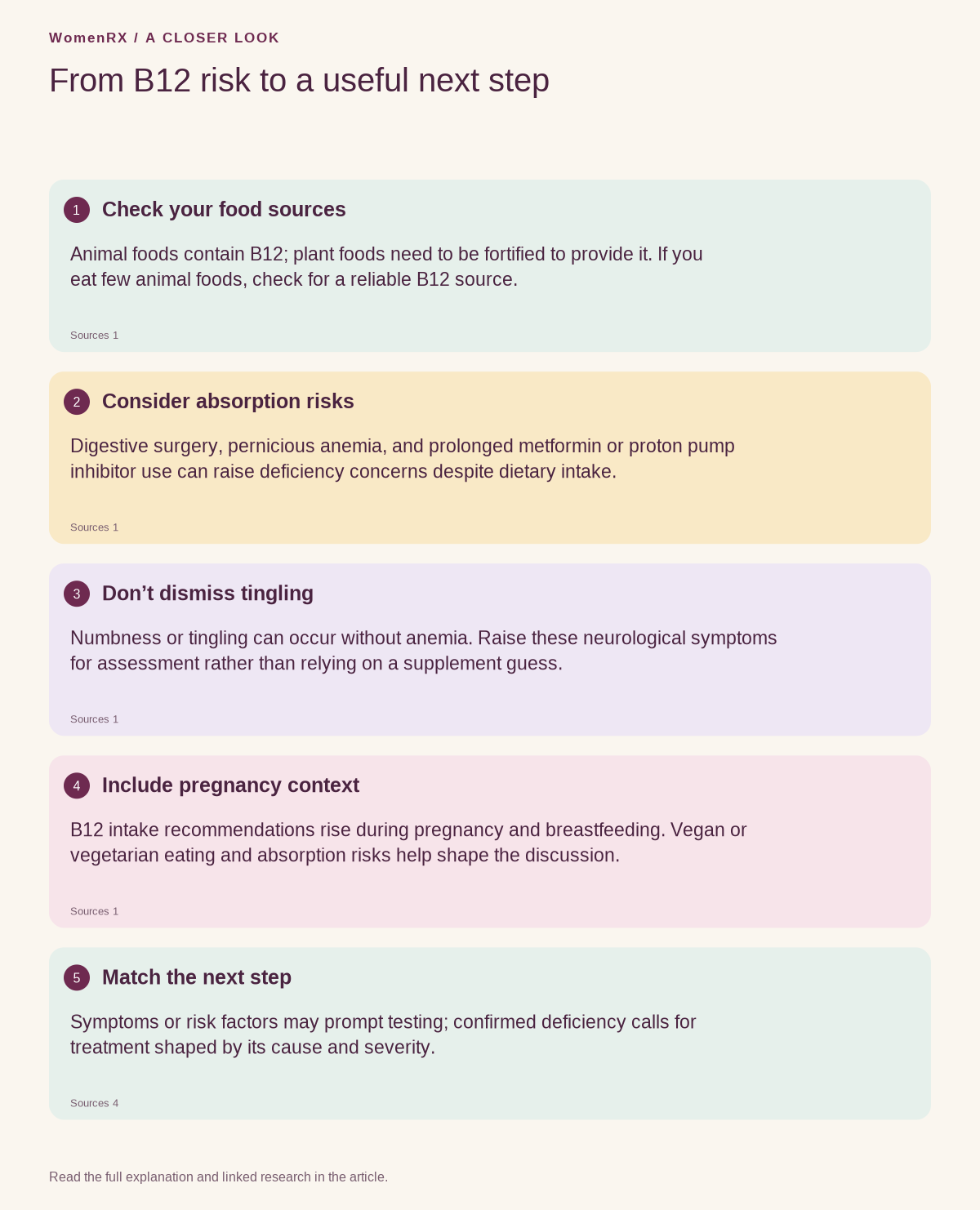
From B12 risk to a useful next step
Check your food sources: Animal foods contain B12; plant foods need to be fortified to provide it. If you eat few animal foods, check for a reliable B12 source.1
Consider absorption risks: Digestive surgery, pernicious anemia, and prolonged metformin or proton pump inhibitor use can raise deficiency concerns despite dietary intake.1
Don’t dismiss tingling: Numbness or tingling can occur without anemia. Raise these neurological symptoms for assessment rather than relying on a supplement guess.1
Include pregnancy context: B12 intake recommendations rise during pregnancy and breastfeeding. Vegan or vegetarian eating and absorption risks help shape the discussion.1
Match the next step: Symptoms or risk factors may prompt testing; confirmed deficiency calls for treatment shaped by its cause and severity.4
Read the figure as text
Follow the reason you’re asking about B12: what you eat, whether absorption may be affected, symptoms, or pregnancy.- Check your food sources: Animal foods contain B12; plant foods need to be fortified to provide it. If you eat few animal foods, check for a reliable B12 source.1
- Consider absorption risks: Digestive surgery, pernicious anemia, and prolonged metformin or proton pump inhibitor use can raise deficiency concerns despite dietary intake.1
- Don’t dismiss tingling: Numbness or tingling can occur without anemia. Raise these neurological symptoms for assessment rather than relying on a supplement guess.1
- Include pregnancy context: B12 intake recommendations rise during pregnancy and breastfeeding. Vegan or vegetarian eating and absorption risks help shape the discussion.1
- Match the next step: Symptoms or risk factors may prompt testing; confirmed deficiency calls for treatment shaped by its cause and severity.4
More questions, answered
Can a vegan diet provide vitamin B12?
Plant foods don’t naturally contain B12, but some foods, including certain breakfast cereals and nutritional yeasts, are fortified. Check labels and make sure your routine includes a reliable B12 source. 1
Can B12 deficiency cause numbness without anemia?
Yes. Neurological symptoms such as numbness and tingling can occur without anemia, so those symptoms are worth raising even if a blood count hasn’t shown anemia. 1
Sources you can check
- Vitamin B12 - Health Professional Fact SheetAccessed 2026-09-25Return to first citation
- Maternal vitamin B12, vitamin D, and folic acid status during pregnancy and child neurodevelopment: a systematic review.Franco L, de Andrade CVF, Margini LV, Sousa N. · Frontiers in neuroscience · 2026Return to first citation
- Maternal supplementation of vitamin B12 in predominantly vegetarian pregnant women improves their vitamin B12 status and the neurodevelopment of their infants: the MATCOBIND multicentric double-blind randomised control trial.Nagpal J, Mathur M, Rawat S, Singhal A, Pant R, Shah A, Nixon L, Mishra VK, Nagrath D, Heys M, Cortina-Borja M, Michie C, Gautam J, Karmacharya SB, Rai S, Lakhanpaul M. · BMJ paediatrics open · 2026Return to first citation
- Vitamin B12 deficiency: testing and treatment.Bedz D, Forsyth C. · Australian prescriber · 2026Return to first citation