Does Vitamin B12 Help With Hair Loss?
A B12 deficiency deserves treatment, but shedding alone can’t tell you whether B12 is the reason your hair is changing.
If you’re losing hair, taking B12 isn’t the same as finding and treating a B12 deficiency. Earlier research has identified deficiency as a possible contributor to diffuse shedding, but a study of 108 women found no significant link between B12 levels and measured hair findings. That study didn’t test whether supplements help hair regrow. 2 3
Treat the deficiency, not an assumption about your hair
Vitamin B12 deficiency matters even if it has nothing to do with your shedding. It can cause anemia and fatigue, as well as numbness or tingling in the hands and feet. Those nerve symptoms can occur without anemia. Low dietary intake is one possible cause, but trouble absorbing B12, gastrointestinal surgery, and prolonged use of medicines such as metformin or proton pump inhibitors can also play a part. 2
That gives you a useful distinction: correcting a confirmed deficiency addresses a health problem; taking B12 because your hair is shedding assumes you know what caused it. Hair loss alone can’t establish that you’re B12 deficient. And a low B12 result, if you have one, doesn’t by itself establish that B12 caused your hair loss. 2 3
What the hair research actually shows
Researchers have discussed B12 deficiency as one possible contributor to telogen hair loss, a form of diffuse shedding. That’s a reason to consider B12 status when it fits the wider picture, not proof that deficiency caused shedding in a particular woman. 3
In a 2024 study, researchers assessed 108 women with diffuse hair loss, including acute and chronic telogen effluvium. They measured blood markers and used a digital hair assessment to look at hair density and the proportion of hairs in different growth phases. B12 levels weren’t significantly correlated with those measured hair findings. The study compared measurements; it did not give women B12 supplements to see whether their hair improved. 3
So the earlier reports and this study answer different pieces of the question, and neither tells you that extra B12 will regrow your hair. If a deficiency is found, it still deserves attention for your overall health. 2 3
Look beyond a single nutrient
The pattern of hair loss can point toward different explanations. Gradual, family-pattern thinning isn’t the same picture as widespread shedding that appears after an illness. Some hair loss is temporary, while family-pattern loss may persist. 1
For diffuse shedding, researchers also discuss stress, thyroid conditions, anemia, nutrition problems, and low ferritin, a measure of iron stores. In the study of 108 women, lower ferritin was associated with a less favorable hair-growth-phase finding within the study group. That association doesn’t mean every woman who sheds hair has low iron stores, or that the study established a treatment target. 3
Timing adds context without supplying a diagnosis. For example, if shedding began after a pregnancy, if you have heavy menstrual bleeding, or if you’re noticing gradual thinning in midlife, say so when describing the change. Those details help frame the question of what else to assess. The B12 study did not separately establish what explains hair changes in postpartum women, women with heavy periods, or women in midlife. 3
When a B12 check makes sense
If you have a reason to suspect deficiency, such as numbness or tingling, a relevant medicine or surgery history, or limited dietary B12 intake, bring that up rather than relying on a hair supplement to answer the question. B12 status is generally assessed with a blood test. When a result is unclear, a clinician may use a second marker called methylmalonic acid to help interpret it; age and kidney function can affect that marker too. 2
You can describe what you’re seeing in plain terms: more hair coming out all over, a widening part, or distinct areas of loss. Pair that with when it started and any relevant health changes. The next step is to work out which explanation fits, not to expect one vitamin result to explain every kind of hair loss. 1 2 3
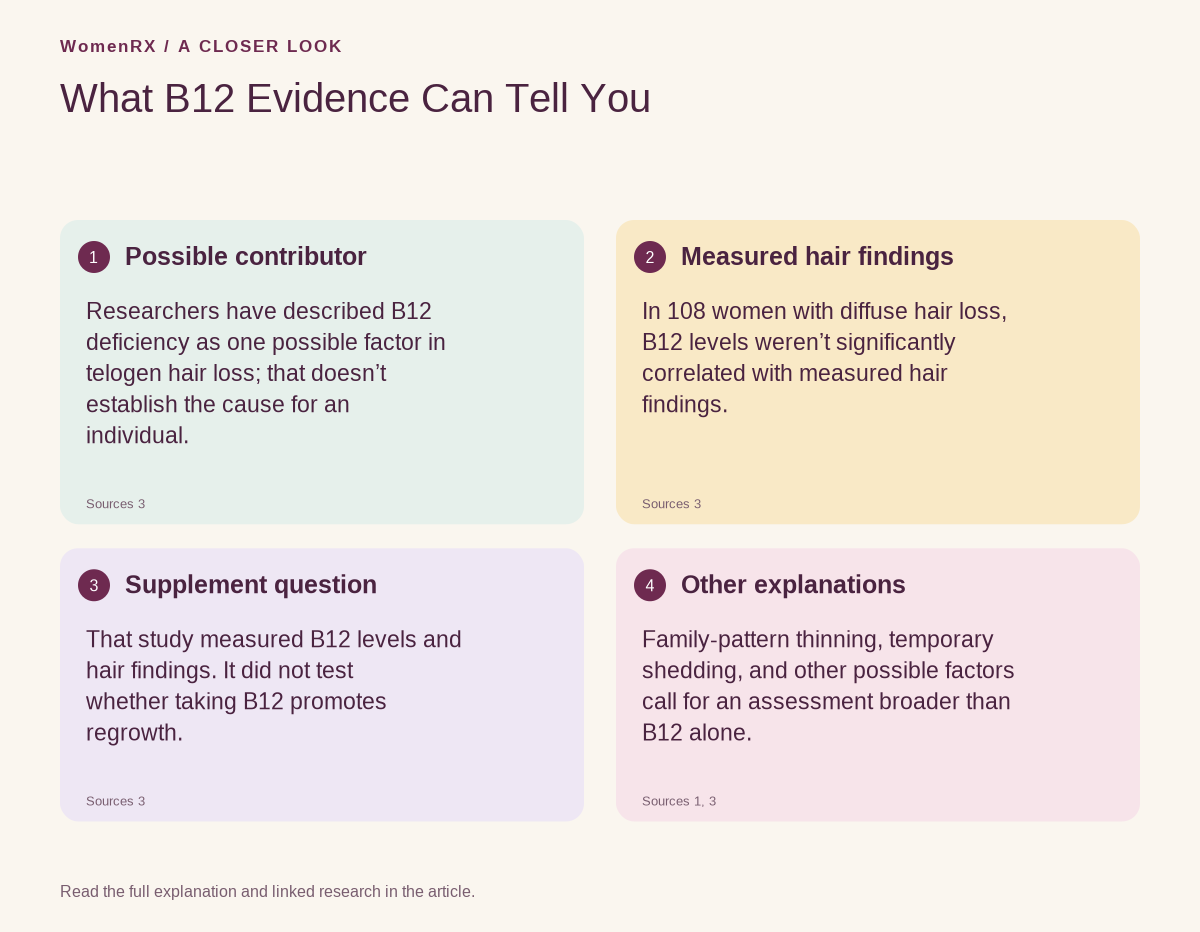
What B12 Evidence Can Tell You
Possible contributor: Researchers have described B12 deficiency as one possible factor in telogen hair loss; that doesn’t establish the cause for an individual.3
Measured hair findings: In 108 women with diffuse hair loss, B12 levels weren’t significantly correlated with measured hair findings.3
Supplement question: That study measured B12 levels and hair findings. It did not test whether taking B12 promotes regrowth.3
Other explanations: Family-pattern thinning, temporary shedding, and other possible factors call for an assessment broader than B12 alone.13
Read the figure as text
Four distinct questions separate a possible contributor to shedding from a diagnosis or a hair treatment.- Possible contributor: Researchers have described B12 deficiency as one possible factor in telogen hair loss; that doesn’t establish the cause for an individual.3
- Measured hair findings: In 108 women with diffuse hair loss, B12 levels weren’t significantly correlated with measured hair findings.3
- Supplement question: That study measured B12 levels and hair findings. It did not test whether taking B12 promotes regrowth.3
- Other explanations: Family-pattern thinning, temporary shedding, and other possible factors call for an assessment broader than B12 alone.13
More questions, answered
Could I have a B12 deficiency without anemia?
Yes. B12-related neurological symptoms, including numbness and tingling, can occur without anemia. If you’re experiencing those symptoms, don’t use the presence or absence of hair loss to decide whether B12 needs checking. 2
Sources you can check
- Hair loss - NHSAccessed 2026-09-25Return to first citation
- Vitamin B12 - Health Professional Fact SheetAccessed 2026-09-25Return to first citation
- Evaluation of the relationship of digital phototrichogram findings of patients with diffuse hair loss with blood TSH, ferritin and vitamin B12 levels.Bilik L, Kokcam I, Esen M. · Northern clinics of Istanbul · 2024Return to first citation