Does Vitamin D Help With Hair Loss?
Low vitamin D is associated with some hair-loss conditions, but that doesn’t show that supplements regrow hair.
Studies have found lower vitamin D levels in people with some forms of hair loss, including female pattern hair loss and alopecia areata. These findings show an association, not that taking vitamin D restores hair. Postpartum shedding has a different, usually temporary pattern; the available research does not establish vitamin D supplements as a treatment for it or for midlife hair changes. 1 5 6
What the vitamin D research can tell you
Two systematic reviews found associations between vitamin D status and some types of nonscarring hair loss. One pooled 23 studies of 3,374 people with hair loss and 7,296 controls; the other found a significant association between vitamin D deficiency and alopecia areata and female pattern hair loss, though not consistently across every type of alopecia. The findings make low vitamin D worth considering in context, but they do not show that low levels caused the hair loss. 5 6
There’s a key difference between studying vitamin D levels and studying treatment. These reviews compare blood levels or deficiency rates; they don’t establish that supplements improve hair growth. The female-pattern findings do not show that supplementation reverses thinning, and they cannot be assumed to apply to every woman with hair loss. 5 6
Postpartum shedding follows a different pattern
After delivery, falling estrogen levels can trigger temporary shedding called telogen effluvium. It often becomes noticeable a few months after birth, commonly peaks around four months, and most women regain their usual fullness by their baby’s first birthday. This time-linked pattern is distinct from the vitamin D associations reported across broader hair-loss groups. 1 5 6
The research reviews do include telogen effluvium, but they don’t report a separate treatment result for postpartum women. So they don’t show that vitamin D supplements treat postpartum shedding. If your fullness hasn’t returned by about a year after delivery, the American Academy of Dermatology recommends getting the hair loss assessed for another cause. 1 5 6
Midlife thinning needs its own explanation
Hair changes in midlife aren’t one single condition. Hair loss can become more common with age, and female pattern hair loss may run in families. Other possible contributors include thyroid problems, some medicines, illness, stress, or poor nutrition. Those possibilities call for a broader assessment rather than assuming that vitamin D explains the change. 2 4
The reviews report associations involving female pattern hair loss, but they don’t establish that vitamin D supplements regrow hair in midlife women or report a specific midlife treatment result. The distinction matters: a finding about vitamin D levels in a group doesn’t tell you what caused one person’s thinning or which treatment will help. 5 6
What to assess before trying a supplement
Start with the pattern and timing: did shedding begin suddenly or gradually, and did it follow pregnancy, illness, stress, or a medication change? Also consider family history, diet, and other health conditions. Hair loss has several potential causes, including thyroid problems and medicines, and treatment depends on the cause. 2
A blood test can measure vitamin D. It may be worth discussing if you have recognized risk factors for deficiency, such as limited sun exposure, darker skin, certain absorption problems, or medicines that affect vitamin D levels. A result can help identify deficiency, but it still can’t establish that vitamin D is the reason for hair loss. 3
If a deficiency is found, treating it is a health decision in its own right, not a proven hair-regrowth plan. Avoid taking more vitamin D than advised: excessive supplements can cause toxicity, raise blood calcium, and damage the kidneys. 3
The practical takeaway is to look for the cause and the type of hair loss, rather than treating a supplement as a universal fix. Postpartum shedding often improves with time; persistent or otherwise unexplained thinning deserves an assessment that considers more than vitamin D. 1 2
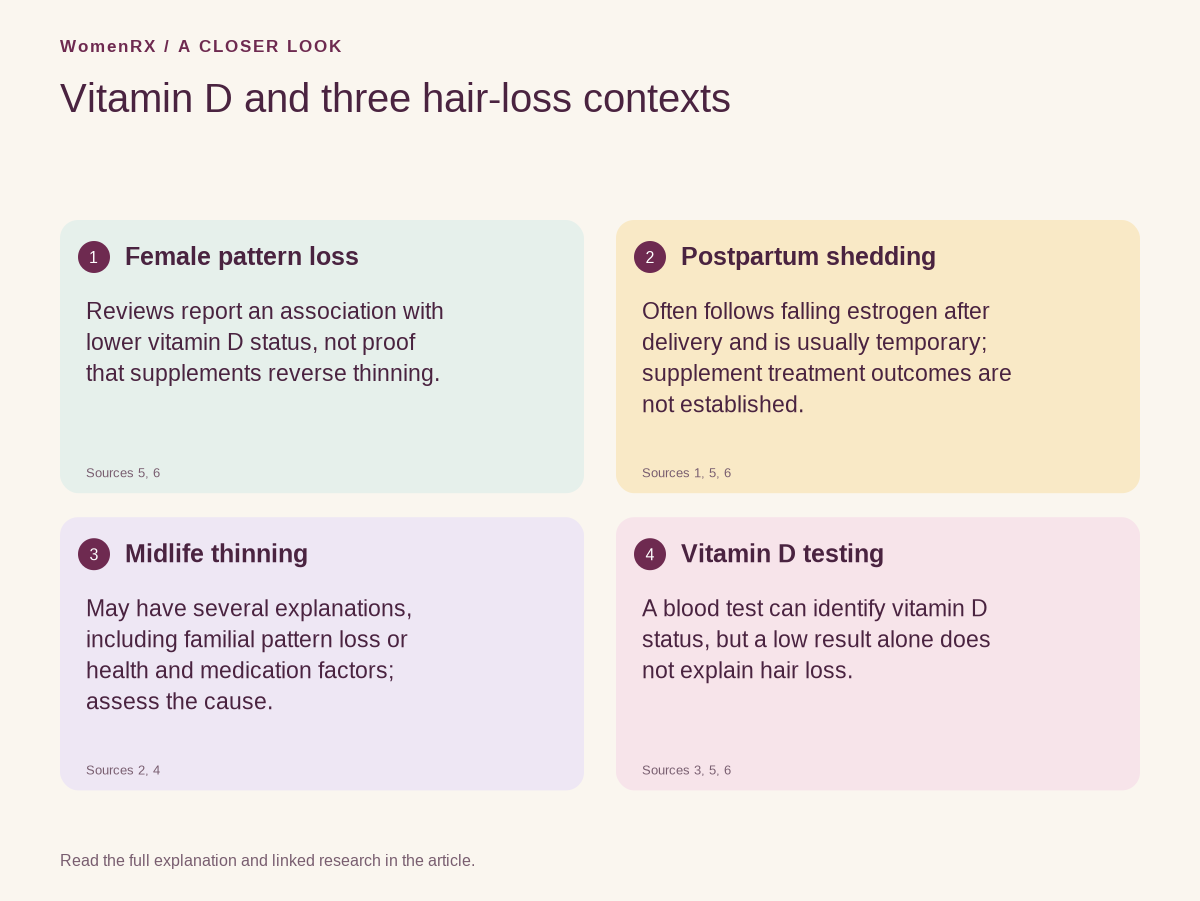
Vitamin D and three hair-loss contexts
Female pattern loss: Reviews report an association with lower vitamin D status, not proof that supplements reverse thinning.56
Postpartum shedding: Often follows falling estrogen after delivery and is usually temporary; supplement treatment outcomes are not established.156
Midlife thinning: May have several explanations, including familial pattern loss or health and medication factors; assess the cause.24
Vitamin D testing: A blood test can identify vitamin D status, but a low result alone does not explain hair loss.356
Read the figure as text
The same vitamin D finding does not mean the same cause or treatment applies to every kind of hair loss.- Female pattern loss: Reviews report an association with lower vitamin D status, not proof that supplements reverse thinning.56
- Postpartum shedding: Often follows falling estrogen after delivery and is usually temporary; supplement treatment outcomes are not established.156
- Midlife thinning: May have several explanations, including familial pattern loss or health and medication factors; assess the cause.24
- Vitamin D testing: A blood test can identify vitamin D status, but a low result alone does not explain hair loss.356
More questions, answered
Can too much vitamin D be harmful?
Yes. Excessive vitamin D from supplements can cause toxicity and raise blood calcium; very high levels can damage the kidneys. 3
Sources you can check
- Hair loss in new moms: Dermatologist tipsAccessed 2026-09-25Return to first citation
- Hair Loss | Alopecia | Alopecia Areata | MedlinePlusAccessed 2026-09-25Return to first citation
- Vitamin D Deficiency: MedlinePlusAccessed 2026-09-25Return to first citation
- Hair loss - NHSAccessed 2026-09-25Return to first citation
- Serum 25 hydroxyvitamin D in non-scarring alopecia: A systematic review and meta-analysis.Chen Y, Dong X, Wang Y, Li Y, Xiong L, Li L. · Journal of cosmetic dermatology · 2024Return to first citation
- Vitamin D deficiency in non-scarring and scarring alopecias: a systematic review and meta-analysis.Yongpisarn T, Tejapira K, Thadanipon K, Suchonwanit P. · Frontiers in nutrition · 2024Return to first citation