Can Zinc Help With Hair Loss?
Zinc is relevant when you’re deficient, but thinning hair alone doesn’t show that you need a supplement.
Zinc deficiency is recognized as a possible cause of alopecia in children, but that doesn’t establish that it causes hair loss in adult women. An adult study found an association between lower zinc levels and hair loss, while a separate alopecia areata study included both children and adults. Neither finding proves zinc caused the hair loss or that supplements regrow hair. Assess the pattern and whether deficiency is plausible before adding zinc. 1 4 7
The key distinction: correcting a deficiency isn’t a hair-growth treatment for everyone
Zinc supports normal cell functions. The NIH Office of Dietary Supplements describes alopecia as one possible sign of zinc deficiency in children, particularly older children. That doesn’t establish zinc deficiency as the cause of hair loss in adult women. 1
Some studies have found lower zinc levels among people with hair loss, but the populations matter. A hospital-based study of Kurdish adults found lower average serum zinc in participants with several types of hair loss than in age- and sex-matched controls. A separate meta-analysis also found lower average serum zinc among people with alopecia areata, an autoimmune condition that can cause round or oval patches of hair loss. These findings show associations, not that low zinc caused the hair loss or that supplements would reverse it. 4 6
A small case-control study of severe alopecia areata found lower zinc levels in affected participants, but its 32 cases included 20 children and 12 adults. It supports an association in a mixed-age group, not an adult-specific finding. 7
A retrospective chart review of 131 people seen by a hair specialist found no statistically significant association between supplementation for identified vitamin or hormone abnormalities and changes in hair density or diameter. The study was small, retrospective, and included different supplements and deficiencies, so it can’t settle whether correcting a confirmed zinc deficiency helps an individual’s hair. 8
What else could explain thinning?
Hair loss has several possible causes, and treatment depends on the cause. MedlinePlus lists thyroid problems, some illnesses and medicines, stress, low protein intake, family history, and poor nutrition among possible contributors. 2
If your periods are heavy, don’t assume zinc is the issue. Heavy periods may warrant assessment for iron-deficiency anemia; this is a separate consideration, not evidence that zinc explains a change in your hair. 3
If you notice shedding after childbirth, keep that timing separate from your zinc status. Lactation raises zinc needs, and women who are pregnant or lactating are among groups more likely to have inadequate zinc. That doesn’t show that low zinc caused the shedding. 1
If thinning began around midlife, menopause-related hair changes are another distinct possibility. A systematic review found female-pattern hair loss among the hair conditions most associated with postmenopause. That association doesn’t show that zinc is responsible. 5
Alopecia areata can appear as round or oval patches of hair loss. It’s an autoimmune condition, and findings of lower zinc levels in affected groups don’t prove that zinc supplementation treats it. 7
When checking zinc may make sense
Zinc status may be considered alongside your diet, health history, and other findings, especially if you have a risk factor for inadequate zinc. Examples include malabsorptive digestive conditions, prior bariatric surgery, a vegetarian or vegan diet, or restricted food intake. 1
Serum or plasma zinc tests can help assess status, but they have limits. Results can vary with the time of day, age, sex, infection, hormone changes, and illness, and they don’t always match zinc intake. A result is best understood in context rather than treated as a stand-alone explanation for hair loss. 1
Why more zinc isn’t necessarily better
For adults, the upper intake level is 40 mg of zinc a day from food and supplements combined. It’s a safety limit, not a target. High zinc intake can cause nausea, vomiting, headaches, dizziness, or stomach upset. Taking 50 mg or more a day for weeks can interfere with copper absorption and affect immune function. 1
Before starting a zinc product, check the elemental zinc amount on its Supplement Facts panel and count zinc from any multivitamin or other supplement you already take. If a deficiency is found, the amount and duration should be guided by the reason for treatment and your overall intake, rather than by hair loss alone. 1
The practical takeaway: treat a confirmed deficiency as a nutrition issue, but assess hair loss as a separate question. That distinction can help you avoid an unnecessary supplement and focus on the cause that fits your pattern and circumstances.
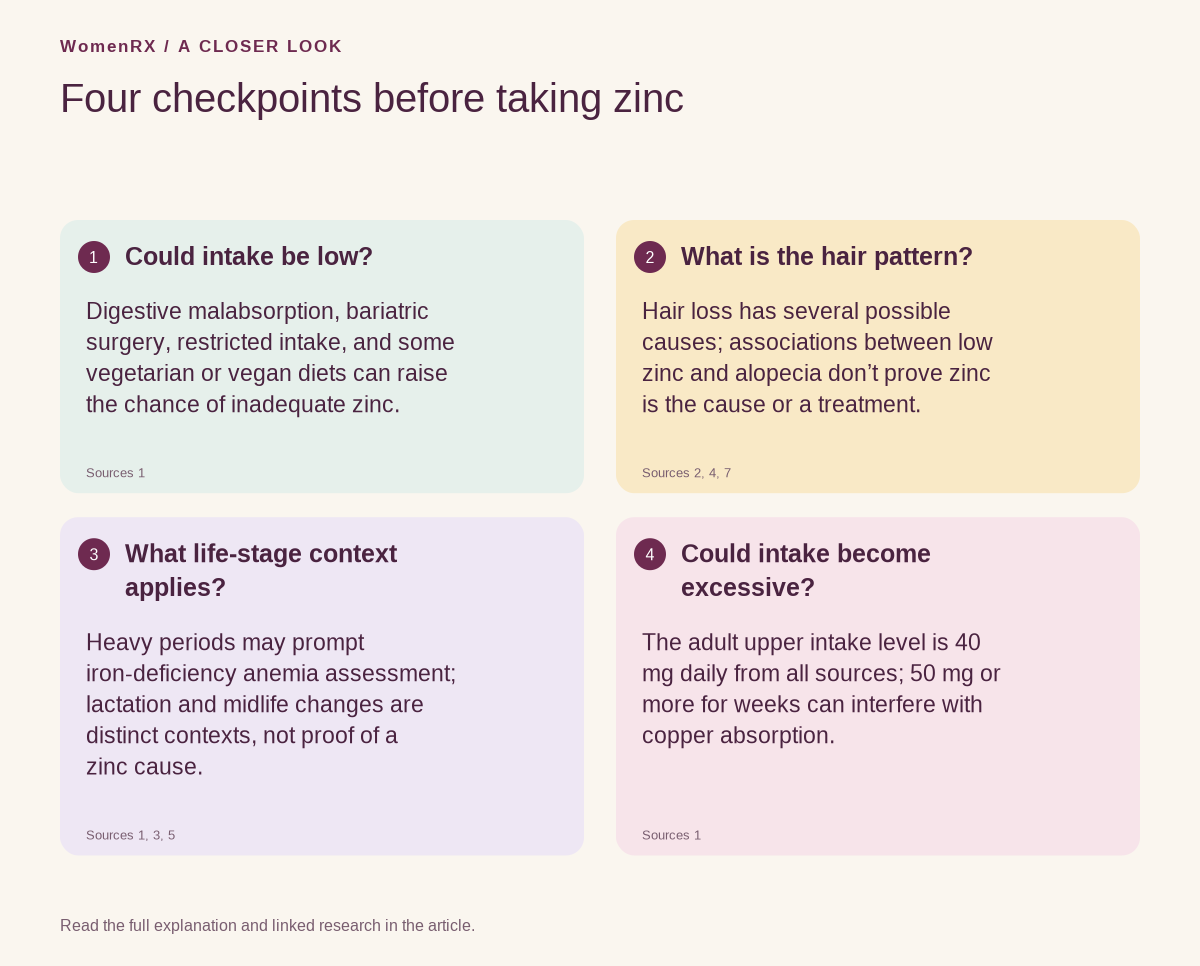
Four checkpoints before taking zinc
Could intake be low?: Digestive malabsorption, bariatric surgery, restricted intake, and some vegetarian or vegan diets can raise the chance of inadequate zinc.1
What is the hair pattern?: Hair loss has several possible causes; associations between low zinc and alopecia don’t prove zinc is the cause or a treatment.247
What life-stage context applies?: Heavy periods may prompt iron-deficiency anemia assessment; lactation and midlife changes are distinct contexts, not proof of a zinc cause.135
Could intake become excessive?: The adult upper intake level is 40 mg daily from all sources; 50 mg or more for weeks can interfere with copper absorption.1
Read the figure as text
A decision about zinc and hair loss depends on whether deficiency is plausible, what the hair pattern may indicate, which life-stage context matters, and whether a supplement could push total intake too high.- Could intake be low?: Digestive malabsorption, bariatric surgery, restricted intake, and some vegetarian or vegan diets can raise the chance of inadequate zinc.1
- What is the hair pattern?: Hair loss has several possible causes; associations between low zinc and alopecia don’t prove zinc is the cause or a treatment.247
- What life-stage context applies?: Heavy periods may prompt iron-deficiency anemia assessment; lactation and midlife changes are distinct contexts, not proof of a zinc cause.135
- Could intake become excessive?: The adult upper intake level is 40 mg daily from all sources; 50 mg or more for weeks can interfere with copper absorption.1
More questions, answered
Does low zinc on a blood test prove it caused hair loss?
No. Blood zinc results can be affected by factors such as time of day, infection, and illness, and studies linking low zinc with hair loss don’t establish cause and effect. A result needs to be interpreted alongside your health and diet. 1 4
Can taking too much zinc cause problems?
Yes. High intake can cause stomach symptoms, and taking 50 mg or more daily for weeks can interfere with copper absorption. The adult upper intake level is 40 mg daily from food and supplements combined. 1
Sources you can check
- Zinc - Health Professional Fact SheetAccessed 2026-09-25Return to first citation
- Hair Loss | Alopecia | Alopecia Areata | MedlinePlusAccessed 2026-09-25Return to first citation
- Heavy periods - NHSAccessed 2026-09-25Return to first citation
- Zinc Status in Kurdish Adults With Hair Loss.Mahmoud H, Saifdeen PM, Al-Timimi D, Saeed SA. · Cureus · 2024Return to first citation
- Menopause and Common Dermatoses: A Systematic Review.Roster K, Fleshner L, Karatas TB, Ecanow A, Sayegh A, Farabi B, Marmon S. · American journal of clinical dermatology · 2026Return to first citation
- Association Between Serum Trace Elements Level and Alopecia Areata: A Systematic Review and Meta-Analysis.Wu R, Li Y, Peng H, Yang Z, Wang Y, Lv S, Yang D. · Journal of cosmetic dermatology · 2025Return to first citation
- Serum Zinc Concentration in Patients with Alopecia Areata.Lalosevic J, Gajic-Veljic M, Lalosevic Misovic J, Nikolic M. · Acta dermato-venereologica · 2023Return to first citation
- Impact of Laboratory Work Up and Supplementation on Alopecia Patients: A Single-Center Retrospective Chart Review.Kakpovbia E, Ugonabo N, Chen A, Adhikari S, Ogbechie-Godec OA, Sicco KL, Shapiro J. · Journal of drugs in dermatology : JDD · 2021Return to first citation