Zinc Supplements: What to Track and When to Reassess
A useful timeline depends on why you’re taking zinc, and more isn’t automatically better.
For zinc taken to correct a suspected deficiency, the NIH zinc guidance explains limits of blood testing but doesn’t specify a treatment-response timeline. Agree with the clinician assessing you on what change to track and when to reassess. Cold-related findings address a different goal, and prolonged high intake can impair copper absorption. 1
First, name the goal
Zinc is essential for immune function, wound healing, and many other processes, but that doesn’t mean a supplement will improve how you feel if you already get enough. Symptoms alone don’t establish zinc deficiency. The signs can vary by age: examples include alopecia and frequent infections in older children, and delayed wound healing in older adults. Risk factors can make low zinc more plausible, including certain digestive disorders or bariatric surgery, and diets with lower zinc bioavailability. 1
That distinction changes what “working” means. When zinc is being used to address a suspected deficiency, the aim is to correct inadequate status and the problem linked to it, not to chase a general feeling of better health. Zinc status is often assessed with a blood test, but serum or plasma zinc can vary with factors such as time of day, age, sex, infection, and illness. A result therefore needs to be considered alongside a person’s health and risk factors. 1
The NIH zinc guidance describes how status is assessed but doesn’t specify when deficiency treatment should produce a change. Rather than assume a deadline, agree with the clinician assessing you on what response to look for and when to review it. The reason for low status, your situation, and the measure being followed all matter. Avoid continuing indefinitely without a clear endpoint.
Immune support isn’t the same as deficiency treatment
For colds, zinc research asks a different question from deficiency correction. A 2024 review summarized by the NIH concluded that zinc may shorten symptoms by about two days in people who already have a cold, but appears to make little to no difference in preventing colds; certainty was low to very low. A systematic review of trials in healthy adults likewise found a possible reduction in cold duration, but not prevention or reduced symptom severity. These findings don’t establish that taking a daily zinc supplement prevents illness or provides a general immune boost, and they don’t set a timeline for correcting deficiency. 1 2
Pregnancy is another distinct situation: zinc needs rise, but routine supplementation does not appear to reduce low birthweight, stillbirth, or neonatal death, although it might lower preterm birth risk. That evidence is not a reason to add a high-dose product on your own. 1
Check the total, not just the bottle
The adult recommended intake is 8 mg a day for women; it’s 11 mg during pregnancy and 12 mg while breastfeeding for adults age 19 and older. For ages 14-18, the corresponding amounts are 9 mg, 12 mg, and 13 mg. These are total daily intake recommendations, not supplement doses. Food, multivitamins, standalone zinc, cold remedies, and some other products can all contribute. 1
The adult upper limit is 40 mg a day from all sources, including during pregnancy and breastfeeding. It’s a safety limit for generally healthy people, not a target or a treatment dose. Medical treatment can sometimes differ, but the NIH guidance says the upper limit does not apply to people receiving zinc for medical treatment and that treatment should be under a physician’s care. 1
Check the Supplement Facts panel for the amount of elemental zinc. That is the amount to count, rather than the total weight of a zinc compound such as zinc sulfate or zinc gluconate. Add the zinc listed on other supplements and remedies before deciding whether a product makes sense. 1
Why long-term excess can backfire
Too much zinc can cause nausea, dizziness, headaches, stomach upset, vomiting, or loss of appetite. Taking 50 mg or more a day for weeks can interfere with copper absorption, and can also reduce immune function and lower HDL cholesterol. The concern isn’t only an unpleasant short-term side effect: impaired copper status can become a separate health problem. 1
Before continuing a higher-intake product, review how much you take and for how long with the clinician who recommended it. Don’t add copper or change a prescribed treatment to compensate on your own. If new symptoms develop while taking zinc, bring the product labels and amounts to a clinician or pharmacist so they can help assess the cause and the next step.
Check medicine interactions before changing timing
Zinc can bind with quinolone and tetracycline antibiotics in the digestive tract, potentially reducing absorption of both the antibiotic and zinc. It can also reduce absorption and action of penicillamine. Thiazide diuretics, including hydrochlorothiazide and chlorthalidone, can increase zinc loss in urine. If you take one of these medicines, ask a pharmacist or prescriber to work out a safe schedule rather than guessing at spacing. 1
A practical reassessment is simple: be clear about the reason for taking zinc, total the elemental zinc from every product, and agree on what would count as a response and when to review it. If there’s no defined reason or review point, ongoing use may add risk without answering whether zinc is helping.
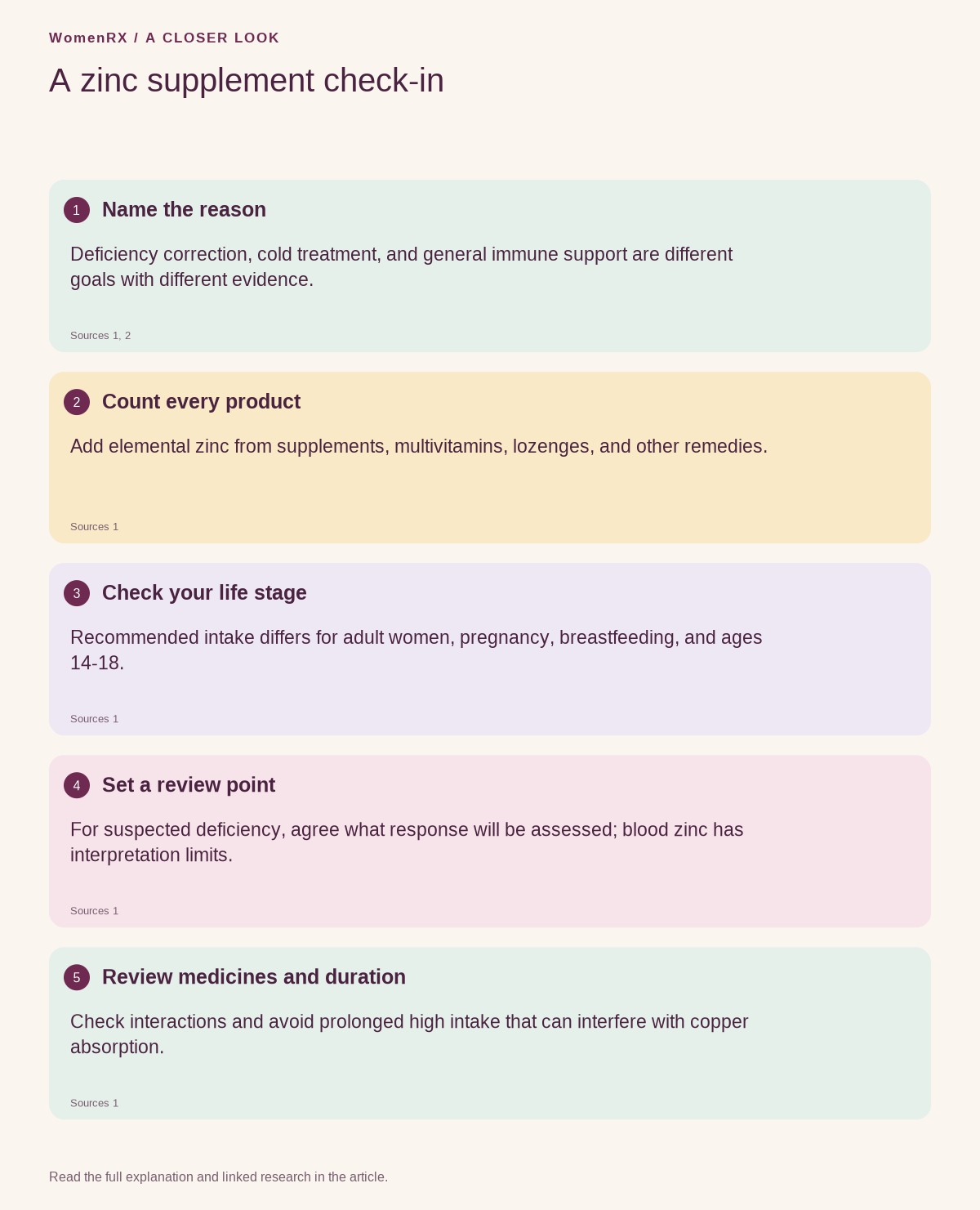
A zinc supplement check-in
Name the reason: Deficiency correction, cold treatment, and general immune support are different goals with different evidence.12
Count every product: Add elemental zinc from supplements, multivitamins, lozenges, and other remedies.1
Check your life stage: Recommended intake differs for adult women, pregnancy, breastfeeding, and ages 14-18.1
Set a review point: For suspected deficiency, agree what response will be assessed; blood zinc has interpretation limits.1
Review medicines and duration: Check interactions and avoid prolonged high intake that can interfere with copper absorption.1
Read the figure as text
Use these questions to make the reason, total intake, and review point clear before continuing zinc.- Name the reason: Deficiency correction, cold treatment, and general immune support are different goals with different evidence.12
- Count every product: Add elemental zinc from supplements, multivitamins, lozenges, and other remedies.1
- Check your life stage: Recommended intake differs for adult women, pregnancy, breastfeeding, and ages 14-18.1
- Set a review point: For suspected deficiency, agree what response will be assessed; blood zinc has interpretation limits.1
- Review medicines and duration: Check interactions and avoid prolonged high intake that can interfere with copper absorption.1
More questions, answered
Does a blood zinc test tell me for sure if I’m deficient?
No single serum or plasma result tells the whole story. Levels can shift with the time of the blood draw and with factors such as infection or illness, so clinicians interpret results alongside diet, risk factors, and health context. 1
Do zinc lozenges mean I should take zinc every day?
No. Cold lozenge studies concern use after a cold begins, not ongoing daily supplementation to prevent colds or treat a deficiency. Evidence suggests a possible modest reduction in cold duration, with low to very low certainty in the 2024 review summarized by NIH. 1
Sources you can check
- Zinc - Health Professional Fact SheetAccessed 2026-09-25Return to first citation
- Zinc Supplementation Reduces Common Cold Duration among Healthy Adults: A Systematic Review of Randomized Controlled Trials with Micronutrients Supplementation.Wang MX, Win SS, Pang J. · The American journal of tropical medicine and hygiene · 2020Return to first citation