Should You Take Zinc for Skin With Food?
If zinc makes you queasy, taking it with a meal may help if your product’s directions allow it.
Zinc supplements can cause nausea and stomach upset, and one clinical review describes taking therapeutic zinc with a meal to reduce nausea in people being treated for liver disease. That doesn’t establish that every product must be taken with food, or that an empty stomach helps acne. Check your product’s directions; if they allow it, a meal is a reasonable way to try to improve tolerance. 1 2
Let tolerance guide the timing
Whether you take zinc with food or on an empty stomach is a timing choice; by itself, it doesn’t establish whether zinc will help a skin concern. If your supplement’s directions don’t require fasting and zinc makes you nauseated, try taking it with a meal instead. The NIH lists nausea, vomiting, and gastric distress among possible effects of excessive zinc intake. A review of zinc treatment for liver disease says therapeutic doses are usually taken with a meal to reduce nausea, but that advice comes from a specific treatment context. It doesn’t mean food will prevent nausea for everyone or that every supplement has the same directions. 1 2
If your label says to take the product a particular way, follow those directions. If it doesn’t explain meal timing, check the Supplement Facts panel and consider taking the supplement with food if that feels better. If nausea persists, check the amount of elemental zinc you’re taking and ask a pharmacist or prescriber whether the product is appropriate for you. High zinc intake can cause stomach symptoms, and taking 50 mg or more for weeks can interfere with copper absorption. 1
Check the amount, not just the zinc form
The Supplement Facts panel lists elemental zinc, not the total weight of the zinc compound. Zinc sulfate, zinc gluconate, and other forms can look different on the front of a bottle, so compare the elemental amount when checking what you’re taking. 1
For adults, the NIH’s tolerable upper intake level is 40 mg of zinc per day from food and supplements combined. This is a general upper limit for healthy people, not a target or a recommended acne dose. High intakes can cause nausea and stomach upset; taking zinc for weeks at 50 mg or more can also interfere with copper absorption. 1
If you take an acne antibiotic, timing matters
Zinc can interfere with absorption of tetracycline and quinolone antibiotics, and the interaction can affect absorption of both the zinc and the antibiotic. The NIH says this interaction can be minimized by taking the antibiotic at least 2 hours before zinc or 4 to 6 hours after it. If you’re using an antibiotic for acne, check the timing with your pharmacist or prescriber rather than relying on a meal to solve the interaction. 1
Keep supplement timing separate from acne treatment
Taking zinc with food is a way to address stomach tolerance. Choosing a meal or fasting, by itself, doesn’t establish whether zinc will help a skin concern. Acne guidance describes other treatments, including topical combinations and, for some women, hormonal options; the right approach depends on the acne and the person. 3 5
If you’re pregnant or breastfeeding and considering a supplement for acne, don’t assume zinc is the right choice just because it’s a nutrient. Acne treatment needs stage-specific review during pregnancy, and treatment decisions also need to account for lactation. 3 4
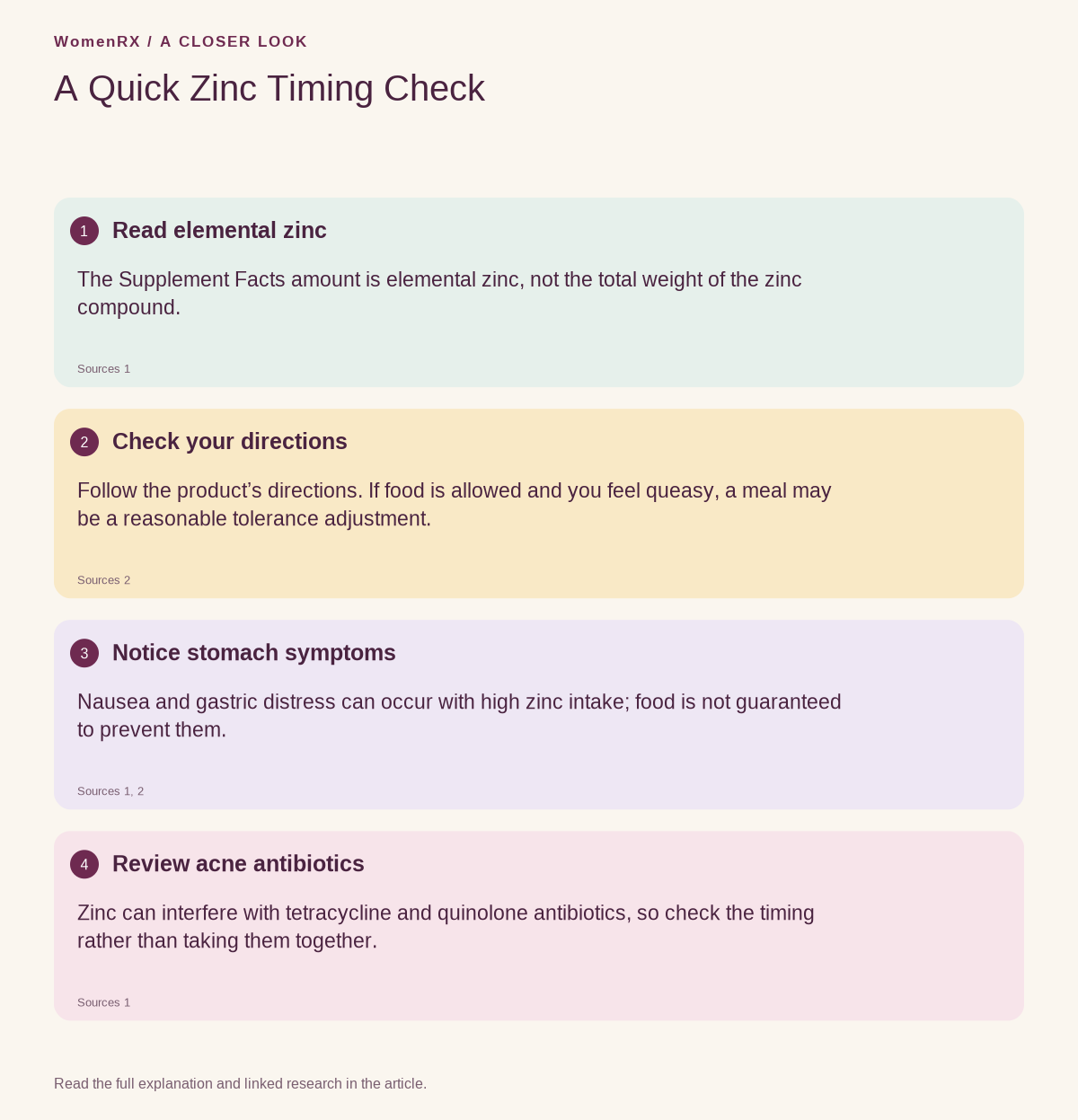
A Quick Zinc Timing Check
Read elemental zinc: The Supplement Facts amount is elemental zinc, not the total weight of the zinc compound.1
Check your directions: Follow the product’s directions. If food is allowed and you feel queasy, a meal may be a reasonable tolerance adjustment.2
Notice stomach symptoms: Nausea and gastric distress can occur with high zinc intake; food is not guaranteed to prevent them.12
Review acne antibiotics: Zinc can interfere with tetracycline and quinolone antibiotics, so check the timing rather than taking them together.1
Read the figure as text
Use these checks to decide whether meal timing, the product amount, or a medication interaction deserves attention.- Read elemental zinc: The Supplement Facts amount is elemental zinc, not the total weight of the zinc compound.1
- Check your directions: Follow the product’s directions. If food is allowed and you feel queasy, a meal may be a reasonable tolerance adjustment.2
- Notice stomach symptoms: Nausea and gastric distress can occur with high zinc intake; food is not guaranteed to prevent them.12
- Review acne antibiotics: Zinc can interfere with tetracycline and quinolone antibiotics, so check the timing rather than taking them together.1
More questions, answered
Does zinc gluconate need to be taken with food?
Zinc gluconate doesn’t have a universal rule that it must be taken with food. Check the product directions; if they allow it and you feel nauseated, taking it with a meal is a reasonable tolerance adjustment. 1 2
Can I take zinc at the same time as doxycycline for acne?
Doxycycline is a tetracycline antibiotic, and zinc can reduce absorption of tetracycline antibiotics. The NIH advises separating the antibiotic from zinc by taking the antibiotic at least 2 hours before zinc or 4 to 6 hours after it. Confirm the schedule with your pharmacist or prescriber. 5 1
Sources you can check
- Zinc - Health Professional Fact SheetAccessed 2026-09-25Return to first citation
- Zinc and liver disease.Mohammad MK, Zhou Z, Cave M, Barve A, McClain CJ. · Nutrition in clinical practice : official publication of the American Society for Parenteral and Enteral Nutrition · 2012Return to first citation
- Update of the EuroGuiDerm evidence-based guideline for the treatment of acne-Short version.Nast A, Al Wattar BH, Beylot Barry M, Brüggemann H, Bukvić Mokos Z, Caruana DM, Degitz K, Dessinioti C, Dréno B, Driessen RJB, Gollnick H, Hædersdal M, Katoulis A, Läuchli S, Lambe... · Journal of the European Academy of Dermatology and Venereology : JEADV · 2026Return to first citation
- Managing Skin Diseases that Flare During Pregnancy and in the Postpartum period: Part 1-Classification, Epidemiology & Pathogenesis.Lyons CE, Smith AD, Schwartzman G, Hickman A, Grant-Kels JM. · Journal of the American Academy of Dermatology · 2026Return to first citation
- Acne vulgaris: a clinical update.Iyengar L, Welsh B. · Australian prescriber · 2026Return to first citation