When Should You Take Zinc for a Skin Concern?
Morning or night isn’t the key choice: check your medicines, the zinc amount, and what else you take.
There’s no established morning-or-night schedule shown to improve skin results with zinc. The more useful timing question is whether zinc overlaps with a medicine: it can interfere with tetracycline or quinolone antibiotics and penicillamine, and taking it at the same time as an iron supplement containing 25 mg or more can reduce zinc absorption. Check your product label and medication instructions before setting a routine. 1 The acne research reviews zinc treatment outcomes, not a preferred time of day. 2 3
Choose a routine around interactions, not the clock
If you’re taking zinc for acne or another skin concern, morning versus evening isn’t an established way to improve the result. Reviews of zinc for acne describe possible benefits, but don’t establish a best time of day to take it. 2 3
Instead, look for a schedule that avoids interactions and fits the directions on your specific product. Zinc is sold alone and in multivitamins or other combination products, so check the Supplement Facts panel for the amount of elemental zinc and see whether another product you take already contains zinc. 1
Medicines that may need space from zinc
Zinc can bind with certain medicines in the digestive tract and reduce how well the medicine, zinc, or both are absorbed. This matters especially if you take an antibiotic for acne.
- Tetracycline or quinolone antibiotics: Taking zinc at the same time can interfere with absorption of both. The NIH Office of Dietary Supplements advises taking the antibiotic at least 2 hours before zinc, or 4 to 6 hours after it. Follow your antibiotic’s own instructions if they give different directions, and ask a pharmacist to help fit the schedule around your doses. 1
- Penicillamine: Zinc can reduce this medicine’s absorption and action. The NIH guidance says to take zinc and penicillamine at least 1 hour apart. 1
- Thiazide diuretics: Medicines such as hydrochlorothiazide and chlorthalidone can increase zinc loss in urine. That’s a possible effect on zinc levels, not an interaction that can necessarily be fixed by choosing morning or evening. 1
Don’t change or skip a prescribed medicine to make room for a supplement. If the timing is difficult, a pharmacist can help you work out a schedule using your medication instructions.
Check iron and overlapping supplements
Taking zinc at the same time as a supplement with 25 mg or more of elemental iron can reduce zinc absorption. If you take iron, ask a pharmacist or clinician how to space the products; the zinc guidance identifies the interaction but doesn’t give a specific spacing interval for iron. Iron in fortified foods generally doesn’t have the same effect because it is usually in a less soluble form. 1
Also check for zinc in a multivitamin, prenatal vitamin, or other supplement before adding a separate zinc product. The upper intake level for adults, including during pregnancy and breastfeeding, is 40 mg a day from food and supplements combined. That limit doesn’t apply to medically supervised treatment, but it’s a reason not to stack products casually. 1
Food, stomach comfort, and pregnancy
The guidance here doesn’t establish that taking zinc on an empty stomach, with food, in the morning, or at night improves skin outcomes. Follow your product label. If zinc bothers your stomach, check the label and ask a pharmacist whether taking that particular product with food is appropriate rather than assuming one rule fits every formulation. High zinc intake can cause nausea and other stomach symptoms. 1
If you’re pregnant or breastfeeding, check the product and total amount with your prenatal clinician before adding zinc. Needs differ by life stage, and prenatal products may already contain zinc; this is a reason to review the choice and amount, not a reason for a special time-of-day schedule. 1
A practical example
If you take a prescribed acne antibiotic in the morning and evening, don’t simply add zinc beside one of those doses. Check which antibiotic you have, use the spacing guidance if it’s a tetracycline or quinolone, and account for any iron or multivitamin in your routine. The best schedule is the one that follows the medicine and product directions without doubling up on zinc.
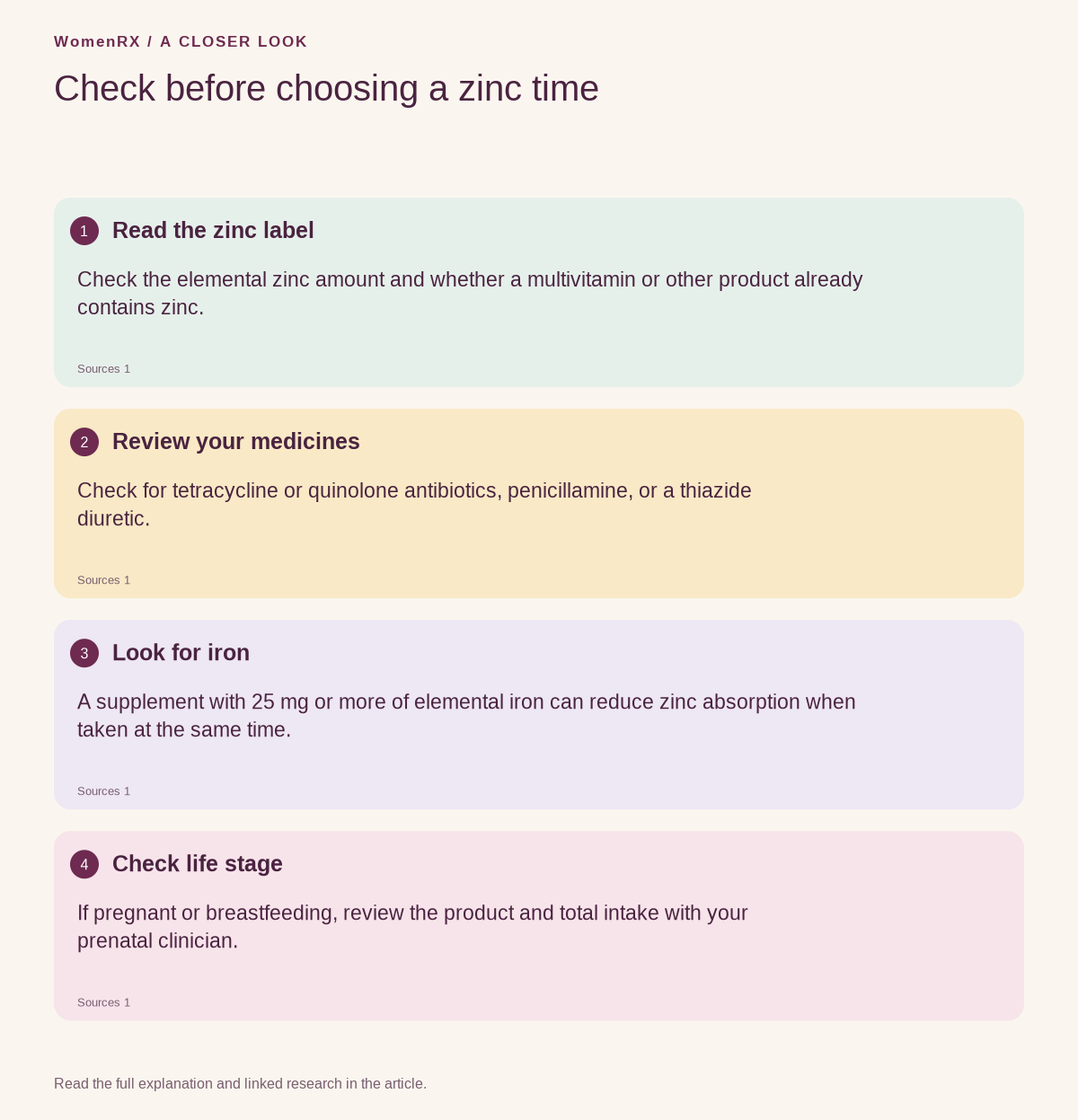
Check before choosing a zinc time
Read the zinc label: Check the elemental zinc amount and whether a multivitamin or other product already contains zinc.1
Review your medicines: Check for tetracycline or quinolone antibiotics, penicillamine, or a thiazide diuretic.1
Look for iron: A supplement with 25 mg or more of elemental iron can reduce zinc absorption when taken at the same time.1
Check life stage: If pregnant or breastfeeding, review the product and total intake with your prenatal clinician.1
Read the figure as text
Use these checks to find a schedule that fits your product and medicines; the list is a practical prompt, not a validated scoring tool.- Read the zinc label: Check the elemental zinc amount and whether a multivitamin or other product already contains zinc.1
- Review your medicines: Check for tetracycline or quinolone antibiotics, penicillamine, or a thiazide diuretic.1
- Look for iron: A supplement with 25 mg or more of elemental iron can reduce zinc absorption when taken at the same time.1
- Check life stage: If pregnant or breastfeeding, review the product and total intake with your prenatal clinician.1
More questions, answered
Does taking zinc at night work better for acne?
The acne reviews describe treatment outcomes but don’t establish that night is better than morning. Focus on product directions and avoiding medication interactions rather than choosing a clock time for skin benefits. 2 3
What if I take zinc and an acne antibiotic?
Some tetracycline and quinolone antibiotics can interact with zinc. The recommended spacing depends on the medicine, so check its instructions and ask a pharmacist to help you plan the doses. 1
Sources you can check
- Zinc - Health Professional Fact SheetAccessed 2026-09-25Return to first citation
- Serum zinc levels and efficacy of zinc treatment in acne vulgaris: A systematic review and meta-analysis.Yee BE, Richards P, Sui JY, Marsch AF. · Dermatologic therapy · 2020Return to first citation
- Effects of Zinc Supplementation on Inflammatory Skin Diseases: A Systematic Review of the Clinical Evidence.Dhaliwal S, Nguyen M, Vaughn AR, Notay M, Chambers CJ, Sivamani RK. · American journal of clinical dermatology · 2020Return to first citation