When Should You Take Zinc: Morning or Night?
A practical zinc schedule fits your product’s directions, avoids interactions, and works for your routine.
The NIH zinc guidance doesn’t recommend a morning or evening hour for a regular supplement. 1 Check your product’s directions, then choose a time you can stick with that accounts for any medicines or other supplements you take. Certain antibiotics and penicillamine need to be separated from zinc, and taking zinc alongside a substantial iron supplement can reduce zinc absorption. 1
The clock matters less than what you take zinc with
The NIH zinc guidance doesn’t identify a preferred morning or evening hour for a regular supplement. Start with your product’s directions, then choose an hour that fits your routine and avoids the interactions below. 1
A small pilot study in children with ADHD included zinc taken once in the morning and zinc taken twice daily, but those schedules involved different total daily doses. Because dose and frequency differed together, the study didn’t isolate the effect of time of day or establish a best schedule for routine zinc use, especially for adults or people taking zinc for other reasons. 2
One easy point of confusion: zinc levels measured in blood can vary with the time of a blood draw. That affects how a test result is interpreted; it isn’t evidence that taking a supplement in the morning or at night works better. 1
Check these interactions before setting a routine
Certain antibiotics: Zinc can interfere with absorption of quinolone antibiotics and tetracycline antibiotics if they’re taken together. Taking the antibiotic at least 2 hours before zinc, or 4 to 6 hours after zinc, minimizes this interaction. If you’re prescribed one of these medicines, check how zinc fits around its directions rather than changing the antibiotic schedule on your own. 1
Penicillamine: Zinc can reduce the absorption and action of this medicine. Separate zinc and penicillamine by at least 1 hour. 1
Iron supplements: Taking zinc at the same time as a supplement containing 25 mg or more of elemental iron can reduce zinc absorption and zinc levels in plasma. The concern described here is supplements; iron used to fortify foods does not significantly interfere with zinc absorption. If you take a multivitamin or separate iron, check the Supplement Facts panel rather than assuming the products are interaction-free. 1
Thiazide diuretics: Medicines such as hydrochlorothiazide and chlorthalidone can increase zinc loss in urine and lower serum zinc. If you take these or other medicines regularly, discuss your zinc status with your health care provider. 1
Tolerability and total intake still matter
Excessive zinc intake can cause nausea, gastric discomfort, and other symptoms. Don’t assume switching to bedtime will fix those effects. Check your product’s directions, including any instructions about food, and pay attention to how you tolerate it. 1
Also check how much elemental zinc you’re getting across products. The Supplement Facts panel lists elemental zinc, not the weight of the whole zinc compound. The Food and Nutrition Board sets an adult upper intake level of 40 mg a day from food and supplements for healthy people; it’s a limit, not a target. Taking 50 mg or more daily for weeks can interfere with copper absorption and cause other harms. 1
Pregnancy and breastfeeding don’t call for a special hour
Zinc needs are higher during pregnancy and lactation than for nonpregnant adults. If you’re pregnant or breastfeeding, review your total zinc from food, prenatal or other supplements, and any separate zinc product with your care team before adding more. Recommended daily intakes are 11 mg during pregnancy and 12 mg during lactation for adults age 19 and older; these are total intake recommendations, not directions to take a supplement. 1
A simple way to choose
Follow your product’s directions and pick a time you can keep up with that avoids the spacing conflicts above. If you take an interacting medicine, are combining zinc with iron, or are unsure how much zinc your products contain, sort that out first rather than trying to solve an interaction by choosing morning over night.
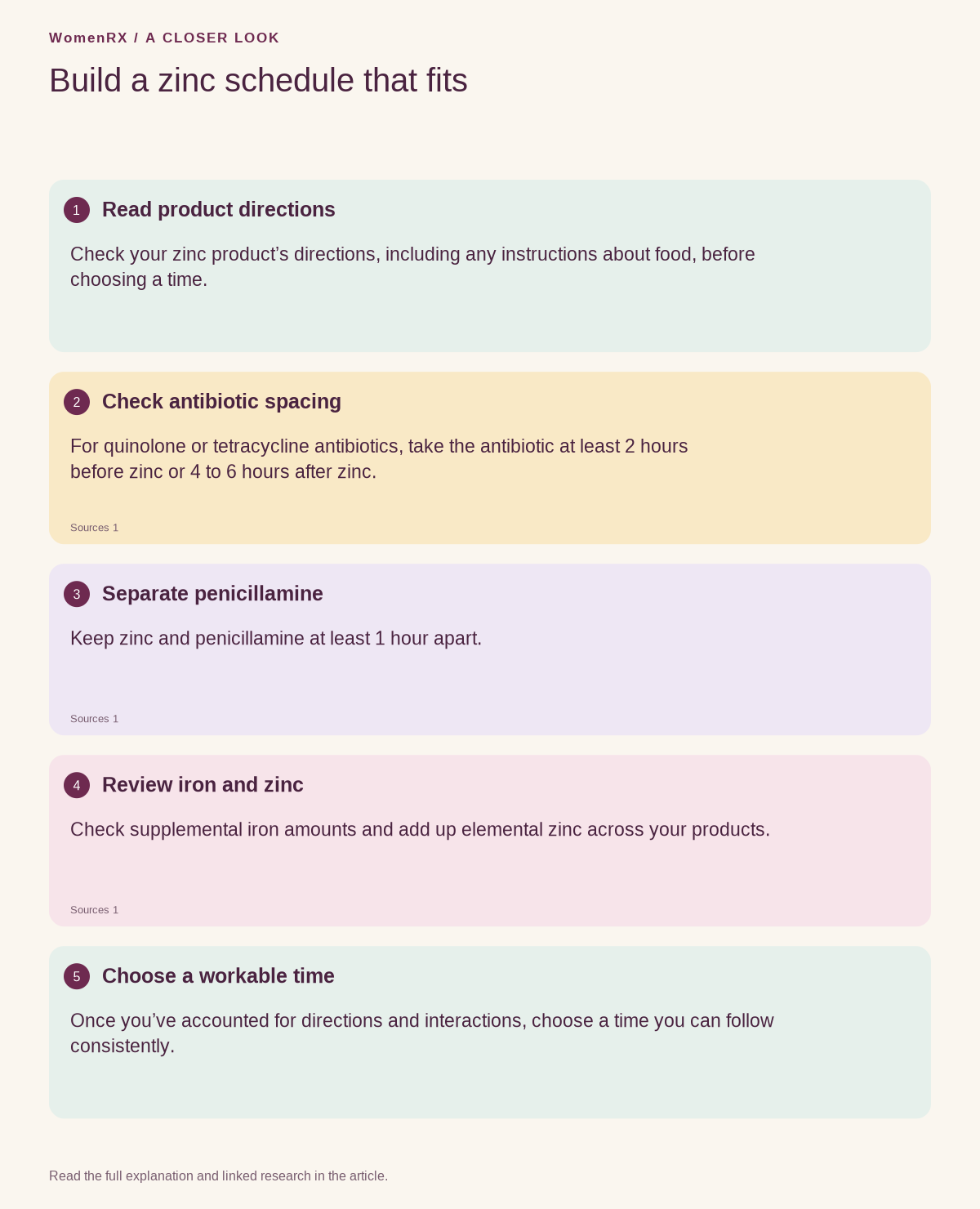
Build a zinc schedule that fits
Read product directions: Check your zinc product’s directions, including any instructions about food, before choosing a time.
Check antibiotic spacing: For quinolone or tetracycline antibiotics, take the antibiotic at least 2 hours before zinc or 4 to 6 hours after zinc.1
Separate penicillamine: Keep zinc and penicillamine at least 1 hour apart.1
Review iron and zinc: Check supplemental iron amounts and add up elemental zinc across your products.1
Choose a workable time: Once you’ve accounted for directions and interactions, choose a time you can follow consistently.
Read the figure as text
Use these checks to choose a practical time without treating morning or night as a requirement.- Read product directions: Check your zinc product’s directions, including any instructions about food, before choosing a time.
- Check antibiotic spacing: For quinolone or tetracycline antibiotics, take the antibiotic at least 2 hours before zinc or 4 to 6 hours after zinc.1
- Separate penicillamine: Keep zinc and penicillamine at least 1 hour apart.1
- Review iron and zinc: Check supplemental iron amounts and add up elemental zinc across your products.1
- Choose a workable time: Once you’ve accounted for directions and interactions, choose a time you can follow consistently.
More questions, answered
Does zinc need to be taken on an empty stomach?
Don’t assume an empty-stomach rule applies to every zinc product. Check your product’s directions for instructions about food. If taking it as directed bothers your stomach, ask a pharmacist how to take that particular product without disrupting any medicine schedule. Excessive zinc intake can cause nausea and gastric discomfort. 1
Sources you can check
- Zinc - Health Professional Fact SheetAccessed 2026-09-25Return to first citation
- Zinc for attention-deficit/hyperactivity disorder: placebo-controlled double-blind pilot trial alone and combined with amphetamine.Arnold LE, Disilvestro RA, Bozzolo D, Bozzolo H, Crowl L, Fernandez S, Ramadan Y, Thompson S, Mo X, Abdel-Rasoul M, Joseph E. · Journal of child and adolescent psychopharmacology · 2011Return to first citation