Does It Matter When You Take 5-HTP?
A small sleep trial doesn’t establish a best time of day, while your medicines may change whether 5-HTP is a sensible choice at all.
A 12-week trial in 30 older adults compared taking 5-HTP daily with not taking it. It didn’t compare morning with bedtime use, so it can’t tell you which time works better. It found improvement in some sleep measures, but that doesn’t establish a treatment for insomnia. 34 Before trying 5-HTP, check any medicines or supplements that affect serotonin with a clinician or pharmacist. 4
A sleep finding isn’t a timing recommendation
5-HTP is involved in the body’s production of serotonin and melatonin, which helps explain why it’s sold for mood and sleep. That connection is a reason to investigate it, not proof that taking it at bedtime works better than taking it in the morning. 4
In a 12-week randomized trial in Singapore, 30 older adults were assigned either to take 5-HTP daily or not to take it. Researchers assessed sleep with questionnaires and wrist-worn activity monitors. They reported favorable changes in certain sleep measures. Among participants who were poor sleepers at the start, the abstract reports a significant subjective score change in those taking 5-HTP, but does not establish that they improved more than the control group. The trial did not compare times of day, so it can’t tell you when to take 5-HTP for the best result. Its small size and older-adult population also limit what it can tell a younger woman about her sleep. 3
There’s a second distinction worth keeping clear: poor sleep and insomnia aren’t interchangeable. Insomnia can mean difficulty falling asleep, staying asleep, or both, and it may be related to stress, medicines, another health condition, or another sleep disorder. Memorial Sloan Kettering Cancer Center notes that studies evaluating 5-HTP for insomnia are lacking. The older-adult trial is a reason to keep studying sleep outcomes, not a reason to assume 5-HTP treats insomnia. 234
Three timing claims, three different questions
| Claim on a label or in an article | What would answer it? | What the adult trial tells us |
|---|---|---|
| “Bedtime works better” | A comparison of morning and bedtime use | It did not make that comparison. |
| “It helps sleep” | Sleep outcomes compared with a suitable control | Some measures improved, but the study was small and used a no-supplement control. |
| “Take it away from your antidepressant” | Evidence that spacing the products prevents the interaction | The trial does not establish this. Changing the hour is not an interaction solution. |
The sleep trial and the medicine guidance answer different parts of the decision. A study's dosing schedule is not proof that the schedule is best. 34
For mood, the clock still isn’t the deciding question
Research on 5-HTP for depression has produced limited, mixed findings, often from small studies. It hasn’t established 5-HTP as a treatment for depression, and the cited evidence provides no basis for choosing a time of day for mood. 4
If mood is why you’re considering it, the practical first question is whether you already take something that affects serotonin. Changing the hour you take 5-HTP doesn’t answer whether combining it with that medicine is safe. 4
Check the combination before the clock
5-HTP can raise serotonin levels. Memorial Sloan Kettering warns against combining it without a treating physician’s supervision with serotonin-affecting medicines, including SSRIs, MAOIs, and tricyclic antidepressants, because of the potential for serious side effects. It also advises avoiding combinations with St. John’s wort or SAM-e. The risk with antidepressant combinations is partly theoretical, and larger studies are needed to define it, but a reported interaction between 5-HTP and the antibiotic linezolid caused serotonin syndrome. 4
That’s why a medication review should include prescription drugs, over-the-counter products, and other supplements, not just anything you think of as a sleep aid. If you’re taking a serotonin-affecting medicine, don’t add 5-HTP or change your prescribed treatment on the strength of a supplement label. Ask the clinician who manages that medicine or a pharmacist to review the combination. 4
Memorial Sloan Kettering describes serotonin syndrome as serious and lists possible symptoms, including agitation, confusion, shivering, fever, poor coordination, and a rapid or irregular heartbeat, alongside its report of a linezolid and 5-HTP interaction. 4
Pregnancy and breastfeeding need their own answer
The sleep trial involved older adults; it cannot establish safety during pregnancy or breastfeeding. Nor does the fact that 5-HTP is sold as a supplement settle that question. If you’re pregnant, planning pregnancy, or breastfeeding, have your prenatal or postpartum care clinician review 5-HTP alongside your current medicines and supplements before using it. That is a safety check, not a claim that the older-adult sleep findings apply to you. 314
If the real problem is ongoing trouble sleeping, identifying what’s keeping you awake may be more useful than trying to find a perfect supplement schedule. Sleep habits can help some people; cognitive-behavioral therapy can help relieve anxiety linked to persistent insomnia. Neither option depends on proving that 5-HTP works at bedtime. 2
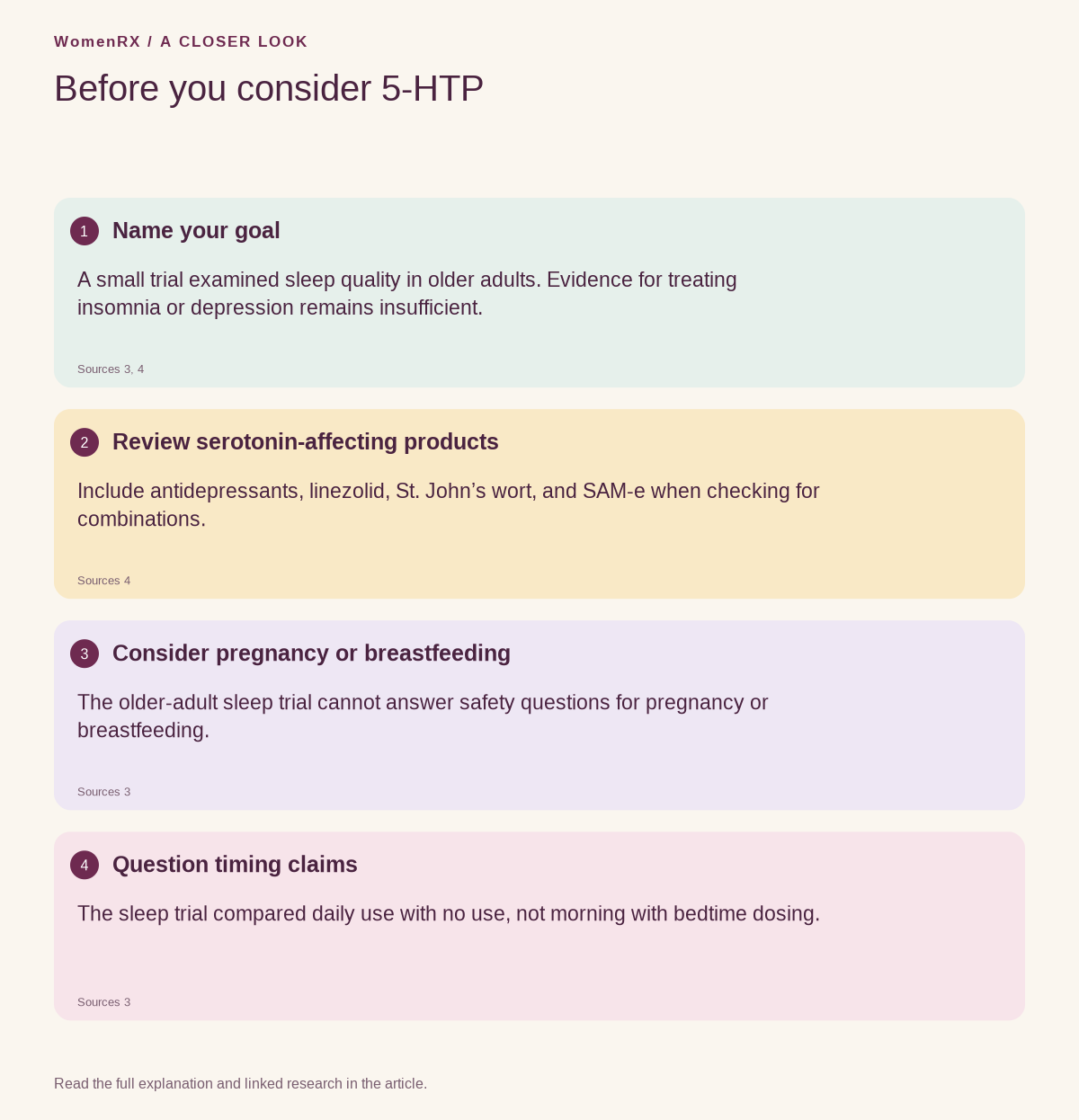
Before you consider 5-HTP
Name your goal: A small trial examined sleep quality in older adults. Evidence for treating insomnia or depression remains insufficient.34
Review serotonin-affecting products: Include antidepressants, linezolid, St. John’s wort, and SAM-e when checking for combinations.4
Consider pregnancy or breastfeeding: The older-adult sleep trial cannot answer safety questions for pregnancy or breastfeeding.3
Question timing claims: The sleep trial compared daily use with no use, not morning with bedtime dosing.3
Read the figure as text
Four different questions matter; a suggested time of day cannot answer the safety questions.- Name your goal: A small trial examined sleep quality in older adults. Evidence for treating insomnia or depression remains insufficient.34
- Review serotonin-affecting products: Include antidepressants, linezolid, St. John’s wort, and SAM-e when checking for combinations.4
- Consider pregnancy or breastfeeding: The older-adult sleep trial cannot answer safety questions for pregnancy or breastfeeding.3
- Question timing claims: The sleep trial compared daily use with no use, not morning with bedtime dosing.3
Sources you can check
- Sleep Disorders | MedlinePlusAccessed 2026-09-25Return to first citation
- Insomnia | MedlinePlusAccessed 2026-09-25Return to first citation
- The impact of 5-hydroxytryptophan supplementation on sleep quality and gut microbiota composition in older adults: A randomized controlled trial.Sutanto CN, Xia X, Heng CW, Tan YS, Lee DPS, Fam J, Kim JE. · Clinical nutrition (Edinburgh, Scotland) · 2024Return to first citation
- 5-HTP | Memorial Sloan Kettering Cancer CenterAccessed 2026-09-25Return to first citation