5-HTP at Midlife: What the Evidence Can Tell You
Small studies in older adults and people with inflammatory bowel disease don’t show that 5-HTP treats menopause-related sleep or mood changes.
There isn’t clear evidence here that 5-HTP helps perimenopausal or postmenopausal sleep, mood, or fatigue. A small trial in Singaporean adults around age 66 reported a decrease in the 5-HTP group’s depression score, but that within-group change does not establish a benefit over no supplementation. A larger trial in people with inactive inflammatory bowel disease found no better fatigue or mood results than placebo. Neither study tested menopause-related symptoms. 6 7

What the studies actually tested
The most relevant mood study was a small, single-blind randomized trial of 30 Singaporean adults with an average age of 66. Over 12 weeks, participants took 5-HTP or were assigned not to take it. The 5-HTP group’s depression questionnaire score decreased between the start of the study and week eight. That within-group change does not establish a mood benefit over no supplementation. The study was small, and its participants weren’t selected for menopause symptoms, so it can’t tell you whether 5-HTP improves perimenopausal or postmenopausal mood changes. 6
A larger trial asked a different question: whether 5-HTP could ease fatigue in 166 people with inactive inflammatory bowel disease. In this placebo-controlled crossover study, 5-HTP did not improve fatigue more than placebo, and the groups’ depression, anxiety, and stress scores also did not improve differently. That result applies to fatigue in people with inflammatory bowel disease, not to menopause, but it’s a reminder that a change in serotonin levels doesn’t necessarily mean a noticeable symptom benefit. 7
Taken together, these studies don’t establish 5-HTP as a treatment for menopause-related sleep, mood, or fatigue concerns. They also don’t prove that no research has ever studied it in midlife women. The key point for your decision is that the findings described here aren’t evidence of a menopause-specific benefit.
When a symptom may need a different explanation
Trouble sleeping can have more than one cause, and the pattern can offer clues. Loud snoring, gasping or choking during sleep, or frequent daytime sleepiness can fit sleep apnea, which is diagnosed using a medical assessment and sleep-study results. Those symptoms call for looking beyond a supplement approach. 2 3
An evening urge to move your legs, often with tingling or prickling that eases when you move, may point toward restless legs syndrome. Some causes resemble it, including leg cramps and peripheral neuropathy. Restless legs can be linked to low iron, and some medicines may worsen symptoms, so identifying the cause can change what helps. 1 3
Ongoing fatigue is another reason to consider causes other than a midlife transition. Anemia, often caused by low iron, can bring fatigue along with symptoms such as feeling cold, dizzy, irritable, short of breath, or having a headache. Blood tests are used to diagnose anemia, and treatment depends on its type. 4
For persistent or distressing mood changes, assessment can help clarify what’s going on and what treatment options fit. A depression guideline developed for care in India describes assessment as part of diagnosis and management, but does not provide US-specific treatment recommendations. 5
Describe the sleep, fatigue or mood problem first
If your main concern is sleep, notice whether it’s difficulty falling asleep, waking repeatedly, leg sensations, or breathing-related signs such as gasping. If fatigue is prominent, consider whether it comes with other physical symptoms. If mood changes are the main concern, focus on how much they’re affecting daily life. These distinctions help direct attention toward possible causes and treatments rather than assuming that age over 40, by itself, makes 5-HTP a good fit.
These studies don’t answer whether 5-HTP is worthwhile for your particular menopause symptoms. They do show why matching the next step to the symptom pattern matters: a supplement trial in older adults is not a menopause study, and persistent sleep, mood, or fatigue concerns may have explanations that call for a different approach. 1 2 4 6 7
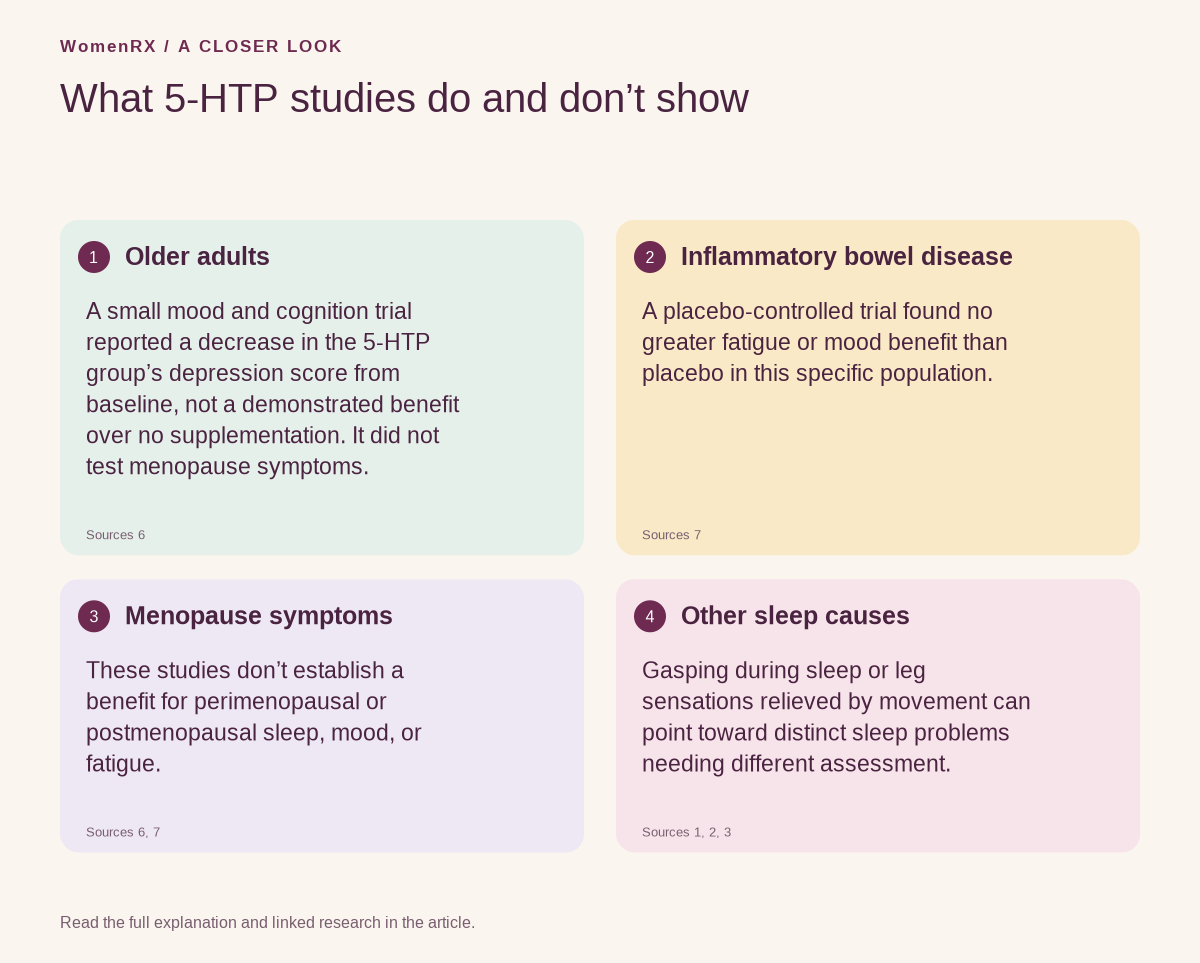
What 5-HTP studies do and don’t show
Older adults: A small mood and cognition trial reported a decrease in the 5-HTP group’s depression score from baseline, not a demonstrated benefit over no supplementation. It did not test menopause symptoms.6
Inflammatory bowel disease: A placebo-controlled trial found no greater fatigue or mood benefit than placebo in this specific population.7
Menopause symptoms: These studies don’t establish a benefit for perimenopausal or postmenopausal sleep, mood, or fatigue.67
Other sleep causes: Gasping during sleep or leg sensations relieved by movement can point toward distinct sleep problems needing different assessment.123
Read the figure as text
The populations and outcomes in these studies differ from menopause-related concerns, so their findings have limits for a midlife decision.- Older adults: A small mood and cognition trial reported a decrease in the 5-HTP group’s depression score from baseline, not a demonstrated benefit over no supplementation. It did not test menopause symptoms.6
- Inflammatory bowel disease: A placebo-controlled trial found no greater fatigue or mood benefit than placebo in this specific population.7
- Menopause symptoms: These studies don’t establish a benefit for perimenopausal or postmenopausal sleep, mood, or fatigue.67
- Other sleep causes: Gasping during sleep or leg sensations relieved by movement can point toward distinct sleep problems needing different assessment.123
More questions, answered
Does the older-adult trial show that 5-HTP helps menopause-related mood changes?
No. It enrolled 30 Singaporean adults around age 66 and measured mood and cognition; participants weren’t studied as a perimenopausal or postmenopausal group. The decrease in the 5-HTP group’s mood score was a within-group change, not a demonstrated benefit over no supplementation. It doesn’t establish a benefit for menopause-related symptoms. 6
What sleep symptoms suggest looking beyond a supplement?
Loud snoring, gasping or choking during sleep, and frequent daytime sleepiness can be signs of sleep apnea. A strong urge to move your legs with tingling or prickling that eases with movement can suggest restless legs syndrome. Both patterns have specific causes and assessment pathways. 1 2 3
Sources you can check
- Restless legs syndrome - NHSAccessed 2026-09-25Return to first citation
- Sleep Apnea | MedlinePlusAccessed 2026-09-25Return to first citation
- Sleep Disorders | MedlinePlusAccessed 2026-09-25Return to first citation
- Anemia | MedlinePlusAccessed 2026-09-25Return to first citation
- Clinical practice guideline for assessment and management of depression in India.Tripathi A, Shukla R, Kar SK, Gupta S, Saran P, Pattojoshi A, Rao T. · Indian journal of psychiatry · 2026Return to first citation
- The Impact of 5-Hydroxytryptophan Supplementation on Cognitive Function and Mood in Singapore Older Adults: A Randomized Controlled Trial.Li S, Sutanto CN, Xia X, Kim JE. · Nutrients · 2025Return to first citation
- Effect of 5-Hydroxytryptophan on Fatigue in Quiescent Inflammatory Bowel Disease: A Randomized Controlled Trial.Truyens M, Lobatón T, Ferrante M, Bossuyt P, Vermeire S, Pouillon L, Dewint P, Cremer A, Peeters H, Lambrecht G, Louis E, Rahier JF, Dewit O, Muls V, Holvoet T, Vandermeulen L, Pee... · Gastroenterology · 2022Return to first citation